Sculpture
Mag men het zien?
Onbekend: het museum bewaart het stilzwijgen

Victoria and Albert Museum
Londen, Verenigd Koninkrijk
De eigenaar is bekend. Of het vandaag te zien is, zegt het museum niet, en gissen hebben wij niet geleerd.
- Ongewijzigd sinds
- 25 sep 2026
- Bron
- De eigen collectiegegevens van het museum
About the sculpture
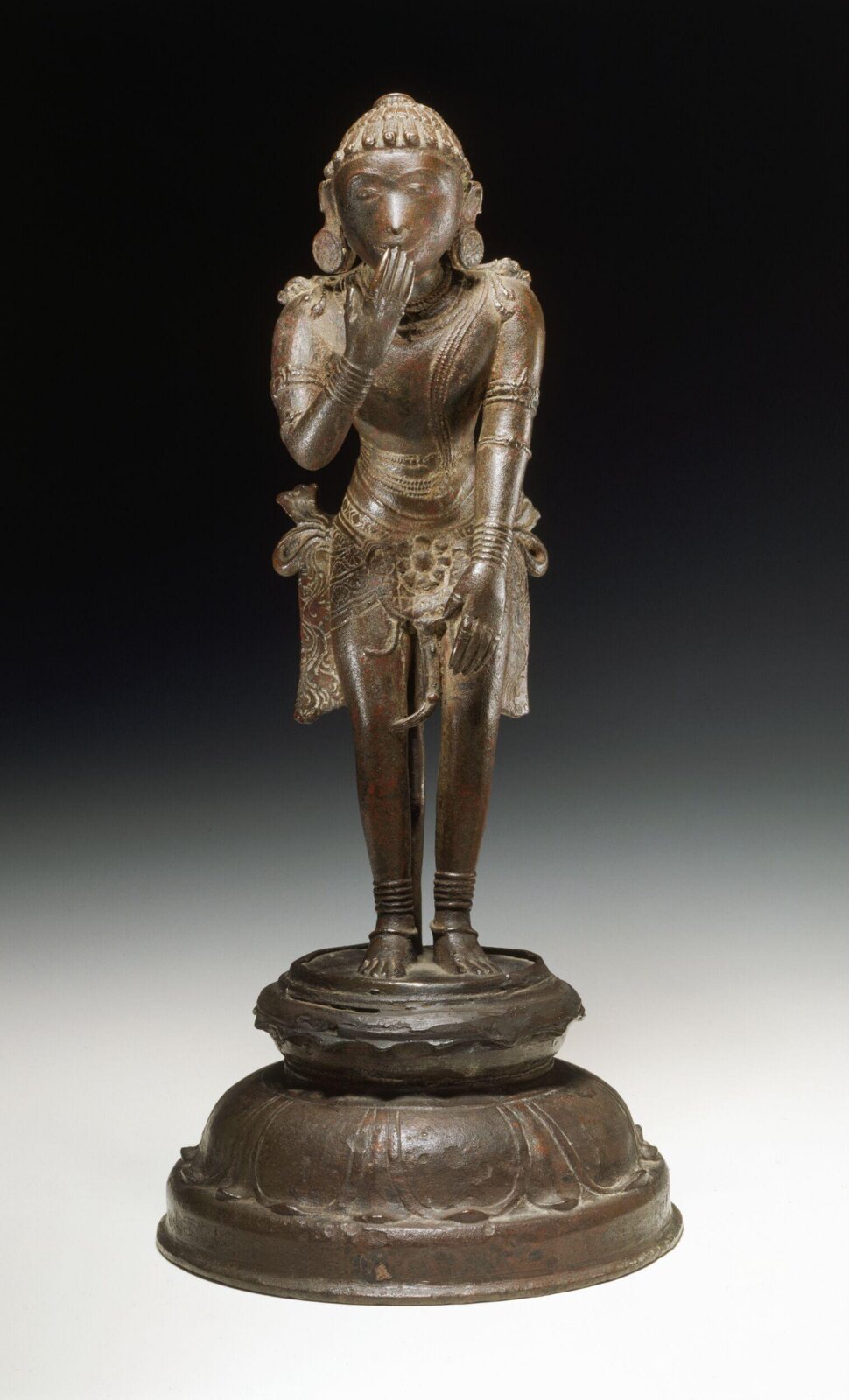
The monkey deity, general of the monkey army and staunch ally of Rama in his war with Ravana, the demon-king of Lanka, as described in the epic Ramayana. Hanuman is worshipped as a minor god attending Visnu as Rama, akin in status to Garuda, Visnu’s bird-vehicle (vahana). He is also venerated as an independent folk-deity, much admired for the high human virtues he displays, most notably bravery and loyalty. His physical strength and prowess has earned him the role of patron-deity of wandering acrobats and wrestlers. Images in his honour are a regular feature of rural settings and wayside shrines. In the context of temple Hinduism, Hanuman forms part of a four-part ensemble along with Rama, his brother Laksmana and his wife Sita. Processional bronzes such as this would be expected to have belonged to such a group.
Read on
The part-human figure of Hanuman flexes slightly forward in humility and gestures obeisance with his raised hand, expressing respect for his god. He wears a short waist-cloth, finely patterned, and an ornate girdle and sash, the latter tied in projecting bows at the hips. The hair is in neat tresses and curls, capped with a small circular crown ornament and he wears jewellery, including circular earplug ornaments, and a sacred cord. This figure achieves a touching humility and tenderness rarely encountered in late Chola art.
The figure is fixed to a thinly cast circular lotus pedestal (padmapitha). The presence of encrusted carbonate material in the surface patina indicates a period of burial. This image was one of a group discovered at Coimbatore, in Kongunadu, and presented to Lord Curzon of Kedleston during his term as Viceroy of India, between 1898 and 1905.
Victoria and Albert Museum
Gegevens
- Inventarisnummer
- IM.135-1927
What it shows
In de catalogus
Bronnen
- Victoria and Albert Museum: the museum's own open data · opgehaald 4 dagen geleden
- Afbeelding: Victoria and Albert Museum — © Victoria and Albert Museum, London