 Pietro PeruginoItalië, 1448–1523
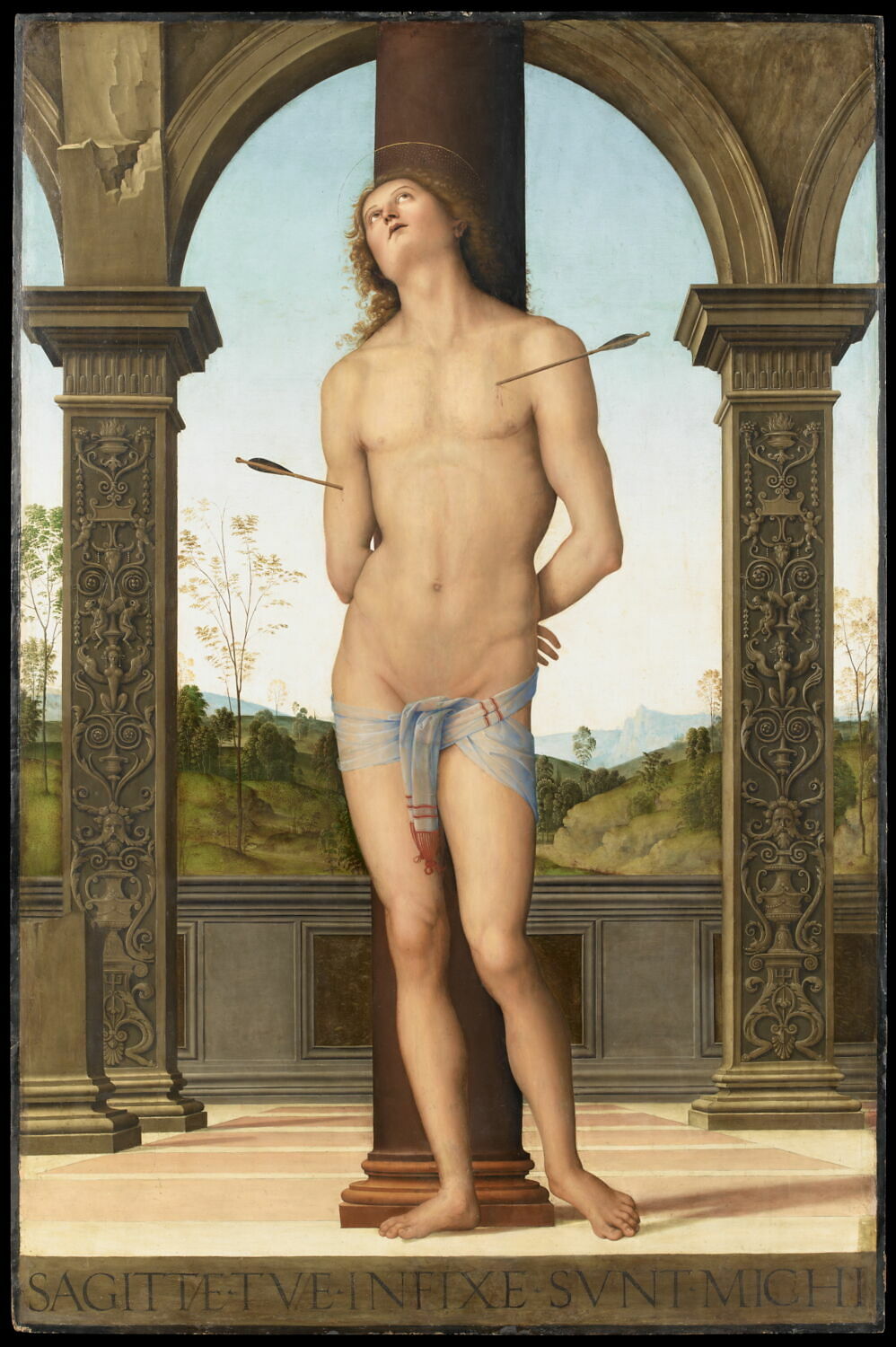
Saint Sébastien
Mag men het zien?
Ja, het ontvangt bezoek

Publiek tentoongesteld. Wie daarvoor instaat, staat hieronder.
- Gecontroleerd
- 9 dagen geleden
- Ongewijzigd sinds
- 26 sep 2026
- Bron
- De eigen collectiegegevens van het museum
About the painting
Saint Sebastian is a c.1495 painting of Saint Sebastian by Perugino, now in the Louvre collection. It was temporarily on display at the Louvre-Lens branch between 2012 and 2017. It is probably the work mentioned in the 17th century inventory of the Barberini collection in Rome, which was later dispersed. Several pieces from it were taken abroad during the 19th century, with St Sebastian being bought by the Louvre in 1896.
Read on
It shows the saint in a contrapposto pose drawn from the Doryphoros of Polykleitos, echoed in a later autograph copy now in São Paulo. The symmetrical composition draws on Perugino's earlier works - he first used the motif in St Sebastian between St Roch and St Peter, a fresco painted in Cerqueto near Perugia. He stands on a terrace beneath a monumental arch with grotesque-decorated pilasters and a balustrade. On the base of the platform is the Latin inscription "SAGITTAE. TUAE.INFIXAE. SUNT. MICHI", drawn from Psalm 38:2 ("Thy arrows are fixed in me"). The deep landscape background is typical of the artist, with wooded hills and mountains. To the left are a ruined vault and pillar, symbolising the downfall of the pagan world.
Gegevens
- Inventarisnummer
- RF 957
Bronnen
- Louvre: the museum's own open data · opgehaald 9 dagen geleden
- Afbeelding: Louvre — © 2012 GrandPalaisRmn (musée du Louvre) / Tony Querrec
Intussen, in het leven van Pietro Perugino
Het hele levenc. 1481
Summoned to Rome to paint the Sistine Chapel
Already a renowned master, Perugino is invited by Pope Sixtus IV to Rome, among the best artists of Italy — Botticelli, Ghirlandaio, Cosimo Rosselli, Luca Signorelli and others — to take part in painting the Sistine Chapel.
c. 1481
Pinturicchio — assistant and partner
Perugino's assistant Pinturicchio accompanies him to Rome and is made his partner, receiving a third of the profits; he may have done some of the Moses and Zipporah subjects.
1486–1499
Two studios: in Florence and in Perugia
Between 1486 and 1499 Perugino works mainly between Florence and Perugia, maintaining a studio in each city. In the 1480s and 1490s he is one of the most celebrated artists of Italy.
September 1493
Marriage to Chiara Fancelli and return to Florence
According to Vasari, Perugino returns to Florence in September 1493 to marry Chiara, daughter of the architect Luca Fancelli. That same year Florence again becomes his permanent home, although he continues to accept work elsewhere.
1496
The money-changers' guild commissions the Cambio hall
The money-changers' guild of Perugia asks Perugino to decorate the Sala delle Udienze of the Collegio del Cambio, with the humanist scholar Francesco Maturanzio as consultant. The scheme — a vault with the seven planets and the signs of the zodiac, and sacred subjects on the walls — may have been finished by 1500; on the mid-pilaster Perugino placed his own bust-form portrait.
c. 1496
Raphael's possible apprenticeship as a boy
Around 1496 Raphael, still a boy, may have been placed by his uncles under Perugino's tuition and may have had a hand in the work on the vaulting of the Cambio hall.

![The Crucifixion with the Virgin, Saint John, Saint Jerome, and Saint Mary Magdalene [left panel], Pietro Perugino, c. 1482/1485](https://api.nga.gov/iiif/b43e331e-ede9-44ca-a276-0b8806630fbd/full/!2400,2400/0/default.jpg)