El LissitzkyRusland, 1890–1941
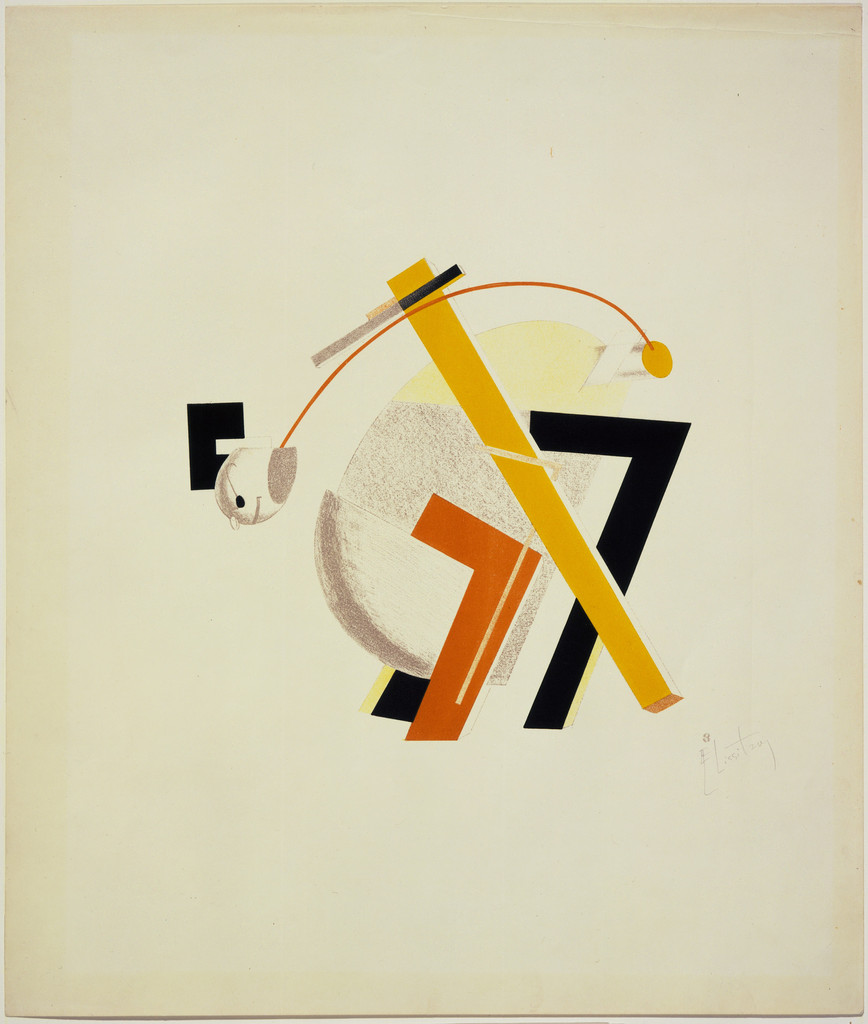
Proun 12E
Mag men het zien?
Ja, het ontvangt bezoek

Publiek tentoongesteld. Wie daarvoor instaat, staat hieronder.
- Gecontroleerd
- Ongewijzigd sinds
- Bron
- De eigen collectiegegevens van het museum
About the painting
While other constructivist artists in postrevolutionary Russia abandoned easel painting in favor of utilitarian forms such as photography, film, and graphic design that were believed to more easily serve the new state, Lissitzky asserted painting’s important role in advancing creative and spiritual life. His compositions, which he named Prouns (an acronym for the Russian phrase “project for the affirmation of the new”), broke with traditional painterly conventions, and fed “on the ground fertilized by the dead bodies of pictures and their painters.” Proun 12E is typical of Lissitzky’s new pictorial language. A wide band extends across the width of the canvas, anchoring a variety of geometric forms that hover above, defying laws of gravity and perspectival logic. The floating construction that hinges on a red sphere seems to project into space instead of receding into it, as it would in traditional painting. Prouns provided the springboard for Lissitzky’s later artistic activities in diverse fields such as typography and architecture.
Harvard Art Museums
Gegevens
- Inventarisnummer
- BR49.303
In de catalogus
Bronnen
- Harvard Art Museums: the museum's own open data · opgehaald 6 dagen geleden
- Afbeelding: Harvard Art Museums — © President and Fellows of Harvard College
Intussen, in het leven van El Lissitzky
Het hele leven1920–1921
Moscow: INKhUK, a lecture on the Prouns, VKhUTEMAS
In 1920 Lissitzky leaves Vitebsk for Moscow and becomes a member of INKhUK (the Institute of Artistic Culture, also referred to as GINKhUK); on 23 September 1921 he gives a lecture there about his Prouns. In 1921 he also starts to teach at VKhUTEMAS but soon leaves Moscow for Germany.
1921
Leaving for Germany as a “cultural emissary”
In 1921, as UNOVIS declines and suprematism begins to fracture into a utopian, spiritual half and a utilitarian one, Lissitzky aligns with neither and leaves Vitebsk: he takes a job as a “cultural emissary” of Soviet Russia and moves to Weimar Berlin to establish contacts between Russian and German artists — what exactly he did in this role remains unclear. In 1921–1925 he lives in Germany and Switzerland.
1922
First solo exhibition in Hanover
The year after the publication of his first Proun series in 1921, Kurt Schwitters introduces Lissitzky to the Hanover gallery Kestnergesellschaft, where he holds his first solo exhibition. The second Proun series, printed in Hanover in 1923, is a success.
1923
The Proun Room at the Great Berlin Art Exhibition
In 1923, for the Great Berlin Art Exhibition, Lissitzky transforms a small room (about 3 by 3 by 2.5 m) into a single work of art, the Proun Room, which lets viewers “walk into an image” and become active participants. He violates the unwritten rule of rejecting the commercialization of art by putting price tags on three elements of the room; the price tags, together with his “half-dance” during the demonstration of the room, alienate his friend Theo van Doesburg.
1923–1924
Tuberculosis and a Swiss hospital
In 1923–1924 Lissitzky is severely ill with tuberculosis and stays in a Swiss hospital; at this time he is reported even to have considered suicide. He will die of tuberculosis in 1941.
1925
Return to the USSR
Lissitzky's years in Germany and Switzerland run from 1921 to 1925; it appears that in 1925 he returns to the Soviet Union.