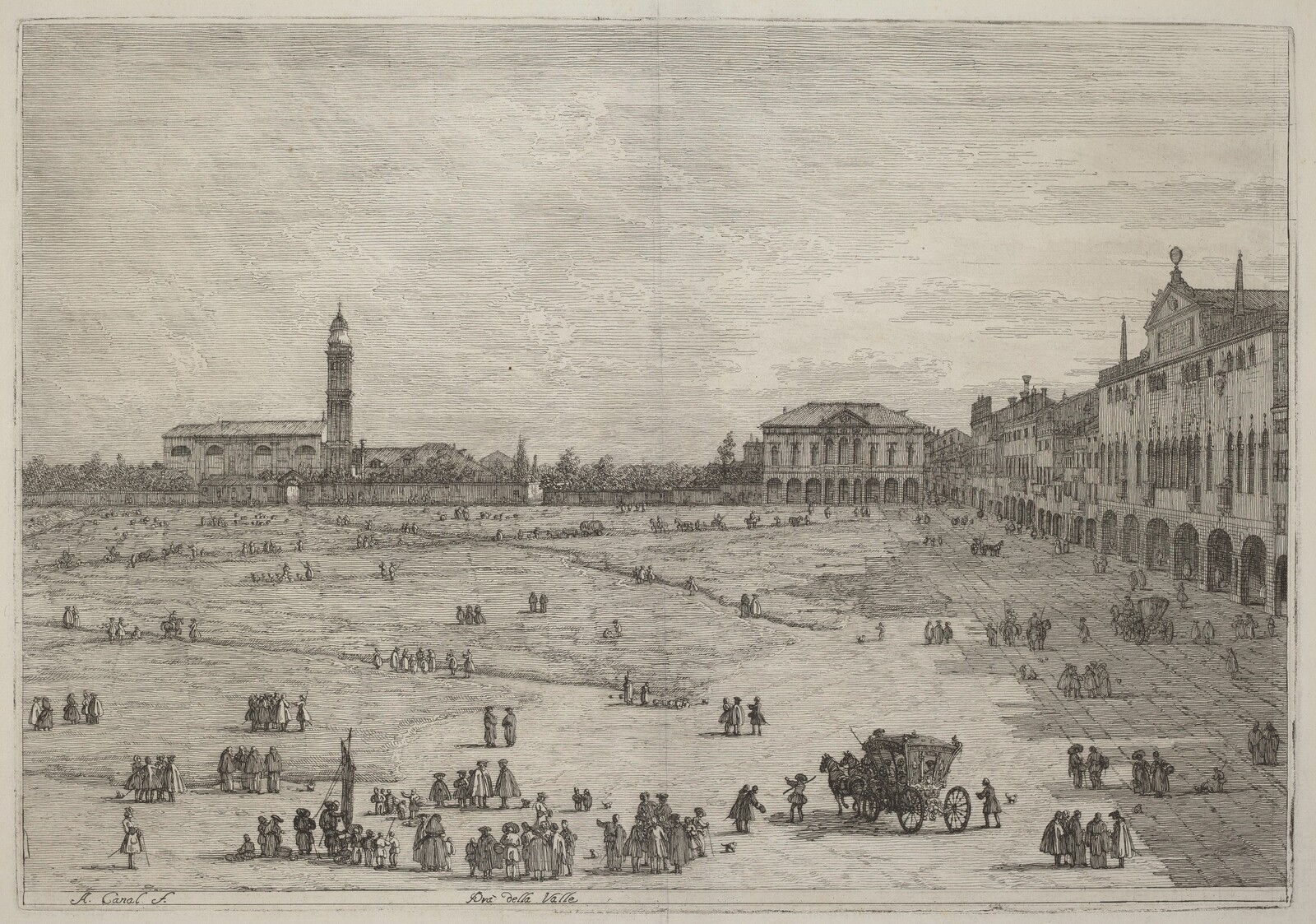
 CanalettoItalië, 1697–1768
Pra della Valle
Mag men het zien?
Ontvangt momenteel niet

Washington D.C., Verenigde Staten
Het hoort bij de collectie, maar is momenteel niet tentoongesteld.
- Gecontroleerd
- Ongewijzigd sinds
- Bron
- Het museum
Gegevens
- Inventarisnummer
- 1941.1.177
Wat het toont
In de catalogus
Bronnen
- National Gallery of Art
- Afbeelding: National Gallery of Art — Museum open access
Intussen, in het leven van Canaletto
Het hele leven1720–1746 · Werkzaam in
Venice
1728–1735
Visentini's etchings after thirty-eight of Canaletto's views
In 1728–35 Smith arranges for thirty-eight of Canaletto's painted vedute to be reproduced in etchings by Antonio Visentini and published under the title “Urbis Venetiarum Prospectus Celebriores ex Antonii Canal”.
c. 1729 – 1735
Smith as agent: a “market of taste” for the Venetian veduta
Joseph Smith — a banker, art dealer and later British consul in Venice — creates a “market of taste” for the Venetian veduta among British aristocrats touring Italy and, as Canaletto's commercial agent from about 1729 to 1735, in effect controls the artist's work to the benefit of them both. Among the young painter's buyers is also the Prince of Liechtenstein.
1740s
The War of the Austrian Succession: the British stop coming
In the 1740s Canaletto's market is disrupted when the War of the Austrian Succession reduces the number of British visitors to Venice. Smith arranges for the publication of a series of etchings of “capricci” (architectural fantasies), but the returns are not high enough.
1746
Moving to London because of wars and a collapsing market
Smith inspires Canaletto to travel to London; because of the wars shaking continental Europe he decides in 1746 to move to England, where he will live for the next ten years.
1746–1755
Rumours of an impostor: a newspaper advertisement
Canaletto's English paintings become repetitive and mechanical, and the critic George Vertue suggests that the man painting under the name “Canaletto” is an impostor — perhaps because his nephew Bernardo Bellotto was also using his uncle's nickname, or, more likely, because unscrupulous dealers passing off copies were anxious to see him return to Venice. To refute the claim the artist invites “any Gentleman”, through a newspaper advertisement, to inspect his latest painting of St James's Park at his studio in Silver Street, but his reputation never fully recovers in his lifetime.


![Ginevra de' Benci [obverse], Leonardo da Vinci, c. 1474/1478](https://api.nga.gov/iiif/8f29e3c9-a289-4d53-abf0-31a66e9e98fa/full/!2400,2400/0/default.jpg)
![Wreath of Laurel, Palm, and Juniper with a Scroll inscribed Virtutem Forma Decorat [reverse], Leonardo da Vinci, c. 1474/1478](https://api.nga.gov/iiif/ff62e8d0-45c4-498f-ad36-6358de827e04/full/!2400,2400/0/default.jpg)


