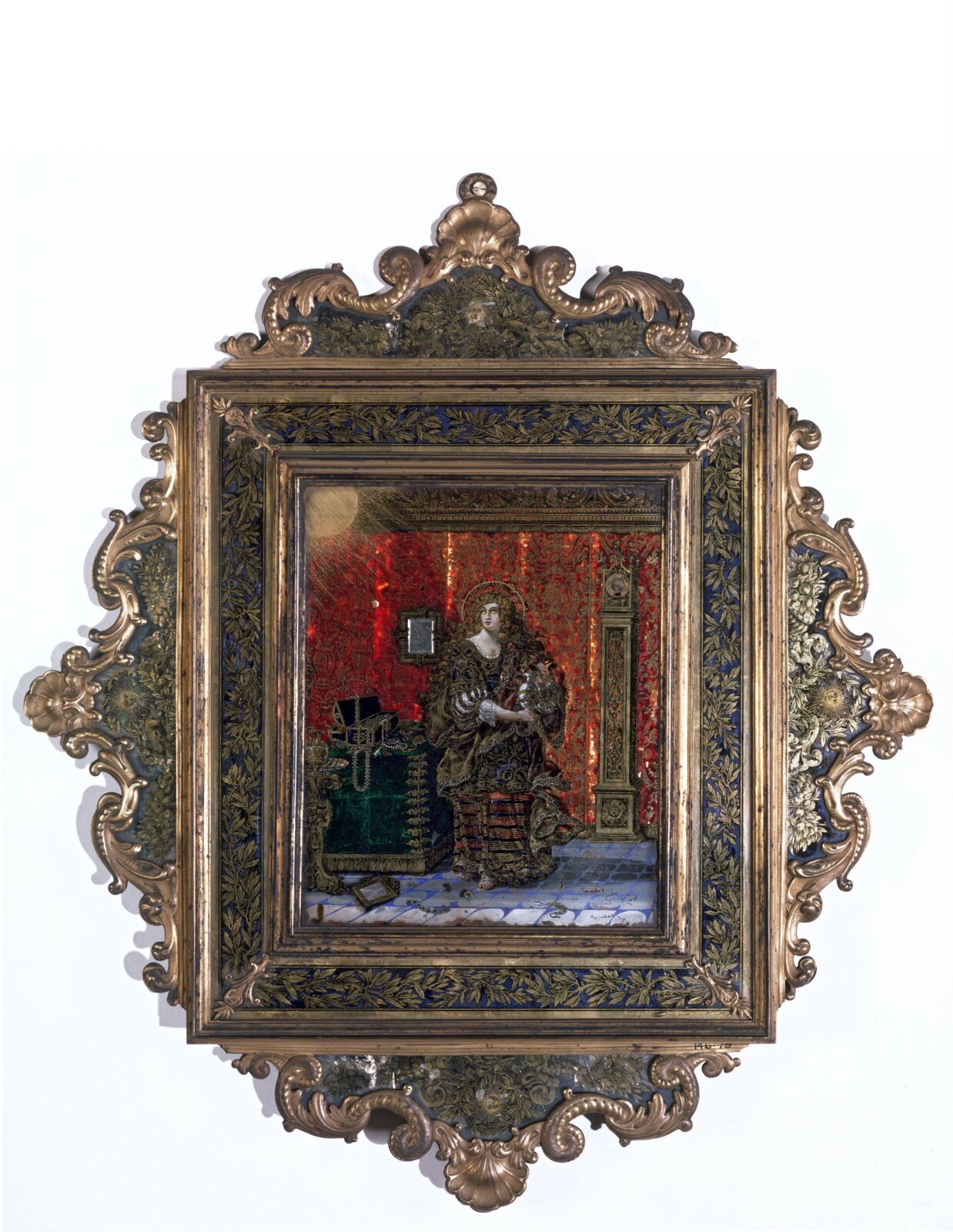
Painting on glass
Mag men het zien?
Ja, het ontvangt bezoek

Victoria and Albert Museum
Londen, Verenigd Koninkrijk
ZaalEurope 1600-1815, Room 5, The Friends of the V&A Gallery
Publiek tentoongesteld. Wie daarvoor instaat, staat hieronder.
- Gecontroleerd
- Ongewijzigd sinds
- Bron
- De eigen collectiegegevens van het museum
Over het schilderij
This brilliant jewel-like image depicts the conversion of Mary Magdalen, a medieval legend painted by a number of artists in the seventeenth century, including Caravaggio, Rubens and Artemisia Gentileschi. The saint's eyes are raised in ecstasy toward the light which streams in from the left; the billowing drapery and discarded jewels suggesting sudden physical movement. Exceptionally in an image of the Magdalen there are two mirrors: one by the saint's head, catching the divine illumination and representing self-knowledge and wisdom, and a second, cracked mirror lying on the floor amid the discarded jewels in an allusion to the perils of vanity and self-deception. The sun as symbolic of spiritual insight is conflated in this object with references to Louis XIV as Roi Soleil, making what appears to be an image of divine revelation into something more complex. It may be that the figure of the saint is also intended as an allegorical portrait of one of the king's mistresses (a popular seventeenth-century conceit).
Verder lezen
Intended for private devotion, this glittering image places the saint in an unusually sumptuous interior and was probably intended to be hung in a similar setting. The reflective qualities of glass, combined with the visual appeal of precious stones, made reverse painted glass popular for small devotional objects. Historically, however, such techniques have tended to be viewed as an inferior type of enamelling, hence the original cataloguing of this object as a ceramic in 1879.
Victoria and Albert Museum
Gegevens
- Inventarisnummer
- 146-1879
Wat het toont
In de catalogus
Bronnen
- Victoria and Albert Museum: de open data van het museum · opgehaald 12 dagen geleden
- Afbeelding: Victoria and Albert Museum — © Victoria and Albert Museum, London