ART WIKI32.963 te zien
KaartCollectieKunstenaarsMuseaTentoonstellingenJournal
Inloggen

ART WIKI

Waar het meesterwerk hangt en wanneer men u toelaat.

Collecties: Art Institute of Chicago, Cleveland Museum of Art, Getty Villa, Harvard Art Museums, Hermitage, Hirshhorn Museum and Sculpture Garden, J. Paul Getty Museum, Louvre, Metropolitan Museum of Art, Minneapolis Institute of Art, Museum of Modern Art, National Gallery of Art, National Museum of Asian Art, National Portrait Gallery, Poesjkinmuseum, Rijksmuseum Amsterdam, Russisch Museum, Smithsonian American Art Museum, Statens Museum for Kunst, Tretjakovgalerij, Victoria and Albert Museum, Whitney Museum of American Art, Staatscatalogus van het Russische museumfonds (274 musea), Europeana (19 musea), Wikidata (6 musea), Paris Musées (12 musea) en Joconde, de museumdatabank van het Franse ministerie van Cultuur (495 musea). De afbeeldingen behoren toe aan hun rechthebbenden.

Rubrieken

  • Kaart
  • Zoeken
  • Collectie
  • Meesterwerken
  • Nu te zien
  • Kunstenaars

Meer

  • Musea & galerieën
  • Tentoonstellingen
  • Journal
  • Waar de gegevens vandaan komen
  • Privacy & cookies
StartpaginaKaartCatalogus
  1. Collectie/
  2. Musée d'Orsay/
  3. L'Orchestre de l'Opéra
L'Orchestre de l'Opéra, Edgar Degas, 1868

L'Orchestre de l'Opéra

1868 · Painting · 56.5 × 45 cm

Over het schilderij

The Orchestra at the Opera (c. 1870) is an oil-on-canvas painting by the French artist Edgar Degas (1834–1917).

The musicians depicted in the orchestra pit of the Salle Le Peletier the home of the Paris Opera (from 1821 until it burnt down in 1873) are mostly portraits of friends of Degas, foremost among them pictorially the bassoonist and composer Désiré Dihau (1838–1909), who commissioned the painting, at work on his instrument, and the cellist Louis-Marie Pilet (1815–1877) on his string instrument.

The painting was handed over, without further retouching possible, to its owner (Dihau), who exhibited it in Lille, which caused Degas' family, until then doubtful about the art of their "Raphael", to remark: "It is thanks to you that he has finally produced and completed a work, a real painting".

Verder lezen

Blurring the distinction between portraiture and genre pieces, Degas painted his bassoonist friend, Désiré Dihau, in The Orchestra at the Opera as one of fourteen musicians in an orchestra pit, viewed as though by a member of the audience. Above the musicians can be seen only the legs and tutus of the dancers onstage, their figures cropped by the edge of the painting. Art historian Charles Stuckey has compared the viewpoint to that of a distracted spectator at a ballet, and says that "it is Degas' fascination with the depiction of movement, including the movement of a spectator's eyes as during a random glance, that is properly speaking 'Impressionist'."

The painting is the first instance in Degas' work where dancers from the ballet appear. He would depict dancers frequently for the rest of his career, and it is for his ballet pictures that he remains best known.

Wikipedia

Intussen, in het leven van Edgar Degas

Het hele leven
  1. late 1860s

    The turn to modern life: racecourses, milliners, laundresses

    By the late 1860s Degas had moved from history painting to an original observation of contemporary life: racecourse scenes let him paint horses and riders in a modern setting, and then he turned to women at work — milliners and laundresses.

  2. late 1860s

    Begins modelling in wax

    Degas modelled small wax figures of dancers, bathers and jockeys for himself, in place of studies. He never worked in bronze or stone; he valued wax for its changeability, and his sculptor friend Bartholomé encouraged him.

  3. 1870

    A volunteer in the war; a flaw in his eyesight

    When the Franco-Prussian War broke out Degas volunteered; at the first shooting practice it turned out that he saw poorly with his right eye. It was the first sign of the macular degeneration that left him almost blind at the end of his life; he was transferred to the artillery and served there to the end of the war.

  4. early 1870s

    Meets Durand-Ruel

    Degas met the dealer Durand-Ruel, later the most prominent of the trusted dealers with whom he planned his strategy at auctions.

  5. 1870s

    From “de Gas” back to plain “Degas”

    The archives disproved the legend of an ancient noble line: the artist's paternal ancestors were bakers, and the name “de Gas” was invented by his father, who commissioned a false genealogy. In the 1870s Edgar returned to the plain spelling, Degas.

Meer van Edgar Degas

Alle werken

Uit de collectie: Musée d'Orsay

Museumpagina
·
CC BY-SA

Gegevens

1868 · op 34-jarige leeftijd
18341917
Inventarisnummer
RF 2417

Bronnen

  • Wikidata
  • Afbeelding: Musée d'Orsay — Edgar Degas · Public domain · Wikimedia Commons
Edgar Degas, portretEdgar DegasFrankrijk, 1834–1917

Mag men het zien?

Onbekend

Musée d'Orsay

Parijs, Frankrijk

De eigenaar is bekend; of het werk nu te zien is, is onbekend.

Ongewijzigd sinds
29 sep 2026
Bron
Het museum
Op de kaartMuseumpagina
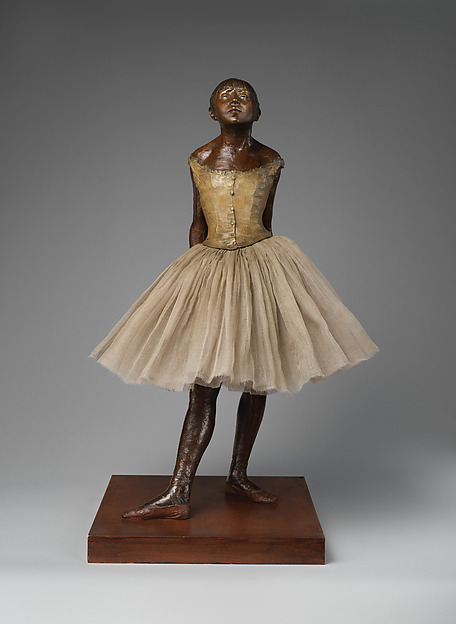
The Little Fourteen-Year-Old Dancer, Edgar Degas, modeled 1881, cast 1922, modern tutu

The Little Fourteen-Year-Old Dancer

modeled 1881, cast 1922, modern tutu · Metropolitan Museum of Art

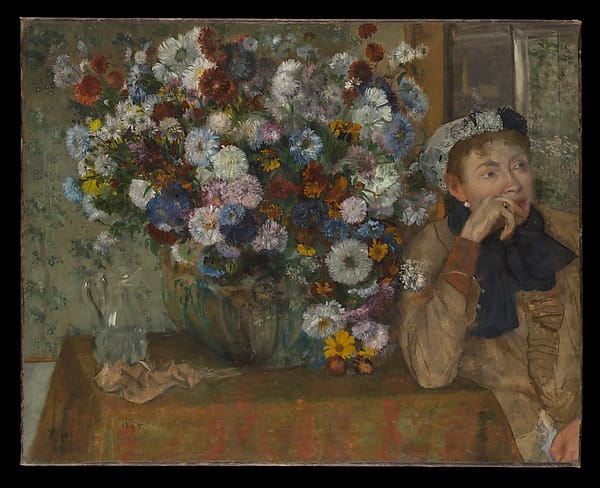
A Woman Seated beside a Vase of Flowers (Madame Paul Valpinçon?), Edgar Degas, 1865

A Woman Seated beside a Vase of Flowers (Madame Paul Valpinçon?)

1865 · Metropolitan Museum of Art

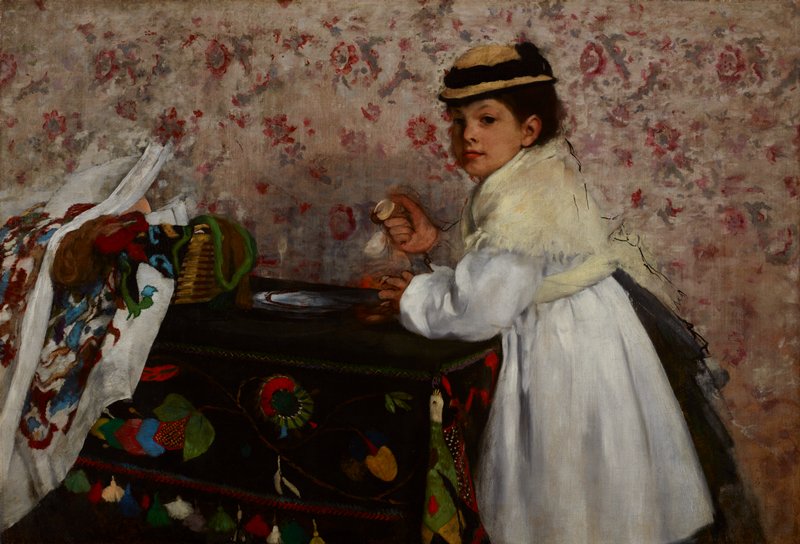
Portrait of Mlle. Hortense Valpinçon, Edgar Degas, c. 1871

Portrait of Mlle. Hortense Valpinçon

c. 1871 · Minneapolis Institute of Art

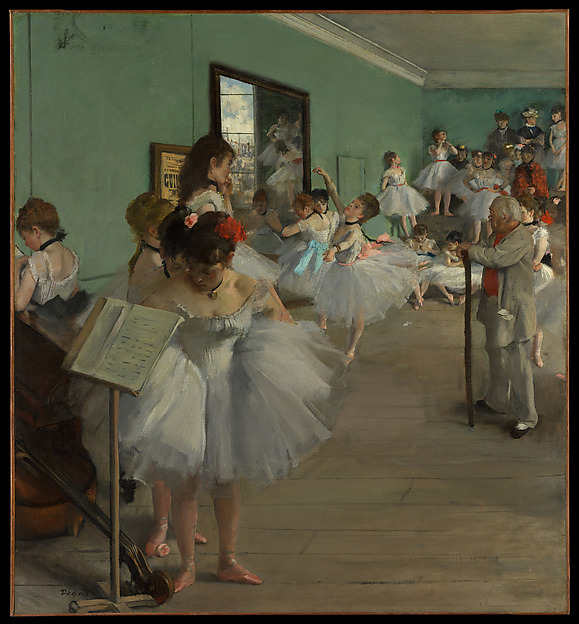
The Dance Class, Edgar Degas, 1874

The Dance Class

1874 · Metropolitan Museum of Art

Woman Having Her Hair Combed, Edgar Degas, ca. 1886–88

Woman Having Her Hair Combed

ca. 1886–88 · Metropolitan Museum of Art

Study in the Nude of Little Dancer Aged Fourteen (Nude Little Dancer), Edgar Degas, original wax c. 1878-1881, cast 1920/1926

Study in the Nude of Little Dancer Aged Fourteen (Nude Little Dancer)

original wax c. 1878-1881, cast 1920/1926 · National Gallery of Art

Horse Galloping on the Right Foot, Edgar Degas, late 1880s

Horse Galloping on the Right Foot

late 1880s · National Gallery of Art

Horse Trotting, the Feet Not Touching the Ground, Edgar Degas, 1870s

Horse Trotting, the Feet Not Touching the Ground

1870s · National Gallery of Art

Still Life: Japanese Vase with Roses and Anemones, Vincent van Gogh, 1890

Vincent van Gogh

Still Life: Japanese Vase with Roses and Anemones, 1890

Chaumes de Cordeville, Vincent van Gogh, 1890

Vincent van Gogh

Chaumes de Cordeville, 1890

Doctor Gachet's Garden in Auvers, Vincent van Gogh, 1890

Vincent van Gogh

Doctor Gachet's Garden in Auvers, 1890

Two Children, Vincent van Gogh, 1890

Vincent van Gogh

Two Children, 1890

The siesta (after Millet), Vincent van Gogh, 1890

Vincent van Gogh

The siesta (after Millet), 1890

Marguerite Gachet in the Garden, Vincent van Gogh, 1890

Vincent van Gogh

Marguerite Gachet in the Garden, 1890

The Church at Auvers, Vincent van Gogh, 1890

Vincent van Gogh

De kerk van Auvers, 1890

Portrait of Dr. Gachet, Vincent van Gogh, 1890

Vincent van Gogh

Portrait of Dr. Gachet, 1890

In de catalogus

SchilderijenFranse schilderkunstRealismeImpressionisme19e eeuw