Lions
Mag men het zien?
Ontvangt momenteel niet

Minneapolis, Verenigde Staten
Het hoort bij de collectie, maar is momenteel niet tentoongesteld.
- Gecontroleerd
- Ongewijzigd sinds
- Bron
- Het museum
Over het schilderij
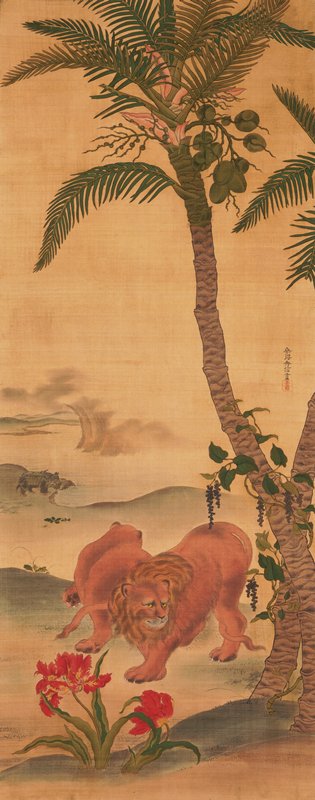
Two lions roam a tropical landscape, framed by a coconut tree and strange red and purple flowers. In the background, a rhinoceros lingers by the water. Even while communication and trade between the rest of the world and Japan was highly restricted, the Japanese were eager to learn about life beyond the seas. Dutch traders brought Western publications, such as Johann Jonston’s Historiae naturalis de quadrupedibus libri (1650), to Japan. Printed, translated versions of the books were disseminated through Japanese publishers and became popular among artists, who often used illustrations in Western books as models for paintings and drawings. While we do not know the source of the lions, the rhinoceros’s source is clear. Though small in scale, the creature resembles that of German painter and printmaker Albrecht Dürer’s woodcut from 1515.
Lees meer
Dürer never saw a real rhinoceros; instead, he based his illustration on written descriptions. The image was reproduced repeatedly within Europe in prints and books, including Jonston’s Historiae naturalis. First presented as a gift to the fourth shogun, Tokugawa Ietsuna, in 1663, Historiae naturalis was kept in the library until the eighth shogun, Yoshimune, rediscovered it.
Enea Vico
Italian, 1523–1567
16th century
Rhinoceros, 1548
Engraving
The William M. Ladd Collection
Gift of Herschel V. Jones, 1916 P.468
Minneapolis Institute of Art
Gegevens
- Inventarisnummer
- 2013.29.5
In de catalogus
Bronnen
- Minneapolis Institute of Art
- Afbeelding: Minneapolis Institute of Art — public domain