ART WIKI32.963 te zien
KaartCollectieKunstenaarsMuseaTentoonstellingenJournal
Inloggen

ART WIKI

Waar het meesterwerk hangt en wanneer men u toelaat.

Collecties: Art Institute of Chicago, Cleveland Museum of Art, Getty Villa, Harvard Art Museums, Hermitage, Hirshhorn Museum and Sculpture Garden, J. Paul Getty Museum, Louvre, Metropolitan Museum of Art, Minneapolis Institute of Art, Museum of Modern Art, National Gallery of Art, National Museum of Asian Art, National Portrait Gallery, Poesjkinmuseum, Rijksmuseum Amsterdam, Russisch Museum, Smithsonian American Art Museum, Statens Museum for Kunst, Tretjakovgalerij, Victoria and Albert Museum, Whitney Museum of American Art, Staatscatalogus van het Russische museumfonds (274 musea), Europeana (19 musea), Wikidata (6 musea), Paris Musées (12 musea) en Joconde, de museumdatabank van het Franse ministerie van Cultuur (495 musea). De afbeeldingen behoren toe aan hun rechthebbenden.

Rubrieken

  • Kaart
  • Zoeken
  • Collectie
  • Meesterwerken
  • Nu te zien
  • Kunstenaars

Meer

  • Musea & galerieën
  • Tentoonstellingen
  • Journal
  • Waar de gegevens vandaan komen
  • Privacy & cookies
StartpaginaKaartCatalogus
  1. Collectie/
  2. Rijksmuseum Amsterdam/
  3. Leeuwendans
Leeuwendans, Kitagawa Utamaro, 1790 - 1795
Kitagawa Utamaro, portretKitagawa UtamaroJapan, 1754–1806

Leeuwendans

1790 - 1795 · Print

Mag men het zien?

Onbekend

Rijksmuseum Amsterdam

Amsterdam, Nederland

De eigenaar is bekend; of het werk nu te zien is, is onbekend.

Bron
Het museum
Op de kaartMuseumpagina

Over het werk

Straatscene met dansers en enkele mensen onder een doek met een leeuwenkop, en toeschouwers achter een raam. In boek met kyoka (komische gedichten) en afbeeldingen van Nieuwjaarsgebruiken.

Rijksmuseum Amsterdam

Gegevens

1790 - 1795
17541806
Inventarisnummer
RP-P-1960-11-3

Wat het toont

January 1 (~ festivities)

In de catalogus

PrentenJapanse prentenNeoclassicisme18e eeuw

Bronnen

  • Rijksmuseum Amsterdam
  • Afbeelding: Rijksmuseum Amsterdam — public domain

Intussen, in het leven van Kitagawa Utamaro

Het hele leven
  1. c. 1783 – 1788

    Years in the publisher Tsutaya's house

    Probably from 1783, Utamaro lives for about five years in the house of Tsutaya Jūzaburō and becomes one of the principal artists of the Tsutaya firm. Evidence of his prints from these years is sporadic: he mostly illustrates books of kyōka, “crazy verse”, a parody of the classical waka form.

  2. 1790–1801

    Tightening censorship: seals on prints

    From 1790 prints can be sold only with a censor's seal of approval; over the following decades censorship grows stricter, and violators can receive harsh punishments. From 1799 even preliminary drafts need approval, and in 1801 the works of a group of Utagawa-school offenders, including Toyokuni, are repressed.

  3. c. 1791

    Giving up book prints for half-length portraits of beauties

    Around 1791 Utamaro gives up designing prints for books and concentrates on single portraits of women shown half-length, rather than the group scenes favoured by other ukiyo-e artists. He was the first in Japanese woodblock printing to use half-length compositions for women's portraits; none of his work from 1790–1792 has survived.

  4. 1793

    Recognition and the end of the arrangement with Tsutaya

    In 1793 Utamaro achieves recognition as an artist, and his semi-exclusive arrangement with the publisher Tsutaya Jūzaburō ends. He then goes on to produce several well-known series featuring women of the Yoshiwara district, and becomes one of the few ukiyo-e artists to win fame throughout Japan in his lifetime.

  5. 1797

    The death of his friend and patron Tsutaya Jūzaburō

    In 1797 Utamaro's long-time friend and supporter, the publisher Tsutaya Jūzaburō, dies; the artist is apparently very upset by the loss, and some commentators feel that his work never reached its former heights afterwards. He later lives in Kyūemon-chō, then Bakuro-chō, and finally near the Benkei Bridge.
Meer van Kitagawa Utamaro

Alle werken
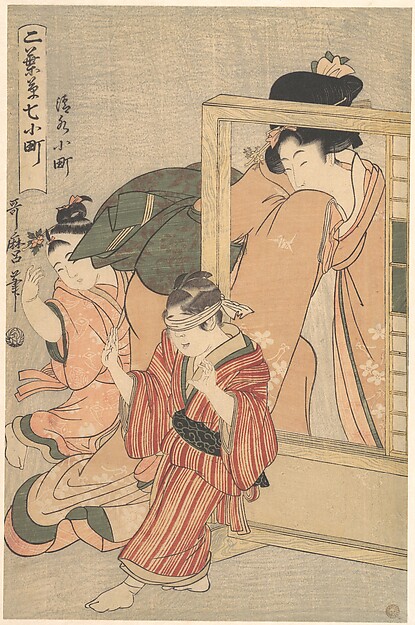
Kiyomizu Komachi, from the series Futabagusa nana Komachi, Kitagawa Utamaro, 1790s

Kiyomizu Komachi, from the series Futabagusa nana Komachi

1790s · Metropolitan Museum of Art

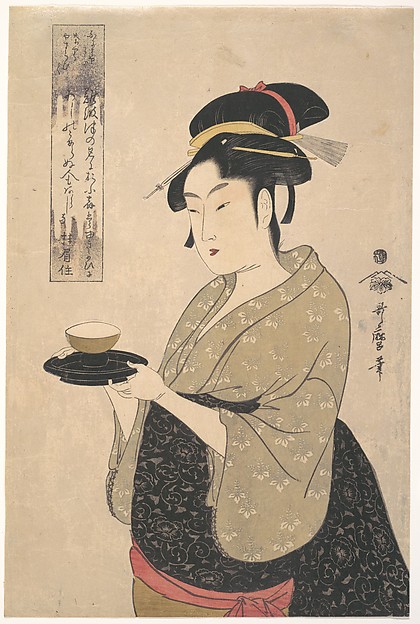
Okita of the Naniwa-ya Teahouse, Kitagawa Utamaro, ca. 1793

Okita of the Naniwa-ya Teahouse

ca. 1793 · Metropolitan Museum of Art

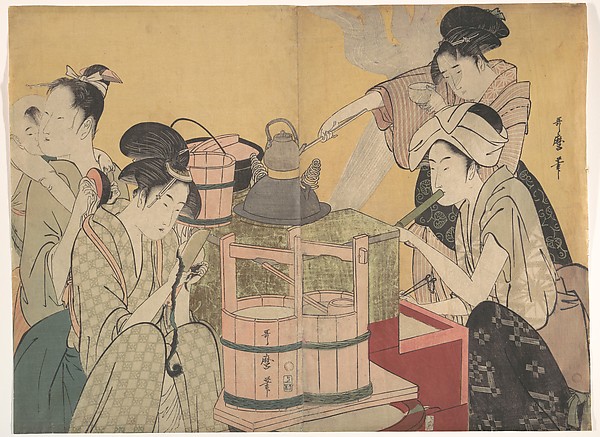
Kitchen Scene, Kitagawa Utamaro, ca. 1794–95

Kitchen Scene

ca. 1794–95 · Metropolitan Museum of Art

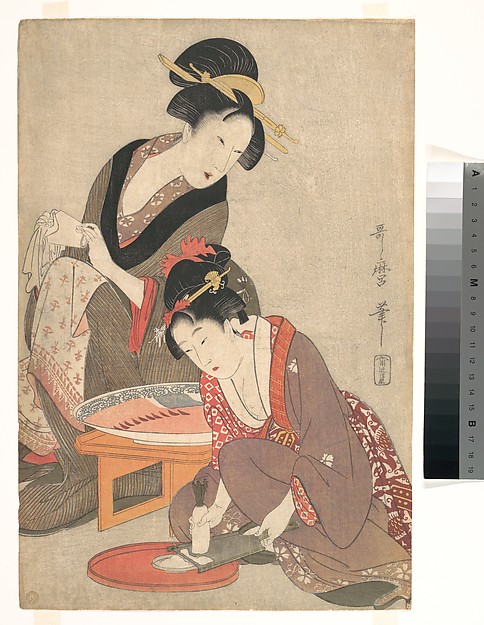
Women Grating Radish for Sashimi, Kitagawa Utamaro, ca. 1798–99

Women Grating Radish for Sashimi

ca. 1798–99 · Metropolitan Museum of Art

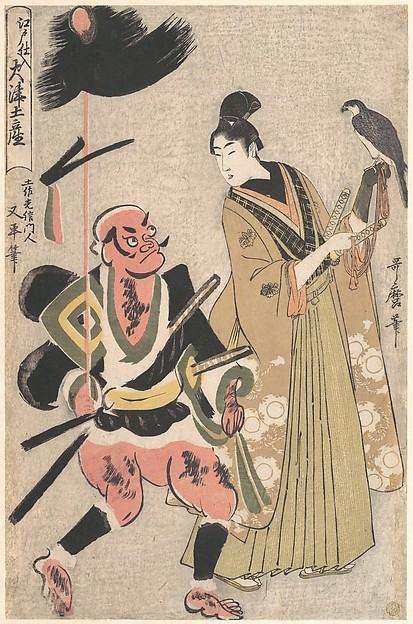
Foot-Soldier with a Spear and Hawk-Handler (Yari-mochi yakko to taka shō), from the series Souvenir Paintings from Ōtsu, Stocked in Edo (Edo Shi-ire Ōtsu Miyage), Kitagawa Utamaro, ca. 1802–3

Foot-Soldier with a Spear and Hawk-Handler (Yari-mochi yakko to taka shō), from the series Souvenir Paintings from Ōtsu, Stocked in Edo (Edo Shi-ire Ōtsu Miyage)

ca. 1802–3 · Metropolitan Museum of Art

House cleaning in preparation for the New Year, Kitagawa Utamaro, late 1790s

House cleaning in preparation for the New Year

late 1790s · Art Institute of Chicago

Enjoying the Cool in a Garden, Kitagawa Utamaro, c. 1788/90

Enjoying the Cool in a Garden

c. 1788/90 · Art Institute of Chicago

Seiro niwaka onna geisha no bu : Asazumabune Ogiuri Uta....., Kitagawa Utamaro, 1793

Seiro niwaka onna geisha no bu : Asazumabune Ogiuri Uta.....

1793 · Art Institute of Chicago

Buren in huis: Rijksmuseum Amsterdam

Museumpagina
Self-portrait, Vincent van Gogh, 1887

Vincent van Gogh

Self-portrait, 1887

La Corniche near Monaco, Claude Monet, 1884

Claude Monet

La Corniche bij Monaco, 1884

De Nachtwacht, Rembrandt van Rijn, 1642

Rembrandt van Rijn

De Nachtwacht, 1642

Portrait of a Woman, Probably Maria Trip (1619-1683), Rembrandt van Rijn, 1639

Rembrandt van Rijn

Portret van Maria Trip, 1639

Still Life with Peacocks, Rembrandt van Rijn, c. 1639

Rembrandt van Rijn

Still Life with Peacocks, c. 1639

Landscape with a Stone Bridge, Rembrandt van Rijn, c. 1638

Rembrandt van Rijn

Landschap met stenen brug, c. 1638

Man in Oriental Dress, Rembrandt van Rijn, 1635

Rembrandt van Rijn

Man in Oriental Dress, 1635

Portrait of Haesje Jacobsdr van Cleyburg, Rembrandt van Rijn, 1634

Rembrandt van Rijn

Portrait of Haesje Jacobsdr van Cleyburg, 1634