 Nicolas PoussinFrankrijk, 1594–1665
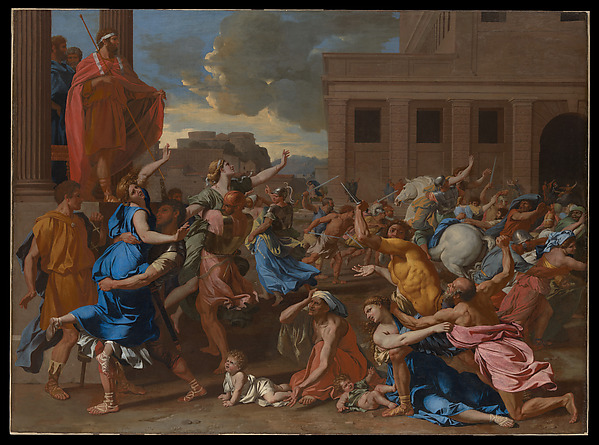
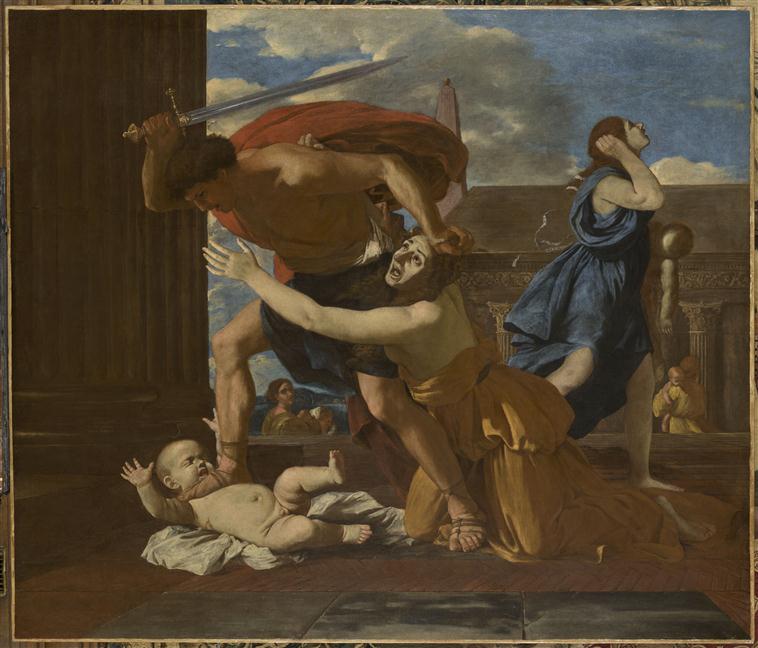
Kindermoord van Bethlehem
LE MASSACRE DES INNOCENTS
Kan ik het zien?
Onbekend
Waar is „Kindermoord van Bethlehem” nu? Collectie: Musée Condé, Chantilly. Onbekend.
Chantilly, Frankrijk
De eigenaar is bekend; of het werk nu te zien is, is onbekend.
- Ongewijzigd sinds
- Bron
- Het museum
Gegevens
- Inventarisnummer
- PE 305
Wat het toont
In de catalogus
Bronnen
- Musée Condé
- Afbeelding: Musée Condé — © Harry Bréjat ; Réunion des musées nationaux - utilisation soumise à autorisation; Ministère de la Culture (France), base Joconde
In het leven van Nicolas Poussin
Het hele leven1620s
The Cavaliere Marino takes the painter under his wing
Poussin’s work caught the attention of the Italian poet Cavaliere Marino, then living in France; his patronage let the thirty-year-old painter work in peace. According to Bellori the poet took him into his house and helped him with the invention of subjects and the rendering of emotion, and in Marino’s house Poussin gained access to a library with treatises by Alberti and Dürer and manuscripts and drawings by Leonardo.
1623
Marino returns to Italy and calls Poussin
In April 1623 Marino returned to Italy and summoned Poussin to the papal court — the pontificate of Urban VIII had just begun; the painter himself was held up in Paris. As Paul Desjardins remarks, Poussin’s career is counted from his arrival in Rome.
spring 1624
Spring 1624: Poussin arrives in Rome
According to Bellori Poussin settled in Rome in the spring of 1624 (other accounts say he first visited Venice); the lists of the church of San Lorenzo in Lucina name him from March 1624 among twenty-two people, mostly French artists, living in the house of Simon Vouet. He studied Raphael, while Caravaggio, whose literal materiality repelled him, he held to have come “to destroy painting”.
1626
Friends in Rome: Claude Lorrain, Stella, the Duquesnoy brothers
In 1626 Pierre Mellin and the brothers François and Jérôme Duquesnoy lodged in his studio; he was close to Claude Lorrain and kept company with Jacques Stella and Jean Lemaire. The circle was united by a pull towards classical antiquity; despite all his disagreements with French painters, it was this milieu that helped Poussin keep his national roots.
1630
Gives up monumental commissions
In 1630 the commission headed by Domenichino and d’Arpino gave the decoration of the Chapel of the Immaculate Conception in San Luigi dei Francesi to the Lorrainer Charles Mellin, not to Poussin. After that he firmly renounced the monumental genre and turned to “cabinet painting” for private patrons.
9 augustus 1630
Married: Anne-Marie Dughet