 Max ErnstFrankrijk, 1891–1976
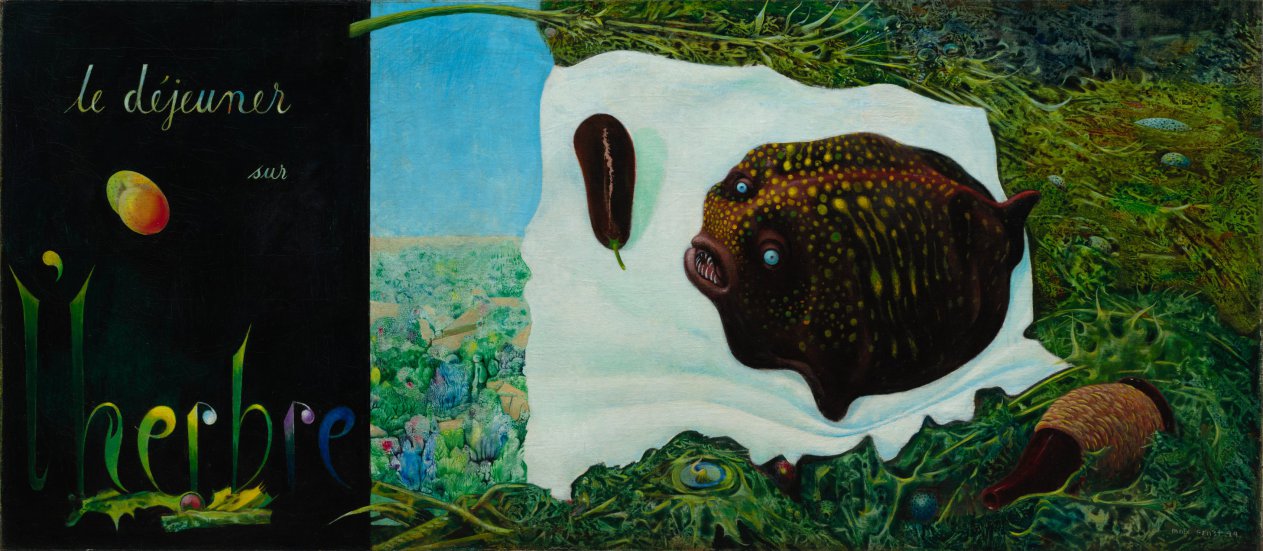
Le Déjeuner sur l'Herbre
Mag men het zien?
Ja, nu te zien
Waar is „Le Déjeuner sur l'Herbre” nu? Cleveland Museum of Art, 225 German Expressionism & Surrealism, Cleveland. Ja, nu te zien. Gecontroleerd 29 september 2026.

Publiek tentoongesteld.
- Gecontroleerd
- Ongewijzigd sinds
- Bron
- Het museum
Over het schilderij
This painting depicts the remains of a picnic on a cloth and a bottle of wine abandoned on the grass. Painted during World War II while the artist was in exile in the United States, the fish out of water has been seen as a symbol of suffering and the scene itself as a poisoned paradise. At the left Max Ernst painted a chalkboard, similar to daily specials in French restaurants. The text satirically alludes to Édouard Manet’s Le Déjeuner sur l’Herbe (Luncheon on the Grass), 1863, a painting that shocked viewers when first exhibited but later became celebrated as an early example of modern art.
Cleveland Museum of Art
Gegevens
- Inventarisnummer
- 2002.55
In de catalogus
Bronnen
- Cleveland Museum of Art
- Afbeelding: Cleveland Museum of Art — © 1944 Artists Rights Society (ARS), New York/ ADAGP, Paris
Intussen, in het leven van Max Ernst
Het hele levenlate 1942
Dorothea Tanning and “Birthday”
Selecting pictures for an exhibition of women artists at Peggy’s gallery, Ernst noticed Dorothea Tanning’s Birthday. Julien Levy introduced him to the painter, and a few meetings were enough for him to fall in love.
1942
Married: Peggy Guggenheim
1942
“First Papers of Surrealism” and “Art of This Century”
In October 1942 the exhibition First Papers of Surrealism opened, its catalogue laid out as a list of modern myths in which “interplanetary communication” was credited to Ernst. That month Peggy Guggenheim’s gallery Art of This Century opened on 57th Street, and Ernst drew the cover of its catalogue.
1946
Married: Dorothea Tanning
1946
A double wedding in Hollywood with Man Ray
Ernst and Dorothea Tanning went to Hollywood to marry, asking Man Ray and his friend Juliet Browner to be their witnesses; the two decided to marry as well, and the result was a double ceremony in Beverly Hills.
1946–1953
Sedona: a house and “Capricorn” built with his own hands
Ernst built the house himself, helped by a young admirer and short of money, and made the 2.4-metre Capricorn, a seated bull-man, from empty bottles, springs and cement; the property became known as Capricorn Hill. The couple took an interest in the rites of the local Native American tribes, Ernst buying objects and masks from them, and friends visited only occasionally.