 Philippe de ChampaigneFrankrijk, 1602–1674
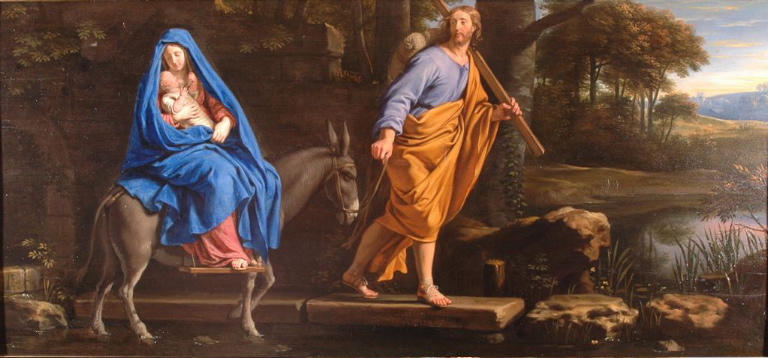
La fuite en Egypte
Mag men het zien?
Onbekend
Senlis, Frankrijk
De eigenaar is bekend; of het werk nu te zien is, is onbekend.
- Ongewijzigd sinds
- Bron
- Het museum
Gegevens
- Inventarisnummer
- A.00.6.47
Wat het toont
In de catalogus
Bronnen
- Musée d'art et d'archéologie de Senlis
- Afbeelding: Musée d'art et d'archéologie de Senlis — Christian Schryve, Compiègne; Ministère de la Culture (France), base Joconde
Intussen, in het leven van Philippe de Champaigne
Het hele leven1648
A founder of the Royal Academy
Champaigne was one of the founding members of the Académie royale de peinture et de sculpture, the premier art institution of Ancien Régime France.
1654
Rivalry with Charles Le Brun
From 1654 Champaigne competed with the king's First Painter, Charles Le Brun, and took part in decorating the Tuileries Palace under his direction.
1660s
Academy lectures recorded by Félibien
Champaigne left no printed writings, but his lectures and commentaries were recorded in the 1660s by André Félibien. In his last years he taught a great deal at the Academy; after his only son died young, his nephew Jean-Baptiste de Champaigne was brought from Brussels to become his main pupil.
c. 1662
His daughter's miraculous cure at Port-Royal
The artist's paralyzed daughter, who lived at the convent of Port-Royal, was reportedly cured by a miracle. Champaigne then painted the atypical votive picture “Ex-Voto de 1662” (Louvre), showing his daughter with Mother Superior Agnès Arnauld.