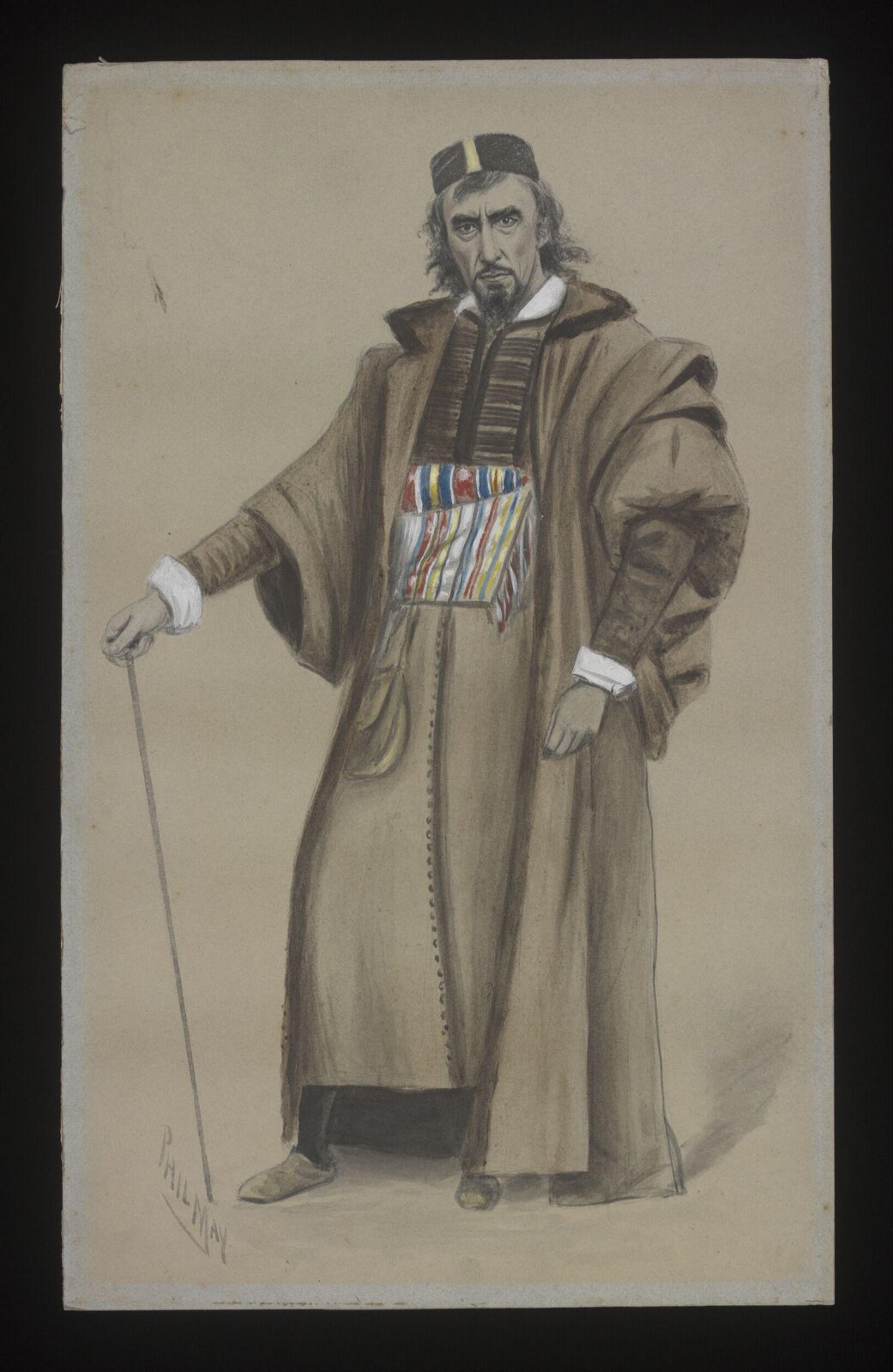
 Philip William MayEngeland, 1864–1903
Henry Irving as Shylock
Kan ik het zien?
Nu niet te zien
Waar is „Henry Irving as Shylock” nu? Collectie: Victoria and Albert Museum, Londen. Nu niet te zien. Gecontroleerd 25 september 2026.

Londen, Verenigd Koninkrijk
Het hoort bij de collectie, maar is momenteel niet tentoongesteld.
- Gecontroleerd
- Ongewijzigd sinds
- Bron
- Het museum
Over het werk
Full length watercolour drawing of the actor/manager Sir Henry Irving (1838-1905) as Shylock in The Merchant of Venice by William Shakespeare, signed by the artist Phil May (1864–1903), ca.1880
Lees meer
Henry Irving became a professional actor in 1856 and learned his trade in regional theatres until 1866, when he came to London. He joined the Lyceum Theatre company under the management of H.L. Bateman in 1871, winning great acclaim that year for his psychologically developed characterisation of the guilt-ridden inn-keeper Mathias in Leopold Lewis’s melodrama The Bells. He took on the responsibilities of ‘actor-manager’ in 1878 when he assumed the management of the Lyceum, and remained there until 1902, enjoying star status with his leading lady Ellen Terry (1847-1928). Irving produced a diverse range of old and new plays at the Lyceum, including Shakespeare, historical drama, and literary adaptations. His tireless work to elevate the status of the theatrical profession was rewarded in 1895 when he became the first actor ever to receive a knighthood for services to the theatre.
Irving first produced The Merchant of Venice in 1879, inspired by a Mediterranean cruise during which he visited Venice and North Africa. His portrayal of Shylock was sympathetic and intellectual, unlike the variously comic or villainous ones of preceding eras. The initial production ran for 250 performances, and it remained in Irving’s repertory of plays until his death in 1905.
Victoria and Albert Museum
Gegevens
- Inventarisnummer
- S.1224-2014
Wat het toont
In de catalogus
Bronnen
- Victoria and Albert Museum
- Afbeelding: Victoria and Albert Museum — © Victoria and Albert Museum, London