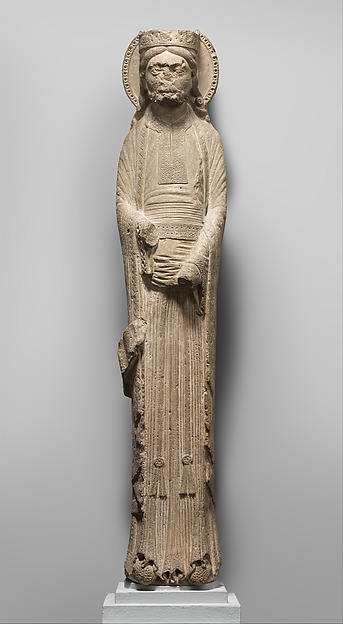
Head of King David
Mag men het zien?
Ja, het ontvangt bezoek

New York, Verenigde Staten
Publiek tentoongesteld.
- Gecontroleerd
- Ongewijzigd sinds
- Bron
- Het museum
Over de sculptuur
Head of King David is a limestone sculptural head in the Metropolitan Museum of Art in New York City. The museum dates it to about 1145 and identifies it as the head of the biblical king David from a statue-column on the Saint Anne Portal, the southern portal of the west façade of Notre-Dame de Paris. The portal's programme concerns Saint Anne, the childhood of Jesus and the genealogy of Christ; David appeared among Christ's ancestors on its right jamb.
The head measures 29.7 cm × 21.1 cm × 21.3 cm (11.7 in × 8.3 in × 8.4 in) and weighs 15 kg (33 lb). A corresponding fragment of the figure's body, excavated in Paris in 1977, is held by the Musée de Cluny; its catalogue identifies the Met head as belonging to the same statue.
Lees meer
The Met acquired the head in 1938. James Rorimer published its identification in 1940, relating it to an eighteenth-century engraving of the portal figures. A neutron-activation study published in 1986 challenged the medieval attribution and concluded that the head was probably carved for the Paris art dealer Lucien Demotte from locally quarried stone. Later compositional research reported inconsistencies among three samples from the object and emphasised the difficulties of assigning heterogeneous limestone by small samples. The Metropolitan Museum and the Musée de Cluny continue to catalogue the head as a mid-twelfth-century fragment of the Saint Anne Portal.
Gegevens
- Inventarisnummer
- 38.180
Wat het toont
In de catalogus
Bronnen
- Metropolitan Museum of Art
- Afbeelding: Metropolitan Museum of Art — Open Access (CC0)



![Four Studies of Heads [verso], Mark Rothko](https://api.nga.gov/iiif/7c2e5905-e667-4b1a-8e15-8592bb0987f8/full/!2400,2400/0/default.jpg)