 Maurits Cornelis EscherNederland, 1898–1972
Dusk
Kan ik het zien?
Nu niet te zien
Waar is „Dusk” nu? Collectie: National Gallery of Art, Washington D.C. Nu niet te zien. Gecontroleerd 16 november 2026.

Washington D.C., Verenigde Staten
Het hoort bij de collectie, maar is momenteel niet tentoongesteld.
- Gecontroleerd
- Ongewijzigd sinds
- Bron
- Het museum
Over het werk
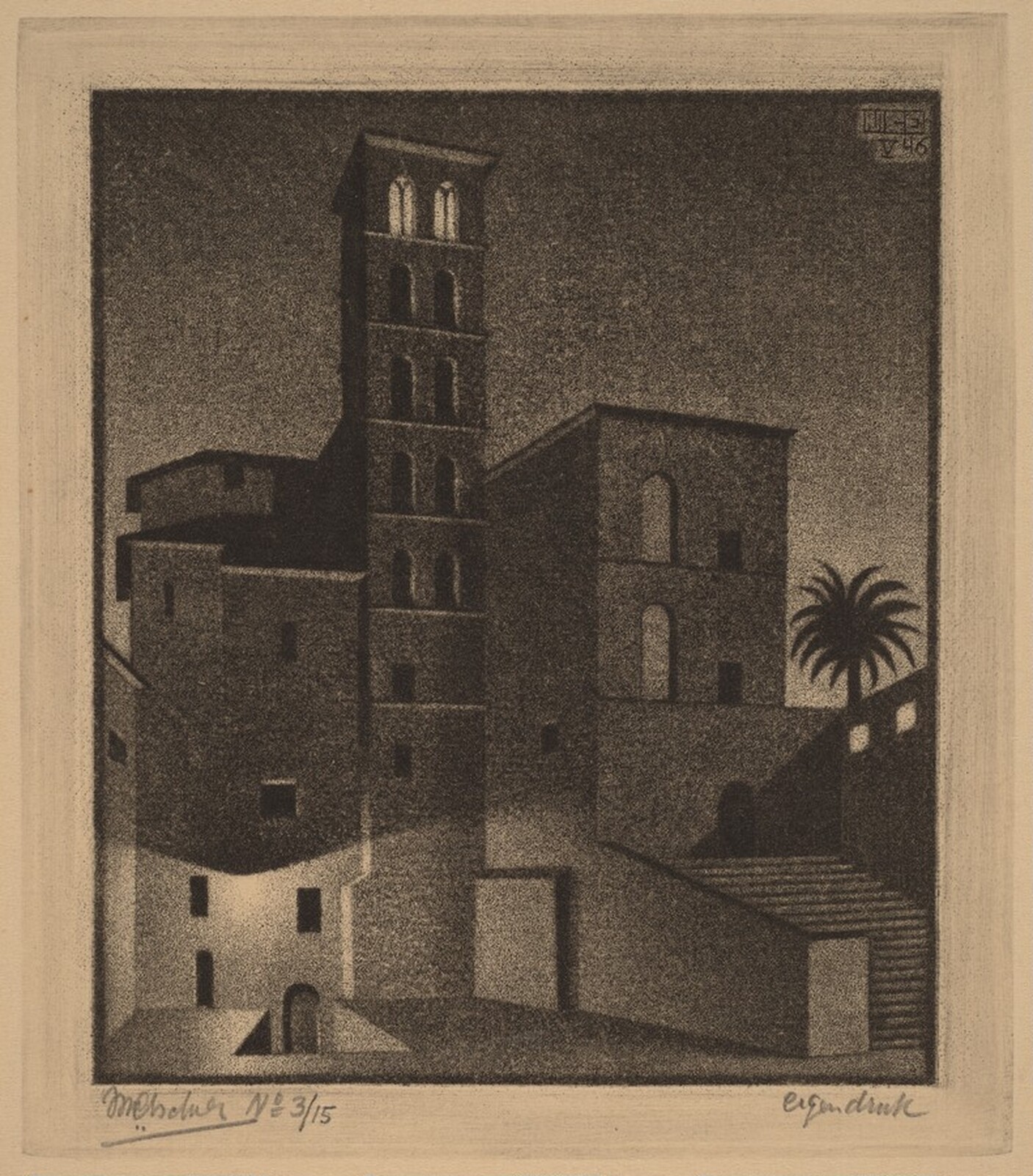
M. C. Escher’s Dusk, a mezzotint from 1946, depicts Rome’s Santi Giovanni e Paolo and is now in the National Gallery of Art, Washington. A tower with repeated windows rises above steps and shadowed buildings; a palm appears at the right. This impression is in the second state, which may also be the final one.
Gegevens
- Inventarisnummer
- 1975.95.1
Wat het toont
In de catalogus
Bronnen
- National Gallery of Art
- Afbeelding: National Gallery of Art — © the artist or rights holder
In het leven van Maurits Cornelis Escher
Het hele leven1 February 1944 – 1946
The death of his teacher Mesquita
On 1 February 1944 the Nazis arrested Samuel de Mesquita, who was of Jewish origin, with his family and sent them to Auschwitz; almost at once after arrival — presumably on 11 February — he and his wife were killed in the gas chamber. Escher helped to send his teacher’s works to the Stedelijk Museum in Amsterdam, keeping for himself a single sketch bearing the print of a German boot, and in 1946 organised a memorial exhibition there.
c. 1945
The end of the occupation: a diploma and an exhibition of the unyielding
Escher lived through the German occupation in the Netherlands. Before the end of the war he designed a diploma for the Temporary Academy in Eindhoven — an institution in the liberated south-east of the country — and immediately after the war he took part in an exhibition of artists who had refused to collaborate with the Nazi regime.
1946–1951
Mezzotint: a brief experiment
In 1946 Escher became interested in intaglio printing, but it took too much time: until 1951 he made no more than seven mezzotint prints and never returned to intaglio, preferring tonal contrast to linear outline. These few works are considered masterpieces of the technique.


