 Angelica KauffmannZwitserland, 1741–1807
Drawing
Mag men het zien?
Ontvangt momenteel niet

Victoria and Albert Museum
Londen, Verenigd Koninkrijk
Het hoort bij de collectie, maar is momenteel niet tentoongesteld.
- Gecontroleerd
- Ongewijzigd sinds
- Bron
- Het museum
Over het werk
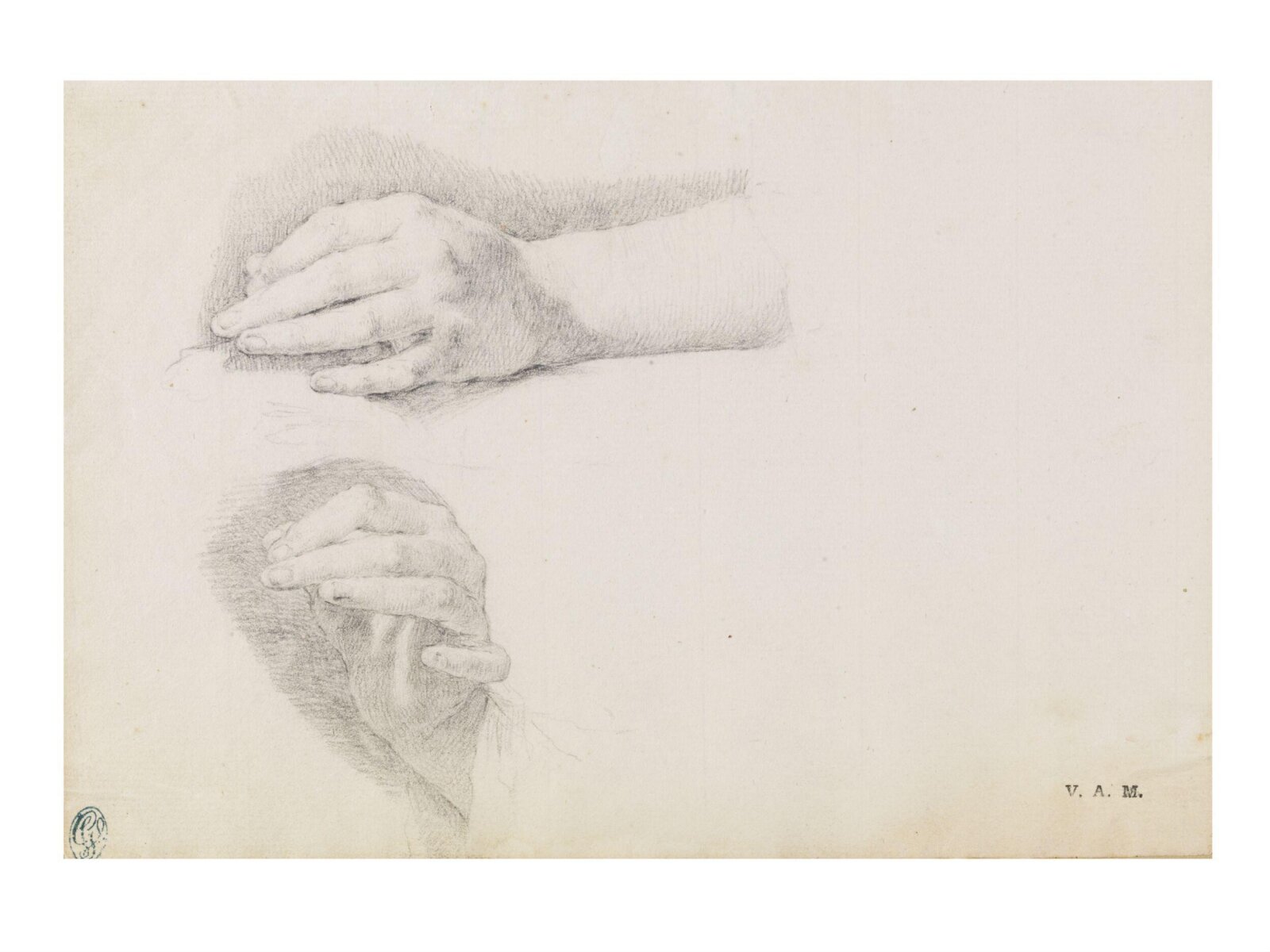
Between 1762 and 1766, Angelica Kauffman (1741-1807) worked in Florence and Rome, where she sketched not only art and antiquities but also many of the artists and antiquarians who flocked to Italy from across Europe to make the Grand Tour. Tourists often concluded their trip to Rome by commissioning a portrait. Her drawings include portraits of the artists Nathaniel Dance (1735-1811), Benjamin West (1738-1820), and art historian Johann Joachim Winckelmann (1717-1768). The sketchbook also contains a series of landscape studies, preparatory studies for prints, drapery studies and drawings of hands and arms, capturing Kauffman’s ongoing experiments with light and gesture as she honed her skills. In 1800, the drawings entered the collection of G. Vallardi, a print dealer in Milan who was an active patron of neoclassical art. Vallardi pasted the various sized drawings into a bound volume. His collector’s mark appears on almost all the drawings except for numbers 92, 94, 103, 108, 130-136, which are unlikely to be by Kauffman.
Victoria and Albert Museum
Gegevens
- Inventarisnummer
- E.358-1927
In de catalogus
Bronnen
- Victoria and Albert Museum
- Afbeelding: Victoria and Albert Museum — © Victoria and Albert Museum, London
Intussen, in het leven van Angelica Kauffmann
Het hele levenJanuary 1763
Meets the English community in Rome
Moving to Rome in January 1763, Kauffman was introduced to the British community there; as she learned more English and continued with portraiture, she became a popular portraitist for British visitors to Rome.
1764
Her portrait of Winckelmann
In Rome Kauffman painted a half-length portrait of the art historian Johann Joachim Winckelmann and also made an etching of it; in August 1764 Winckelmann wrote to a friend about her popularity: she spoke Italian and German, handled French and English with ease, could be called beautiful, and in singing could vie with the best virtuosi.
1766
Friendship with Joshua Reynolds
Reynolds became Kauffman’s firmest friend: in his pocketbooks she often appears as “Miss Angelica” or “Miss Angel”; in 1766 he painted her portrait, and she answered with her portrait of Reynolds.
June 1766
Arrives in London
In June 1766 Kauffman arrived in London, having been persuaded by Lady Wentworth to go with her. Lady Wentworth’s rank opened society to her, and the royal family showed her particular favour.
1767
Marries the impostor “Count de Horn”
In 1767 Kauffman married an impostor calling himself Count Frederick de Horn; the marriage ended in scandal: by one account it was declared void within a few months, by another the couple separated the following year.
December 1768
Founding member of the Royal Academy of Arts
In December 1768 Kauffman became one of the founding members of the Royal Academy of Arts in London, one of only two women among them.