Joseph Mallord William TurnerVerenigd Koninkrijk, 1775–1851
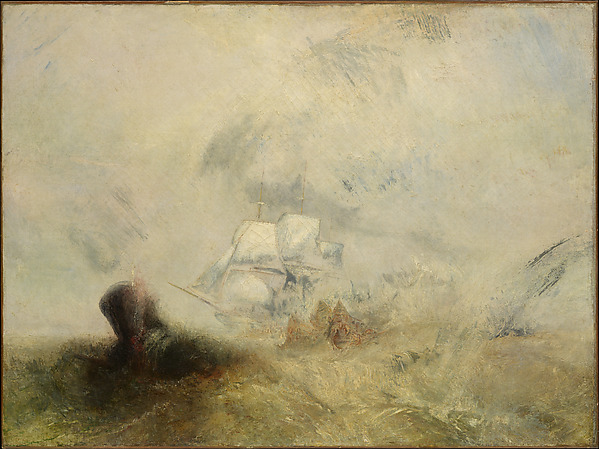
Disaster at Sea
Kan ik het zien?
Onbekend
Waar is „Disaster at Sea” nu? Collectie: National Gallery, Londen. Onbekend.

Londen, Verenigd Koninkrijk
De eigenaar is bekend; of het werk nu te zien is, is onbekend.
- Ongewijzigd sinds
- Bron
- Het museum
Over het schilderij
A Disaster at Sea is a c. 1835 seascape painting by the British artist J.M.W. Turner. It depicts a ship floundering at sea with those on board clinging desperately to the sinking vessel. The painting was never exhibited in Turner's lifetime and is likely to be unfinished, although by the latter stages of Turner's career his Romantic style became increasingly abstract and impressionist.
The work is generally held to be inspired by the loss of Amphitrite, a vessel carrying convicts being transported to Australia, off Boulogne in August 1833. It has also been suggested that it may have been based on Hibernia, a ship that caught fire in the Atlantic Ocean with too few lifeboats on board.
Lees meer
Stylistically and the thematically the painting draws on the 1819 work The Raft of the Medusa by Théodore Géricault which Turner had seen when it was displayed in London in the early 1820s. The painting was part of the Turner Bequest to the United Kingdom in 1856. It is now part of the collection of the Tate Britain in Pimlico.
Gegevens
- Inventarisnummer
- NG558
In de catalogus
Bronnen
- Wikidata
- Afbeelding: National Gallery — J. M. W. Turner · Public domain · Wikimedia Commons
In het leven van Joseph Mallord William Turner
Het hele leven1830–1840s
Criticism in the 1830s–1840s and Ruskin’s defence
His innovative works, bordering on abstraction, gave him a reputation for madness: the Victorian public preferred realism and sentimentality, and Queen Victoria refused to knight him. John Ruskin came to his defence, calling him “the greatest artist of all time”.
1833
Vienna and Venice: down the Danube, back by the Rhine
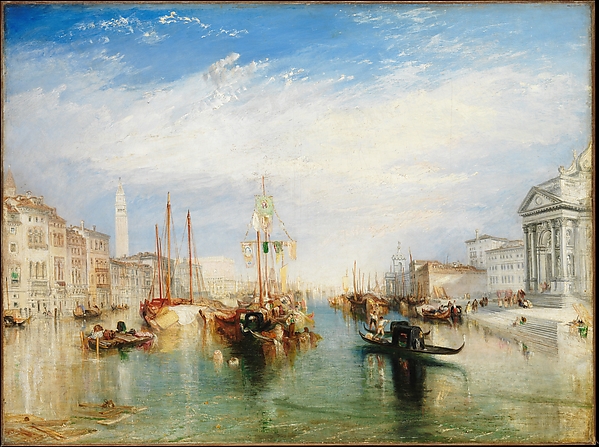
He visited Vienna and Venice, travelling down the Danube and returning via the Rhine; the trip to Venice inspired important works such as “Venice, from the Porch of Madonna della Salute” (1835), “Venice, the Bridge of Sighs” (1840) and “The Sun of Venice Going to Sea” (1843).
1835–1836
Denmark and Prussia, then Switzerland and the Val d’Aosta
In 1835 he visited Denmark, Prussia, Hamburg and Rotterdam, and in 1836 France and Switzerland, crossing the Alps into the Val d’Aosta valley.