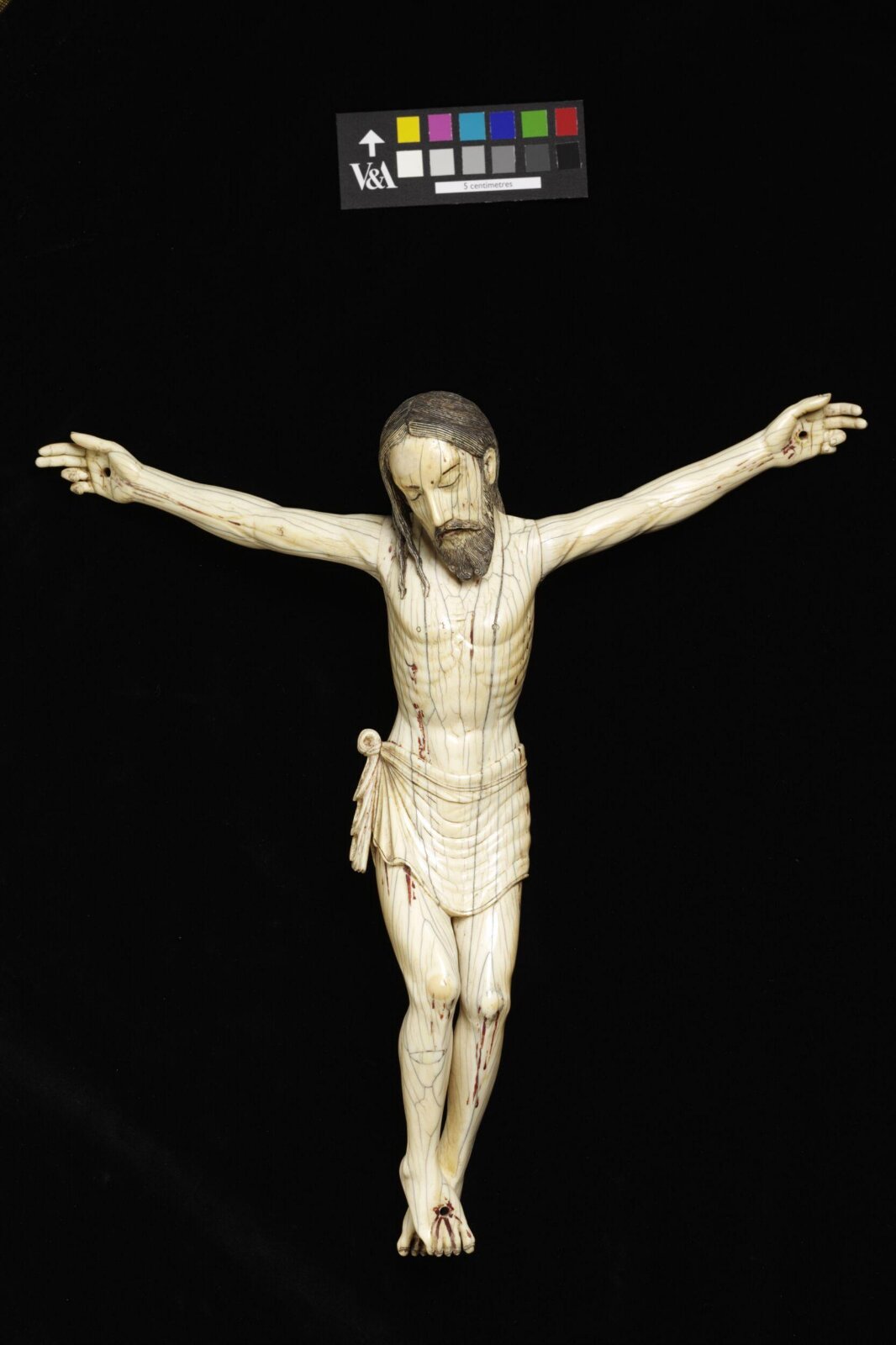
Crucified Christ
Mag men het zien?
Ja, het ontvangt bezoek

Victoria and Albert Museum
Londen, Verenigd Koninkrijk
ZaalSculpture, Room 111, The Gilbert Bayes Gallery
Publiek tentoongesteld. Wie daarvoor instaat, staat hieronder.
- Gecontroleerd
- 9 dagen geleden
- Ongewijzigd sinds
- 25 sep 2026
- Bron
- De eigen collectiegegevens van het museum
About the sculpture
This ivory was probably made in Ceylon (now Sri Lanka) for export to Portugal. The fine carving of folds on the drapery and delicate facial features are typical of Christian ivories made in Sri Lanka in the mid-17th century, when it was under Portuguese rule (other ivories were carved in Portuguese Goa on the West coast of India). Local artists specialising in ivory carving made such pieces, usually under the direction of Portuguese missionaries. Most of them were made as luxury items for export to Europe, although some were used to convert the local people to Catholicism. These pieces, whether made for export or for local use, were devotional objects, but would also have been highly valued as a work of art, partly because ivory was a rare and costly material. The sensitive carving seen here is typical of Sri Lankan ivory sculptures: the striated lines on the hair and parallel carved folds of the loincloth are particularly fine. Also characteristic of such works is the use of polychromy: brown pigment for the hair, gilding on the loincloth, and red for the blood from Christ's wounds.
Read on
Many colonial ivories were relatively large, a sign of the rich resources available in the territories conquered by the Europeans. The artists were anonymous, and the pieces undated, but the majority were made during the sixteenth and seventeenth centuries. The ivory was often imported to Sri Lanka from Africa (parts of which had also been invaded by the Portuguese in the sixteenth century), as the elephant tusks there were more suitable for carving.
Victoria and Albert Museum
Gegevens
- Inventarisnummer
- A.66-1927
What it shows
In de catalogus
Bronnen
- Victoria and Albert Museum: the museum's own open data · opgehaald 9 dagen geleden
- Afbeelding: Victoria and Albert Museum — © Victoria and Albert Museum, London