ART WIKI33.040 te zien
KaartCollectieKunstenaarsMuseaTentoonstellingenJournal
Inloggen

ART WIKI

Waar het meesterwerk hangt en wanneer men u toelaat.

Collecties: Art Institute of Chicago, Cleveland Museum of Art, Getty Villa, Harvard Art Museums, Hermitage, Hirshhorn Museum and Sculpture Garden, J. Paul Getty Museum, Louvre, Metropolitan Museum of Art, Minneapolis Institute of Art, Museum of Modern Art, National Gallery of Art, National Museum of Asian Art, National Portrait Gallery, Poesjkinmuseum, Rijksmuseum Amsterdam, Russisch Museum, Smithsonian American Art Museum, Statens Museum for Kunst, Tretjakovgalerij, Victoria and Albert Museum, Whitney Museum of American Art, Staatscatalogus van het Russische museumfonds (274 musea), Europeana (19 musea), Wikidata (6 musea), Paris Musées (12 musea) en Joconde, de museumdatabank van het Franse ministerie van Cultuur (495 musea). De afbeeldingen behoren toe aan hun rechthebbenden.

Rubrieken

  • Kaart
  • Zoeken
  • Collectie
  • Meesterwerken
  • Nu te zien
  • Kunstenaars

Meer

  • Musea & galerieën
  • Tentoonstellingen
  • Journal
  • Waar de gegevens vandaan komen
  • Privacy & cookies
StartpaginaKaartCatalogus
  1. Collectie/
  2. Rijksmuseum Amsterdam/
  3. Colofon
Colofon, Kitagawa Utamaro, 1804
Kitagawa Utamaro, portretKitagawa UtamaroJapan, 1754–1806

Colofon

1804 · page

Mag men het zien?

Onbekend

Rijksmuseum Amsterdam

Amsterdam, Nederland

De eigenaar is bekend; of het werk nu te zien is, is onbekend.

Bron
Het museum
Op de kaartMuseumpagina

Over het werk

Laatste pagina van deel twee van Utamaro`s boek: Gebeurtenissen in de lusthuizen gedurende het jaar.

Rijksmuseum Amsterdam

Gegevens

1804 · op 50-jarige leeftijd
17541806
Inventarisnummer
RP-P-1960-12A-23

In de catalogus

Foto’sNeoclassicismeRomantiek19e eeuw

Bronnen

  • Rijksmuseum Amsterdam
  • Afbeelding: Rijksmuseum Amsterdam — public domain

Intussen, in het leven van Kitagawa Utamaro

Het hele leven
  1. 1804

    Arrest and fifty days in manacles

    In 1804 Utamaro is imprisoned over prints of the sixteenth-century ruler Toyotomi Hideyoshi, depicted, in the authorities' view, “in an improper form”, and then manacled for fifty days, together with Tsukimaro, Toyokuni, Shuntei, Shun'ei and Jippensha Ikku; their publishers are heavily fined. It is probably the most famous case of censorship of the Edo period, and Utamaro appears to have been the most prominent of those punished.

  2. 1804

    The prints of Hideyoshi that angered the authorities

    The trigger was a wave of prints and books based on the “Ehon Taikōki”, an illustrated life of Hideyoshi (1797–1802): the authorities may have taken offence at historical figures being named and shown with their crests, which was prohibited, and at Hideyoshi being depicted with women of the pleasure quarters. Utamaro's censored prints include the daimyō Katō Kiyomasa lustily gazing at a Korean dancer, Hideyoshi holding the hand of his page Ishida Mitsunari in a sexually suggestive manner, and Hideyoshi with his five consorts viewing cherry blossoms at Daigo-ji temple.

  3. 1804–1806

    Never recovering from the arrest

    The arrest and imprisonment are held to have dealt Utamaro a severe psychological trauma: he could not recover from the shock, and the late period of his work is coloured by tragic tones. Soon after his release the artist died.

  4. 31 oktober 1806

    Died

Meer van Kitagawa Utamaro

Alle werken
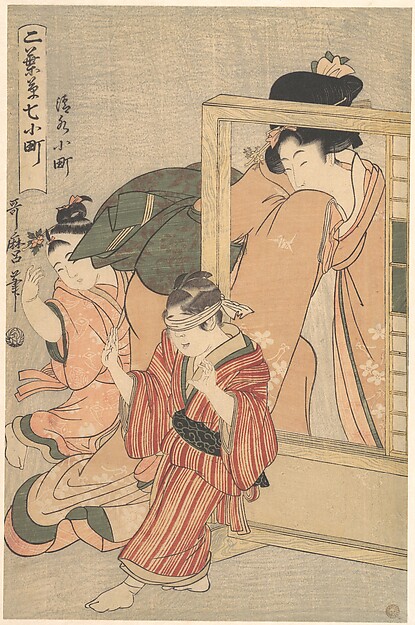
Kiyomizu Komachi, from the series Futabagusa nana Komachi, Kitagawa Utamaro, 1790s

Kiyomizu Komachi, from the series Futabagusa nana Komachi

1790s · Metropolitan Museum of Art

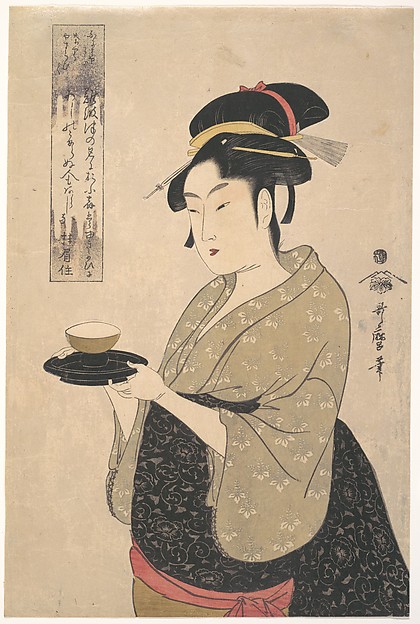
Okita of the Naniwa-ya Teahouse, Kitagawa Utamaro, ca. 1793

Okita of the Naniwa-ya Teahouse

ca. 1793 · Metropolitan Museum of Art

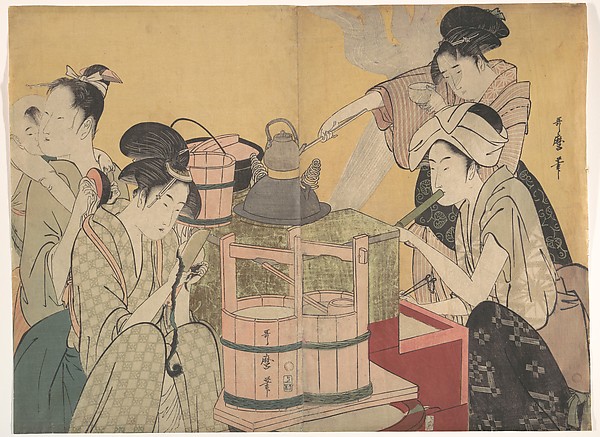
Kitchen Scene, Kitagawa Utamaro, ca. 1794–95

Kitchen Scene

ca. 1794–95 · Metropolitan Museum of Art

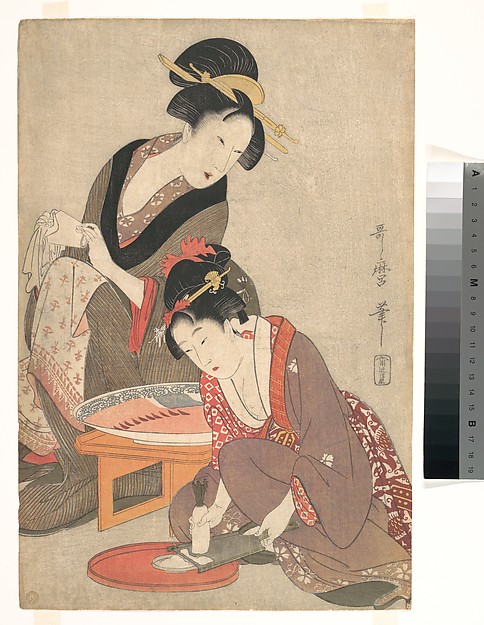
Women Grating Radish for Sashimi, Kitagawa Utamaro, ca. 1798–99

Women Grating Radish for Sashimi

ca. 1798–99 · Metropolitan Museum of Art

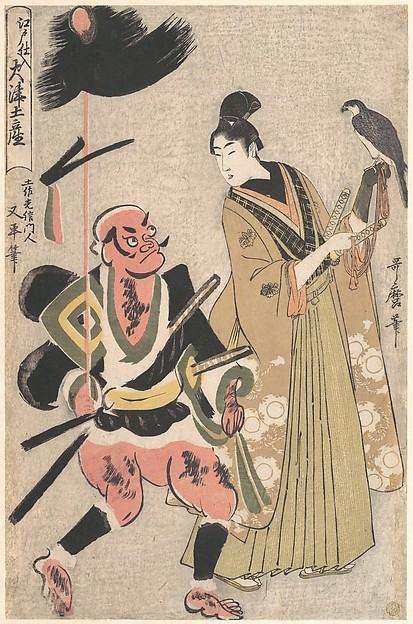
Foot-Soldier with a Spear and Hawk-Handler (Yari-mochi yakko to taka shō), from the series Souvenir Paintings from Ōtsu, Stocked in Edo (Edo Shi-ire Ōtsu Miyage), Kitagawa Utamaro, ca. 1802–3

Foot-Soldier with a Spear and Hawk-Handler (Yari-mochi yakko to taka shō), from the series Souvenir Paintings from Ōtsu, Stocked in Edo (Edo Shi-ire Ōtsu Miyage)

ca. 1802–3 · Metropolitan Museum of Art

Enjoying the Cool in a Garden, Kitagawa Utamaro, c. 1788/90

Enjoying the Cool in a Garden

c. 1788/90 · Art Institute of Chicago

House cleaning in preparation for the New Year, Kitagawa Utamaro, late 1790s

House cleaning in preparation for the New Year

late 1790s · Art Institute of Chicago

Seiro niwaka onna geisha no bu : Asazumabune Ogiuri Uta....., Kitagawa Utamaro, 1793

Seiro niwaka onna geisha no bu : Asazumabune Ogiuri Uta.....

1793 · Art Institute of Chicago

Buren in huis: Rijksmuseum Amsterdam

Museumpagina
Self-portrait, Vincent van Gogh, 1887

Vincent van Gogh

Self-portrait, 1887

La Corniche near Monaco, Claude Monet, 1884

Claude Monet

La Corniche bij Monaco, 1884

De Nachtwacht, Rembrandt van Rijn, 1642

Rembrandt van Rijn

De Nachtwacht, 1642

Portrait of a Woman, Probably Maria Trip (1619-1683), Rembrandt van Rijn, 1639

Rembrandt van Rijn

Portret van Maria Trip, 1639

Landscape with a Stone Bridge, Rembrandt van Rijn, c. 1638

Rembrandt van Rijn

Landschap met stenen brug, c. 1638

Man in Oriental Dress, Rembrandt van Rijn, 1635

Rembrandt van Rijn

Man in Oriental Dress, 1635

Portrait of Haesje Jacobsdr van Cleyburg, Rembrandt van Rijn, 1634

Rembrandt van Rijn

Portrait of Haesje Jacobsdr van Cleyburg, 1634

Jonge vrouw in gefantaseerde kleding, Rembrandt van Rijn, 1633

Rembrandt van Rijn

Jonge vrouw in gefantaseerde kleding, 1633