Joseph Mallord William TurnerVerenigd Koninkrijk, 1775–1851
Calais Pier
Mag men het zien?
Onbekend

National Gallery
Londen, Verenigd Koninkrijk
De eigenaar is bekend; of het werk nu te zien is, is onbekend.
- Ongewijzigd sinds
- Bron
- Het museum
Over het schilderij
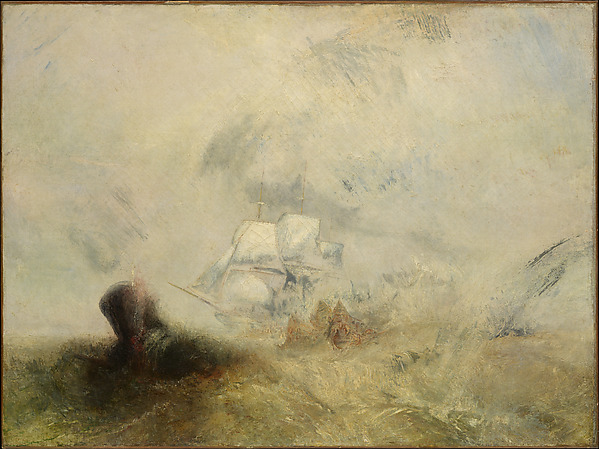
Calais Pier is a landscape painting by the British artist J. M. W. Turner, painted in 1803 and exhibited at the Royal Academy's Summer Exhibition the same year. The painting's full title is Calais Pier, with French Poissards preparing for Sea: an English Packet arriving. The painting shows a British packet boat arriving in the harbour.
The painting was inspired by a visit Turner made to Calais, France, the previous year when the Peace of Amiens led to a brief break in the French Revolutionary War against France. Having made the crossing during stormy weather, his ship was stuck outside the harbour for some time during which he made a number of sketches. After transferring to the pilot boat he nearly drowned while getting ashore. It was also a clever allusion to the concerns about the political situation in Europe.
Verder lezen
Turner's contemporary John Constable was privately critical of both this work and Turner's The Opening of the Vintage of Macon after viewing them at the Royal Academy, as he felt the artist had become "more and more extravagant and less attentive to nature". However, art critic John Ruskin later hailed it as the first painting to display "Turner's colossal power".
The work is now in the collection of the National Gallery having been part of the Turner Bequest of 1856.
Gegevens
- Inventarisnummer
- NG472
In de catalogus
Bronnen
- Wikidata
- Afbeelding: National Gallery — J. M. W. Turner · Public domain · Wikimedia Commons
Intussen, in het leven van Joseph Mallord William Turner
Het hele leven1801
The triumph of the “Bridgewater Sea Piece” at the Academy
“Dutch Boats in a Gale” (the “Bridgewater Sea Piece”), commissioned for 250 guineas by the Duke of Bridgewater, one of the richest men in England, “took the Academy by storm” and was hung in the best location of the whole exhibition: in the Great Room, centred, opposite the entrance.
1801
Birth of Evelina, Sarah Danby’s daughter
Turner never married, but is generally believed to have been the father of the two older daughters of his housekeeper, the widow Sarah Danby — Evelina (born 1801) and Georgiana; their discreet relationship lasted twelve years.
10 February 1802
Becomes a Royal Academician
On 10 February 1802 he was granted the title of Royal Academician, which gave him the right to exhibit without passing the selection committee that previewed all works.
1802–1803
Paris and the Swiss Alps in a year of peace
In the only year without war in Europe between 1793 and 1814 (the Peace of Amiens, 1802–1803) a consortium of noblemen sponsored a visit to Paris, where he saw old master paintings in the Louvre, and then he toured the Swiss Alps; his Alpine sketches later let him represent “the sublime” in paintings such as “Snow Storm: Hannibal and his Army Crossing the Alps” (1812).
1804
Opens his own gallery
Distrustful of dealers, he opened his own gallery so that he could sell directly and group the pictures he wanted seen together, something he could not control at the Royal Academy exhibitions; his father left his barbershop to help in the gallery and studio. For over a decade the gallery was a regular feature of the London exhibition season.
1804
His mother dies in Bethlem Hospital
His mother, Mary Marshall, whose symptoms of mental disorder grew worse, had to be placed by his father in St Luke’s Hospital for Lunatics; she was later moved to Bethlem Hospital, commonly known as “bedlam”, where she died in 1804.