 Beatrix Potter1866–1943
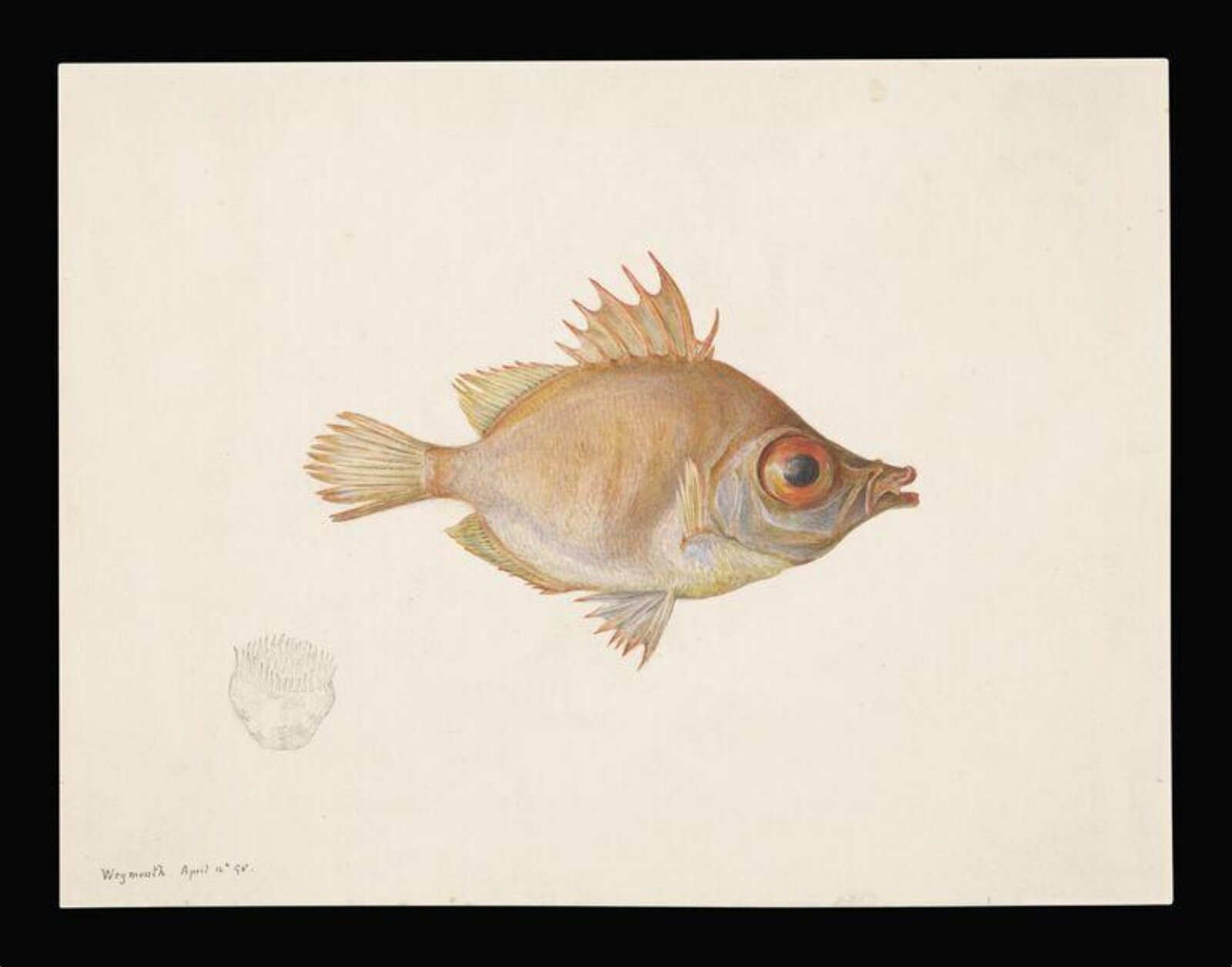
Boar fish
Mag men het zien?
Ontvangt momenteel niet

Victoria and Albert Museum
Londen, Verenigd Koninkrijk
Het hoort bij de collectie, maar is momenteel niet tentoongesteld.
- Gecontroleerd
- 9 dagen geleden
- Ongewijzigd sinds
- 25 sep 2026
- Bron
- De eigen collectiegegevens van het museum
Over het werk
Natural history was a topic of great interest to Beatrix Potter (1866-1943). She made numerous studies of animals and plants from life and her keen eye for observation is also reflected in her book illustrations. This vivid study of a Boar fish was made during a stay in Weymouth; in her journal entry for 14 April 1895 Potter recorded that she ‘picked up a strange little red fish which I painted’.
Beatrix Potter is one of the world's best-loved children's authors and illustrators. She wrote the majority of the twenty-three Original Peter Rabbit Books between 1901 and 1913. The Tale of Peter Rabbit (Frederick Warne, 1902) is her most famous and best-loved tale.
Victoria and Albert Museum
Gegevens
- Inventarisnummer
- BP.403
What it shows
In de catalogus
Bronnen
- Victoria and Albert Museum: the museum's own open data · opgehaald 9 dagen geleden
- Afbeelding: Victoria and Albert Museum — © Victoria and Albert Museum, London
Intussen, in het leven van Beatrix Potter
Het hele leven1881–1897
A journal in a cipher of her own
From 1881 Beatrix kept a journal in a simple substitution cipher of her own devising — in tiny handwriting, serving as both sketchbook and literary experiment, in which she described society, her impressions of art and the life around her. The entries stop in 1897, when her energies were absorbed in scientific study and in efforts to publish her drawings.
1890–1894
First commissions: cards, rabbits and frogs
In the 1890s Beatrix printed Christmas and other greeting cards of her own design — her first commercially successful works. In 1890 the firm of Hildesheimer and Faulkner bought several drawings of her rabbit Benjamin Bunny to illustrate Frederic Weatherly’s verses “A Happy Pair”, in 1893 several more for “Our Dear Relations”, and in 1894 the publisher Ernest Nister took a series of frog illustrations and verses for the annual “Changing Pictures”.
September 1893
A letter to Noel Moore about four rabbits
In September 1893, on holiday at Eastwood near Dunkeld, Beatrix ran out of things to write to Noel, the often-ill eldest son of her former governess Annie Carter Moore, and told him a story about “four little rabbits whose names were Flopsy, Mopsy, Cottontail, and Peter”. It became one of the most famous children’s letters ever written and the basis of her future career; it was Annie who later suggested that such letters might make good children’s books.
1895–1897
A theory of spore germination, and Kew Gardens
In 1895, curious about how fungi reproduce, Beatrix began microscopic drawings of agaric spores and developed a theory of their germination. Through her uncle, the chemist Sir Henry Roscoe, she consulted botanists at Kew and convinced George Massee of her ability to germinate spores, but William Thiselton-Dyer, the director of Kew, rebuffed her because of her sex and amateur status.
1897
A paper for the Linnean Society
In 1897 Beatrix submitted a paper, “On the Germination of the Spores of the Agaricineae”, to the Linnean Society, but as a woman she could neither attend the meeting nor read it herself — George Massee introduced it. She later withdrew it on realising that some of her samples were contaminated, yet she continued her microscopic studies for several more years.