 Joseph Mallord William TurnerVerenigd Koninkrijk, 1775–1851
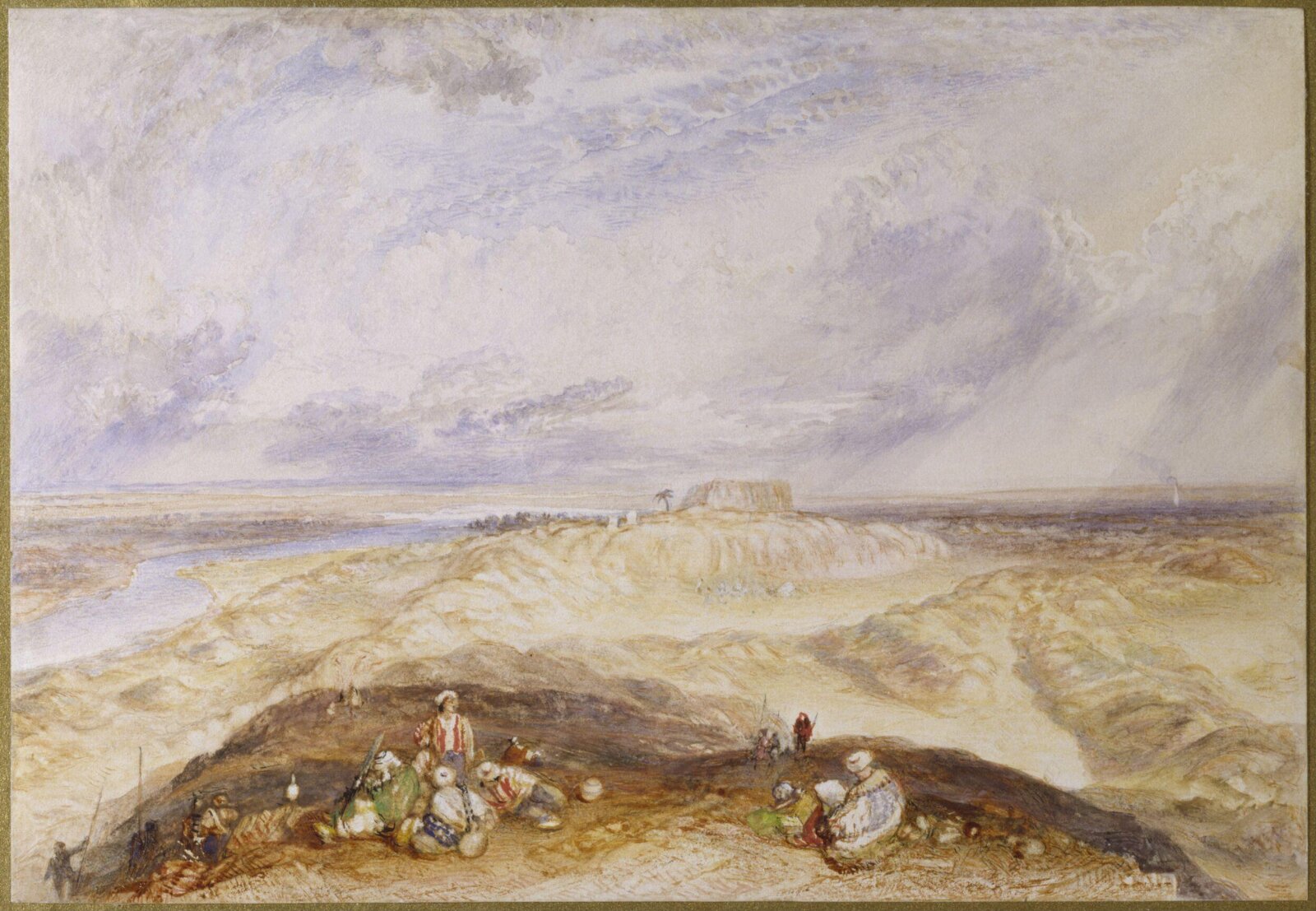
Babylon
Mag men het zien?
Ontvangt momenteel niet

Londen, Verenigd Koninkrijk
Het hoort bij de collectie, maar is momenteel niet tentoongesteld.
- Gecontroleerd
- Ongewijzigd sinds
- Bron
- Het museum
Over het werk
This watercolour, showing a rocky landscape outside the ancient biblical city of Babylon, was based upon a drawing by Sir Robert Ker Porter, and itself became the basis of an engraving for an illustrated Bible. Sir Robert Ker Porter (1777-1842) was a founder-member of a group of young painters called the Brothers, who wished to establish a tradition of history painting in Britain. Turner himself may have been a later member.
Victoria and Albert Museum
Gegevens
- Inventarisnummer
- 982-1900
Wat het toont
In de catalogus
Bronnen
- Victoria and Albert Museum
- Afbeelding: Victoria and Albert Museum — © Victoria and Albert Museum, London
Intussen, in het leven van Joseph Mallord William Turner
Het hele leven4 November 1799
Elected an associate of the Royal Academy
On 4 November 1799 Turner, by then a popular artist, was elected an associate (corresponding) member of the Royal Academy.
1801
The triumph of the “Bridgewater Sea Piece” at the Academy
“Dutch Boats in a Gale” (the “Bridgewater Sea Piece”), commissioned for 250 guineas by the Duke of Bridgewater, one of the richest men in England, “took the Academy by storm” and was hung in the best location of the whole exhibition: in the Great Room, centred, opposite the entrance.
10 February 1802
Becomes a Royal Academician
On 10 February 1802 he was granted the title of Royal Academician, which gave him the right to exhibit without passing the selection committee that previewed all works.
1802–1803
Paris and the Swiss Alps in a year of peace
In the only year without war in Europe between 1793 and 1814 (the Peace of Amiens, 1802–1803) a consortium of noblemen sponsored a visit to Paris, where he saw old master paintings in the Louvre, and then he toured the Swiss Alps; his Alpine sketches later let him represent “the sublime” in paintings such as “Snow Storm: Hannibal and his Army Crossing the Alps” (1812).
1819
First journey through Italy
He visited Turin, Milan, Rome, Venice and Naples, studying the works of Titian, Tintoretto, Raphael and contemporary Italian artists; after the trip his painting became brighter, his palette more intense, with primary colours predominating, and the Venetian theme took a special place in his work.
19 december 1851
Died