ART WIKI32.963 te zien
KaartCollectieKunstenaarsMuseaTentoonstellingenJournal
Inloggen

ART WIKI

Waar het meesterwerk hangt en wanneer men u toelaat.

Collecties: Art Institute of Chicago, Cleveland Museum of Art, Getty Villa, Harvard Art Museums, Hermitage, Hirshhorn Museum and Sculpture Garden, J. Paul Getty Museum, Louvre, Metropolitan Museum of Art, Minneapolis Institute of Art, Museum of Modern Art, National Gallery of Art, National Museum of Asian Art, National Portrait Gallery, Poesjkinmuseum, Rijksmuseum Amsterdam, Russisch Museum, Smithsonian American Art Museum, Statens Museum for Kunst, Tretjakovgalerij, Victoria and Albert Museum, Whitney Museum of American Art, Staatscatalogus van het Russische museumfonds (274 musea), Europeana (19 musea), Wikidata (6 musea), Paris Musées (12 musea) en Joconde, de museumdatabank van het Franse ministerie van Cultuur (495 musea). De afbeeldingen behoren toe aan hun rechthebbenden.

Rubrieken

  • Kaart
  • Zoeken
  • Collectie
  • Meesterwerken
  • Nu te zien
  • Kunstenaars

Meer

  • Musea & galerieën
  • Tentoonstellingen
  • Journal
  • Waar de gegevens vandaan komen
  • Privacy & cookies
StartpaginaKaartCatalogus
  1. Collectie/
  2. Harvard Art Museums/
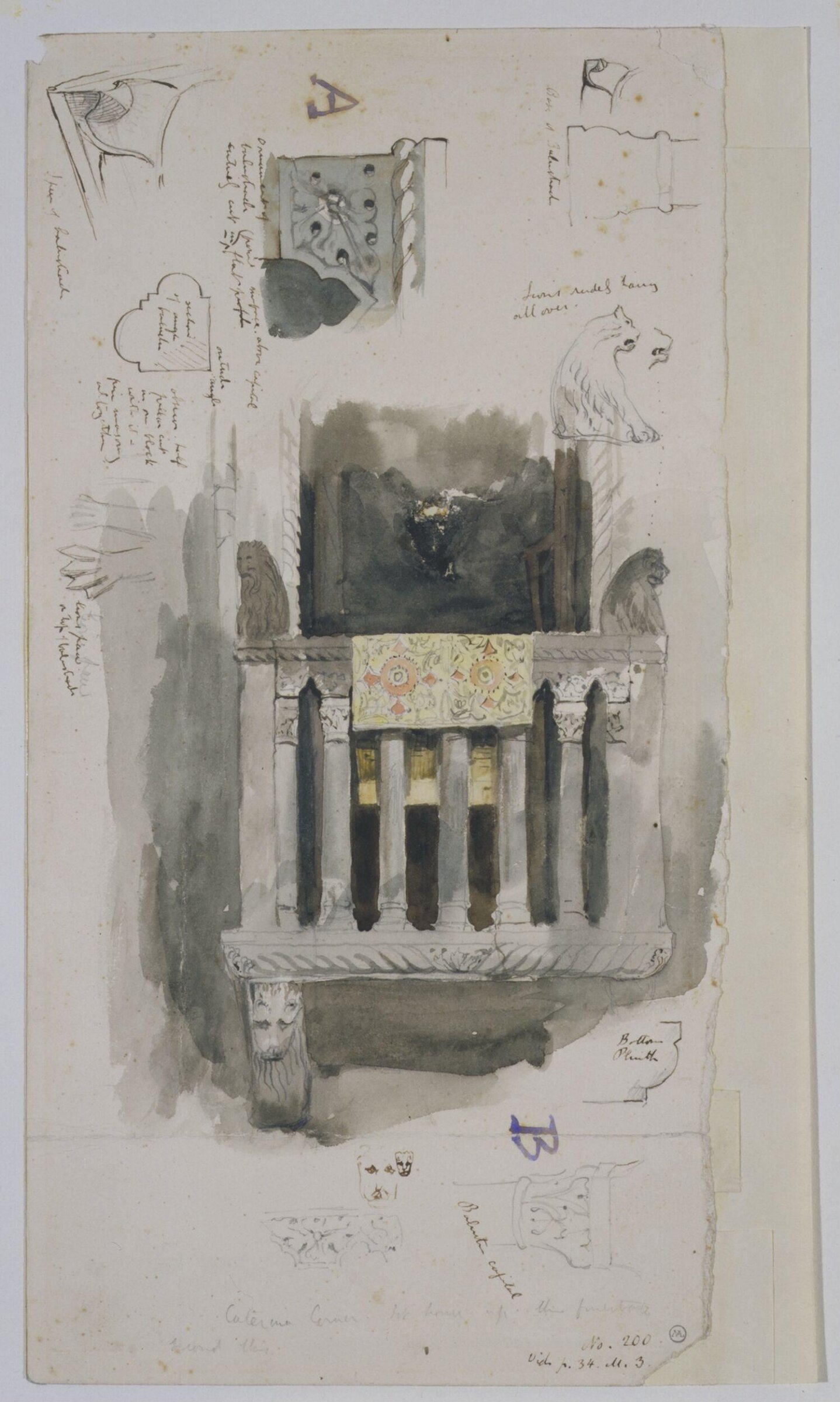
  3. Architectural Sketch, Venice
Architectural Sketch, Venice, John Ruskin, 1850
John Ruskin, portretJohn RuskinEngeland, 1819–1900

Architectural Sketch, Venice

1850 · Drawing

Mag men het zien?

Ontvangt momenteel niet

Harvard Art Museums

Cambridge, Verenigde Staten

Het hoort bij de collectie, maar is momenteel niet tentoongesteld.

Gecontroleerd
3 dagen geleden
Ongewijzigd sinds
27 sep 2026
Bron
Het museum
Op de kaartMuseumpagina

Gegevens

1850 · op 31-jarige leeftijd
18191900
Inventarisnummer
1957.186

In de catalogus

Tekeningen & aquarellenAquarelRealisme19e eeuwVerenigd Koninkrijk

Bronnen

  • Harvard Art Museums
  • Afbeelding: Harvard Art Museums — © President and Fellows of Harvard College

Intussen, in het leven van John Ruskin

Het hele leven
  1. 1834–1900 · Werkzaam in

    Great Britain

  2. 10 april 1848

    Married: Effie Gray

  3. 1849

    “The Seven Lamps of Architecture”, the first book to bear his name

    His growing interest in Gothic architecture produces a book with fourteen plates etched by the author: seven moral categories — sacrifice, truth, power, beauty, life, memory and obedience — that Ruskin considers vital to and inseparable from all architecture. It promotes a secular and Protestant form of Gothic and challenges the Catholic influence of the architect A. W. N. Pugin.

  4. November 1849

    In Venice with Effie: the sketches behind “The Stones of Venice”

    In November 1849 the couple stay at the Hotel Danieli: Effie looks for company, while Ruskin works alone and hurries to draw the Ca' d'Oro and the Doge's Palace, fearing that the occupying Austrian troops will destroy them. These sketches and notes will grow into “The Stones of Venice”.

  5. May 1851

    Letters to The Times defending the Pre-Raphaelites

    Millais and his fellow artists approach Ruskin through their mutual friend Coventry Patmore; Millais's “Christ in the House of His Parents” (1849–50), which some considered blasphemous, at first fails to impress him, but in May 1851 he writes letters to The Times defending the Pre-Raphaelite Brotherhood.

  6. 1851–1853

    The three-volume “Stones of Venice”

    Growing from a technical history of Venetian architecture, from the Byzantine to the Renaissance, into a broad cultural history, the work is a warning to contemporary England about the moral and spiritual health of society: Ruskin explains the decline of Venice by the loss of true Christian faith. The chapter “The Nature of Gothic” from the second volume — a critique of the division of labour and industrial capitalism — will be published by William Morris as a separate book.
Meer van John Ruskin

Alle werken
Architectural details from the Sagredo Palace, Venice, John Ruskin, 19th century

Architectural details from the Sagredo Palace, Venice

19th century · Victoria and Albert Museum

View of Amalfi, John Ruskin, 1844

View of Amalfi

1844 · Harvard Art Museums

Fragment of the Alps, John Ruskin, c. 1854-1856

Fragment of the Alps

c. 1854-1856 · Harvard Art Museums

Tree Study, John Ruskin, mid-1850s

Tree Study

mid-1850s · Niet te zien · National Gallery of Art

Gezicht op S. Anastasia te Verona, over de Adige, John Ruskin, 1829 - 1900

Gezicht op S. Anastasia te Verona, over de Adige

1829 - 1900 · Rijksmuseum Amsterdam

Bergkam aan het Meer van Genève, John Ruskin, 1829 - 1900

Bergkam aan het Meer van Genève

1829 - 1900 · Rijksmuseum Amsterdam

The Garden of San Miniato near Florence, John Ruskin, 1845

The Garden of San Miniato near Florence

1845 · Niet te zien · National Gallery of Art

Tower of the Cathedral at Sens, John Ruskin, c. 1845

Tower of the Cathedral at Sens

c. 1845 · Niet te zien · National Gallery of Art

Buren in huis: Harvard Art Museums

Museumpagina
Glück auf in Deutschland (N:4), Pınar Öğrenci, 2024

Pınar Öğrenci

Glück auf in Deutschland (N:4), 2024

Glück auf in Deutschland (N:10), Pınar Öğrenci, 2024

Pınar Öğrenci

Glück auf in Deutschland (N:10), 2024

Glück auf in Deutschland (N:7b), Pınar Öğrenci, 2024

Pınar Öğrenci

Glück auf in Deutschland (N:7b), 2024

Glück auf in Deutschland (N:6), Pınar Öğrenci, 2024

Pınar Öğrenci

Glück auf in Deutschland (N:6), 2024

Glück auf in Deutschland (N:11), Pınar Öğrenci, 2024

Pınar Öğrenci

Glück auf in Deutschland (N:11), 2024

Dwarpalika (Temple Guardian), Sneha Shrestha, 2023

Sneha Shrestha

Dwarpalika (Temple Guardian), 2023

The Eternal Pond of the Universe, Bingyi 冰逸, 2022-2024

Bingyi 冰逸

The Eternal Pond of the Universe, 2022-2024

Head from a Statue of Ur-Ningirsu, Ruler of Lagash, c. 2113 BCE-2017 BCE

Head from a Statue of Ur-Ningirsu, Ruler of Lagash, c. 2113 BCE-2017 BCE