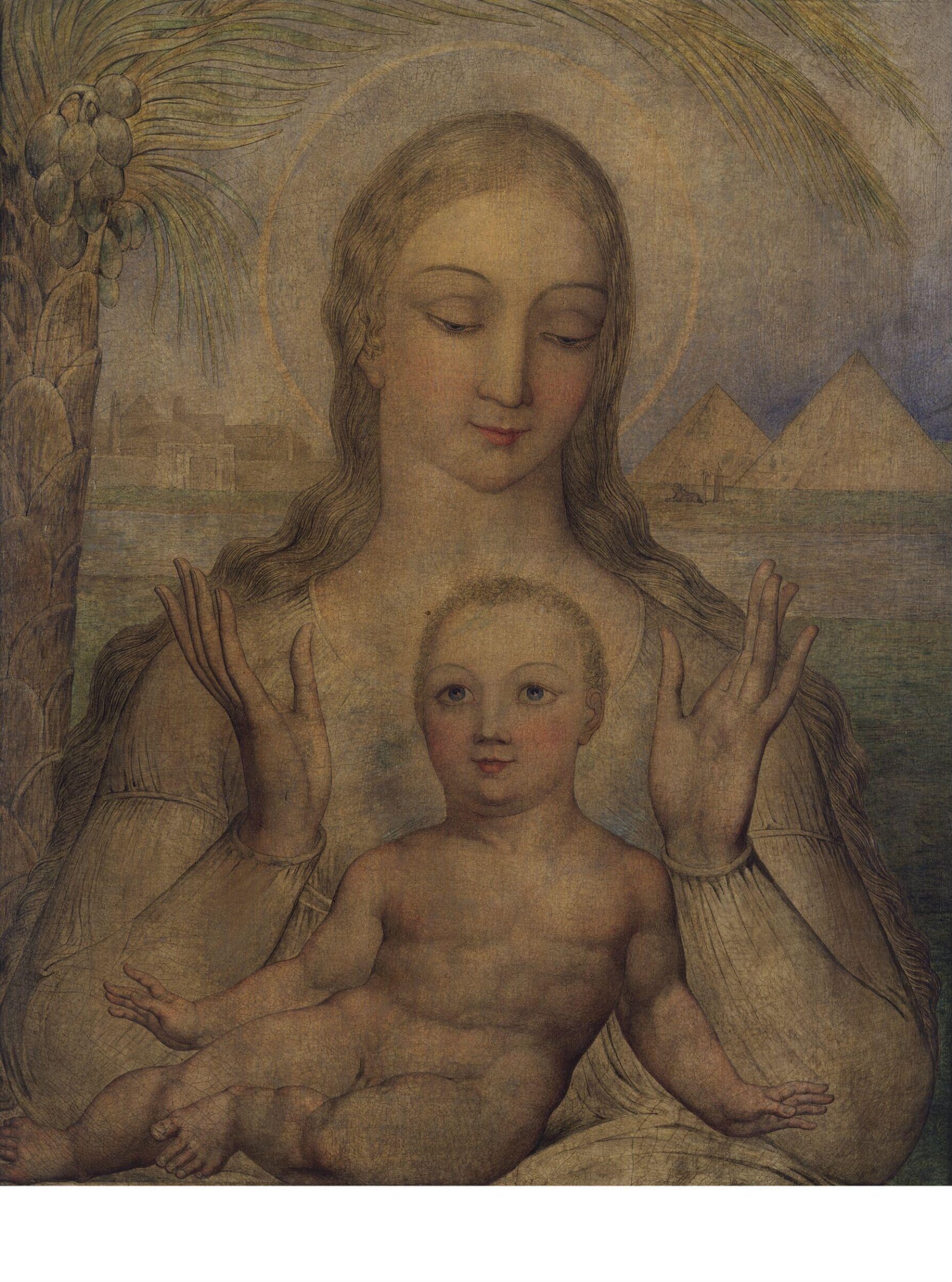
William BlakeVerenigd Koninkrijk, 1757–1827
Agony in the Garden
Kan ik het zien?
Onbekend
Waar is „Agony in the Garden” nu? Collectie: National Gallery, Londen. Onbekend.

Londen, Verenigd Koninkrijk
De eigenaar is bekend; of het werk nu te zien is, is onbekend.
- Ongewijzigd sinds
- Bron
- Het museum
Over het schilderij
The Agony in the Garden is a small painting by William Blake, completed as part of his 1799–1800 series of Bible illustrations commissioned by his patron and friend Thomas Butts. The work illustrates a passage from the Gospel of Luke which describes Christ's turmoil in the Garden of Gethsemane before his arrest and Crucifixion following Judas's betrayal. In Blake's painting a brilliantly coloured and majestic angel breaks through the surrounding darkness and descends from a cloud to aid and physically support Jesus in his hour of agony. The work is dominated by vertical lines, formed both from the trees and from the two arms of the angel. Two inner lines converge on Christ's palms, evoking the nails driven through him during his crucifixion.
Lees meer
The Agony in the Garden was bequeathed by Blake collector Graham Robertson to the National Trust in 1948. It was acquired by the Tate Gallery the following year.
Gegevens
- Inventarisnummer
- NG5894
In de catalogus
Bronnen
- Wikidata
- Afbeelding: National Gallery — William Blake · Public domain · Wikimedia Commons
In het leven van William Blake
Het hele leven28 november 1757
Born
1757–1782 · Woonplaats
Broadwick Street
1767 · Opleiding
Henry Pars Drawing School
augustus 1779 · Opleiding
Royal Academy of Arts
18 August 1782
Marries Catherine Boucher
On 18 August 1782, at St Mary's Church, Battersea, Blake married Catherine Boucher, who was five years his junior; illiterate, she signed the marriage contract with an X. The marriage was successful, and Catherine became his “partner in both life and work”, working as an engraver and colourist.
1788
Invents relief etching
In 1788, aged 31, Blake invented relief etching, or “illuminated printing”: text and designs are drawn on a copper plate in acid-resistant ink and etched so that the protected areas stand in relief, and the printed pages are coloured by hand in watercolours. He used it for most of his well-known works, including “Songs of Innocence and of Experience”, “The Book of Thel”, “The Marriage of Heaven and Hell” and “Jerusalem”.