Man Ray미국, 1890–1976
Untitled
볼 수 있나요?
현재 전시하지 않습니다
〈Untitled〉는 지금 어디에 있나요? 소장처: 시카고 미술관, 시카고. 현재 전시하지 않습니다. 확인일 2026년 11월 2일.

시카고, 미국
소장품이지만 현재 전시하지 않습니다.
- 확인일
- 이 상태가 시작된 날짜
- 출처
- 미술관
작품 소개
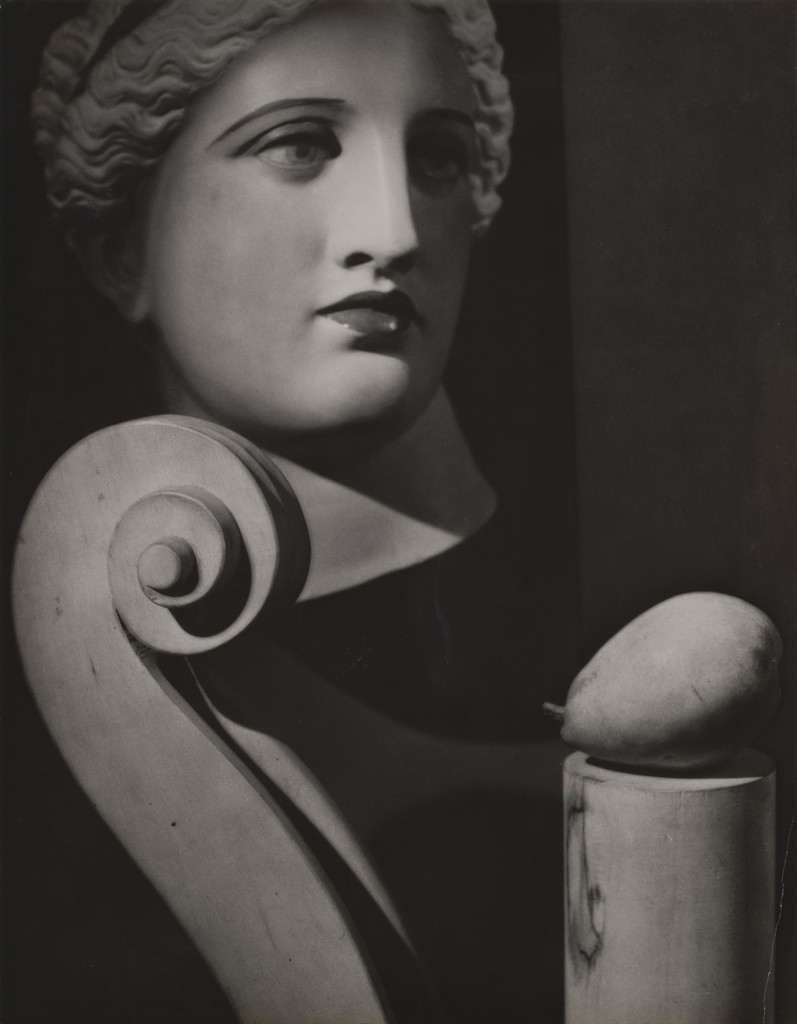
In late 1921 the American Dada painter and photographer Man Ray produced his first photograms—photographs made without a camera by placing objects on a sheet of light-sensitive paper, then exposing the arrangement to light. He claimed to have stumbled upon the process, which he dubbed “Rayographs,” by chance; it turned out to be an appropriate method for an artist who looked to accidental and automatic occurrences for inspiration. With unexpected combinations of everyday objects, Rayographs articulated a key Dada interest in homemade, “anti-art” reworkings of industrial and consumer society. Man Ray frequently used translucent items like glass bottles, filmstrips, and feathers, valuing their gradation of tones and illusion of three-dimensionality. “They looked startlingly new and mysterious,” he later wrote. With these cameraless images, photography straddled the line between abstraction and representation. Dada leader Tristan Tzara called them “pure Dada creations.”
시카고 미술관CC BY 4.0
상세 정보
- 소장품 번호
- 1979.99
그림에 담긴 것
목록에 등록됨
출처
- 시카고 미술관
- 이미지: 시카고 미술관 — © the artist or rights holder
Man Ray의 생애 속 이 작품
생애 전체 보기1920s
A photography studio: portraits of Paris bohemia
Convinced that he cannot make a living from his art alone, Ray buys a camera and opens a studio; he creates a series of famous photographic portraits of Erik Satie, James Joyce, Gertrude Stein and Jean Cocteau.
1921
His first Paris exhibition at the Galerie Six
Ray's first solo exhibition in Paris is held at the Galerie Six, organised by Philippe Soupault; for it he creates his first Dadaist work in France, The Gift (Le Cadeau).
c. 1921
Rayographs: photograms without a camera
His accidental rediscovery of the cameraless photogram, which he calls 'rayographs', produces images hailed by Tristan Tzara as 'pure Dada creations'.
c. 1921
Meeting Kiki de Montparnasse
Shortly after arriving in Paris Ray meets and falls in love with Alice Prin, known as Kiki de Montparnasse, an artists' model and celebrated figure of Paris bohemian circles. She remains his companion for most of the 1920s, the subject of some of his most famous photographs, and stars in his films Le Retour à la raison and L'Étoile de mer.
1921
Moving to Paris, Montparnasse
In July 1921 Ray goes to live and work in Paris, settling in the Montparnasse quarter favoured by many artists.
1925
The first Surrealist exhibition at the Galerie Pierre
Ray is represented in the first Surrealist exhibition at the Galerie Pierre in Paris, alongside Jean Arp, Giorgio de Chirico, Max Ernst, Georges Malkine, André Masson, Joan Miró and Pablo Picasso.