Ferdinand Hodler스위스, 1853–1918
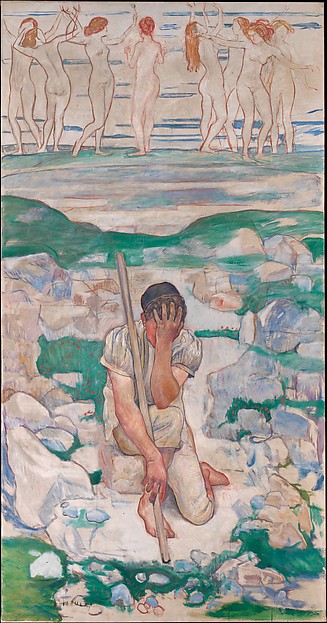
Study for Day (Truth)
볼 수 있나요?
현재 전시하지 않습니다
〈Study for Day (Truth)〉는 지금 어디에 있나요? 소장처: 시카고 미술관, 시카고. 현재 전시하지 않습니다. 확인일 2026년 11월 9일.

시카고, 미국
소장품이지만 현재 전시하지 않습니다.
- 확인일
- 이 상태가 시작된 날짜
- 출처
- 미술관
작품 소개
The artist’s wife, Berthe Jacques, served as the model for this preliminary study for the Art Institute’s painting Day (Truth). Hodler would often have his models pose behind a wooden frame with a grid of threads stretched across it—a method first described by the artist Albrecht Dürer in the 16th century. This allowed Hodler to accurately check the subject’s proportions and measurements against the drawing, which was also outlined with a grid.
시카고 미술관CC BY 4.0
상세 정보
- 소장품 번호
- 2004.1117
목록에 등록됨
출처
- 시카고 미술관
- 이미지: 시카고 미술관 — CC0
Ferdinand Hodler의 생애 속 이 작품
생애 전체 보기1894
Meets Berthe Jacques
In 1894 Hodler met Berthe Jacques (1868–1957); in 1898 she became his second wife.
16 May 1896
Filmed by the Lumière brothers
On 16 May 1896, the opening day of the National Exhibition in Geneva, Hodler was filmed by the Lumière brothers for a documentary in the “Swiss Village”, where he was showing 26 painted façade panels.
1897
Frescoes for the Swiss National Museum
In 1897 Hodler accepted a commission for a series of large frescoes for the Weapons Room of the Swiss National Museum in Zurich. His proposed compositions — including The Battle of Marignano, a battle the Swiss lost — proved controversial, and he was not allowed to execute the frescoes until 1900.
1897
The lecture “La Mission de l'artiste”
In 1897 Hodler first made his theory of “parallelism” public, in the manuscript of his lecture La Mission de l'artiste.