Raphael이탈리아, 1483–1520
Oddi Altarpiece
볼 수 있나요?
확인되지 않았습니다
〈Oddi Altarpiece〉는 지금 어디에 있나요? 소장처: 바티칸 박물관, Vatican City. 오늘 전시 중인지는 확인되지 않았습니다.
Vatican City, 바티칸 시국
소장자는 확인됐으나 오늘 전시 중인지는 알 수 없습니다.
- 이 상태가 시작된 날짜
- 출처
- 미술관
그림 소개
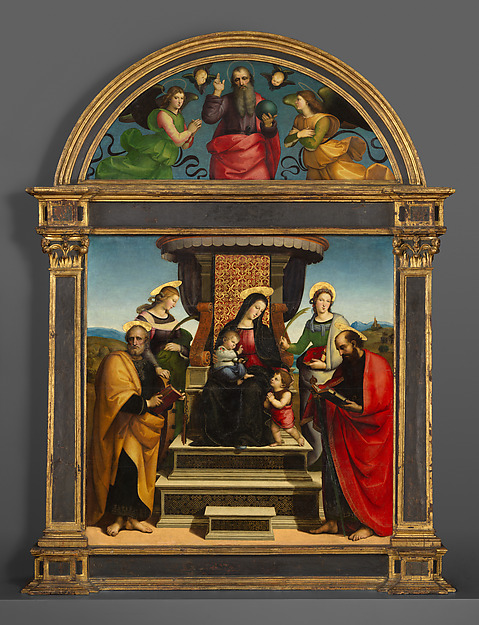
The Oddi Altarpiece, or more correctly the degli Oddi altarpiece, is an altarpiece of the Coronation of the Virgin painted in 1502-1504 by the Italian Renaissance master Raphael for the altar of the Oddi family chapel in the church of San Francesco al Prato in Perugia, Italy, now in the Vatican Pinacoteca. The altarpiece was commissioned for the Oddi family chapel in San Francesco al Prato in Perugia, was taken to Paris in 1797 (for the Musée Napoleon) and in 1815 brought back to Italy, not to Perugia but to the Vatican Pinacoteca.
The altarpiece was commissioned by Leandra Baglioni, widow of Simone degli Oddi; in Perugia there were different Oddi and degli Oddi families, but English sources often ignore this, including the English version of the Vatican Museums website.
상세 정보
목록에 등록됨
출처
- 위키데이터
- 이미지: 바티칸 박물관 — Raphael · Public domain · Wikimedia Commons
Raphael의 생애 속 이 작품
생애 전체 보기1500
Called a master at seventeen
In December 1500 Raphael is first described as a “master”, that is, fully trained. His first documented work was the Baronci Altarpiece for the church of Saint Nicholas of Tolentino in Città di Castello, commissioned in 1500 and finished in 1501; only fragments survive.
1501
In Perugino's workshop
From 1501 Raphael studied and worked in Pietro Perugino's workshop in Perugia; according to Vasari, his early works cannot be told apart from his master's. He often travelled home to Urbino, to Città di Castello and, with Pinturicchio, to Siena.
c. 1501 – c. 1502 · 작업 장소
Perugia
late 1504
Meets Leonardo and Michelangelo
Having moved to Florence, Raphael met Leonardo da Vinci, Michelangelo and Bartolomeo della Porta and closely studied Leonardo's sfumato. His first Florentine commission, portraits of Agnolo Doni and his wife, was painted under the clear impression of the “Mona Lisa”.
1504
Friendship with Baldassare Castiglione
In Urbino Raphael met the philosopher, writer and patron Count Baldassare Castiglione; they formed a firm friendship and correspondence, including the famous letters about the fresco “The Triumph of Galatea”.
1504
To Florence, to study
The mother of the next Duke of Urbino gave Raphael a letter of recommendation to the Gonfaloniere of Florence: “The bearer of this will be found to be Raphael, painter of Urbino, who, being greatly gifted in his profession has determined to spend some time in Florence to study.” She called him “a sensible and well-mannered young man”.