Berthe Morisot프랑스, 1841–1895
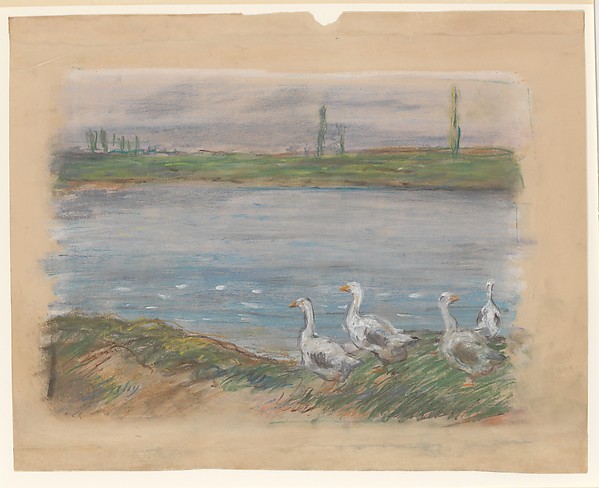
Goose
볼 수 있나요?
현재 전시하지 않습니다
〈Goose〉는 지금 어디에 있나요? 소장처: 메트로폴리탄 미술관, 뉴욕. 현재 전시하지 않습니다. 확인일 2026년 11월 11일.

뉴욕, 미국
소장품이지만 현재 전시하지 않습니다.
- 확인일
- 이 상태가 시작된 날짜
- 출처
- 미술관
상세 정보
- 소장품 번호
- 22.60.92
그림에 담긴 것
목록에 등록됨
출처
- 메트로폴리탄 미술관
- 이미지: 메트로폴리탄 미술관 — Open Access (CC0)
Berthe Morisot의 생애 속 이 작품
생애 전체 보기1885–1887
A turn to drawing: line and form
After 1885 drawing begins to dominate Morisot's work: she experiments with charcoal and coloured pencils and clarifies form and line, influenced by photography and Japonism. Like the Japanese prints of the time, she places objects away from the centre of the composition.
1887–1895
Squaring and tracing paper: the synthesis of her last years
Morisot starts to use squaring and tracing paper to transcribe her drawings exactly onto the canvas, which lets her build compositions with more complicated interaction between figures. Her late works are distinctive for their synthesis of the Impressionist touch with broad strokes and light reflections and the graphic approach of clear lines.
1888–1889
From short strokes to long, sinuous ones
In 1888–89 Morisot's brushstrokes change from short, rapid ones to long, sinuous ones that define form; the outer edges of her paintings are often left unfinished, so that the canvas shows through and increases the sense of spontaneity.
1890
“No man has ever treated a woman as an equal”
In 1890 Morisot writes in a notebook about her struggle to be taken seriously as an artist: she does not think there has ever been a man who treated a woman as an equal, and that is all she would have asked for, since she knows she is worth as much as they are.