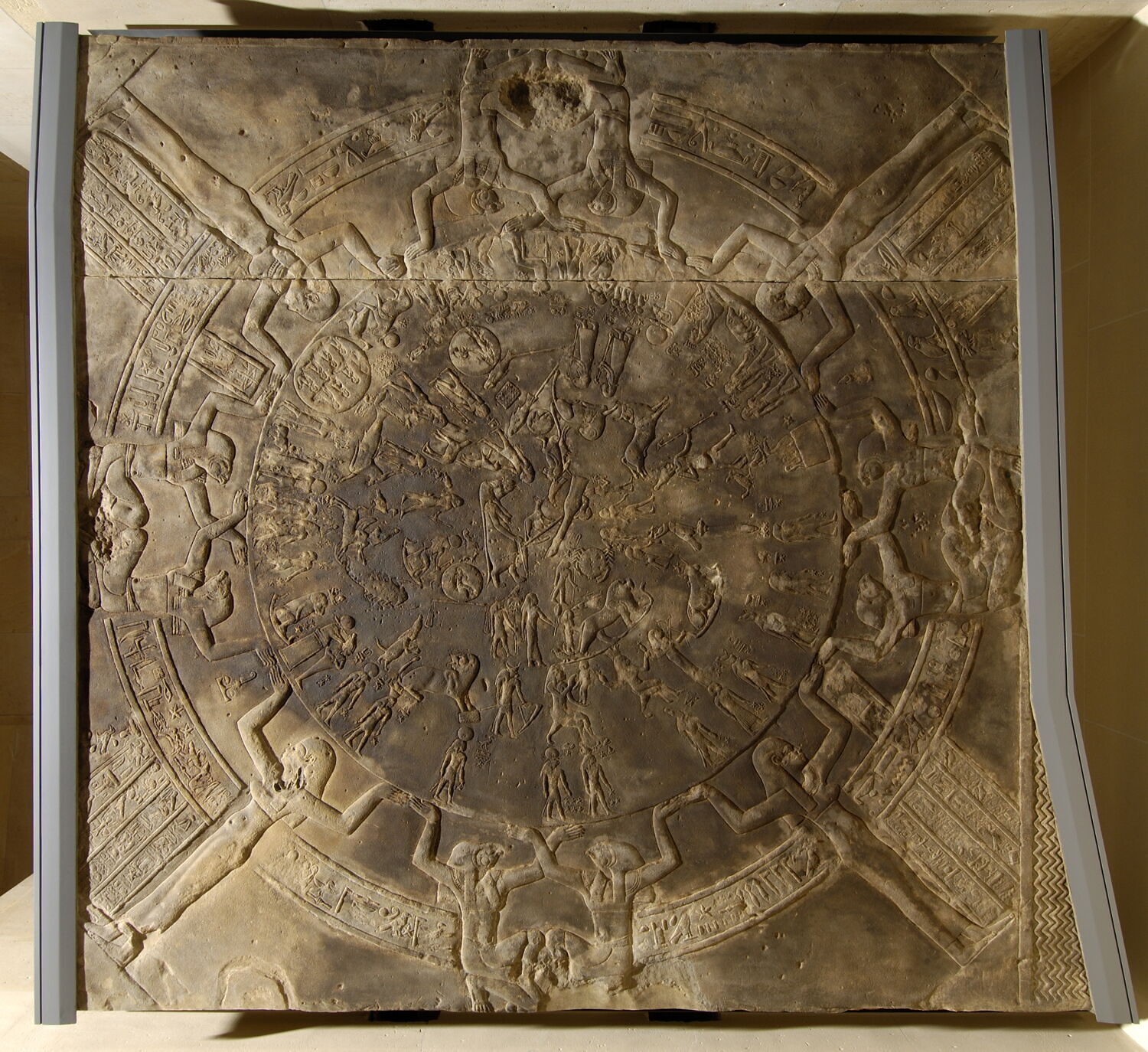
デンデラの黄道帯
Zodiaque de Dendéra
見られますか?
はい、現在展示中
『デンデラの黄道帯』は今どこに? ルーヴル美術館, Salle 325, Aile Sully, Niveau 0, パリ. はい、現在展示中. 確認 2026年11月16日.

開館中· 21:00まで
一般公開されています。
- 確認
- この状態になった日
- 出典
- 美術館
この彫刻について
The Dendera zodiac, an anonymous Egyptian relief dated June–August 50 BC, belongs to the Louvre in Paris. Its circular sky chart originally decorated a ceiling in a chapel of Osiris within the temple complex at Dendera. Zodiac signs share the disc with figures from Egyptian tradition. Removed to France in 1821, the relief entered the Louvre in 1922 and is currently displayed in Room 325, Sully wing, level 0.
The sculptured Dendera zodiac (or Denderah zodiac) is a widely known Egyptian bas-relief from the ceiling of the pronaos (or portico) of a chapel dedicated to Osiris in the Hathor temple at Dendera, containing images of Taurus (the bull) and Libra (the scales). This chapel was begun in the late Ptolemaic period; its pronaos was added by the emperor Tiberius. This led Jean-François Champollion to date the relief to the Greco-Roman period, but most of his contemporaries believed it to be of the New Kingdom.
The relief, which John H. Rogers characterised as "the only complete map that we have of an ancient sky", has been conjectured in the past to represent the basis on which later astronomy systems were based. It is now on display at the Musée du Louvre, Paris.
作品データ
- 収蔵番号
- E 13482
カタログ収録
出典
- ルーヴル美術館
- 画像: ルーヴル美術館 — © 2008 Musée du Louvre, Dist. GrandPalaisRmn / Christian Décamps