 Paul Kleeドイツ, 1879–1940
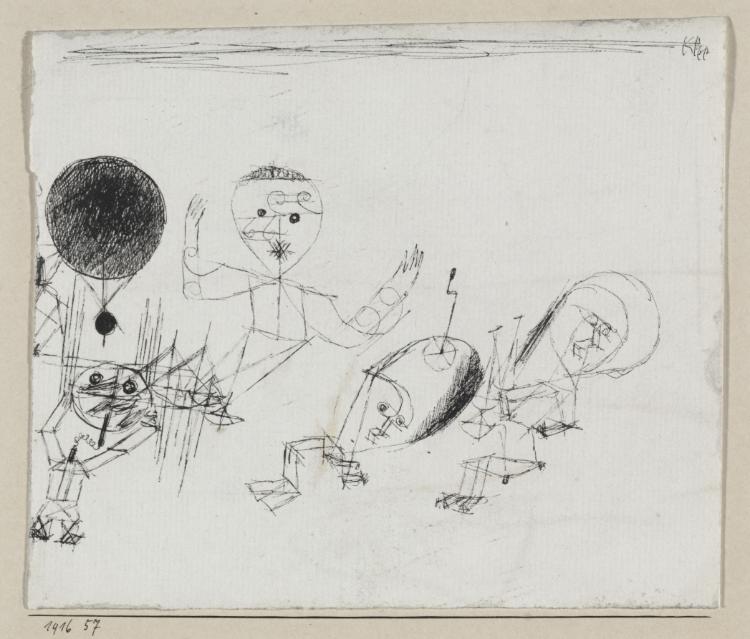
With the Dot
お目にかかれますか?
ただいまはお迎えしていません

クリーブランド美術館
クリーブランド, アメリカ合衆国
コレクションに属していますが、現在は展示されていません。
- 確認
- この状態になった日
- 出典
- 美術館自身の所蔵データ
作品について
Paul Klee made this drawing during World War I. It shows a hovering figure, who could be saintly or demonic, overlooking a scene that includes a zeppelin, a decapitated child, a fallen soldier, and a recoiling (or attacking) figure. The soldier’s helmet displays a handle, implying the mechanized or dehumanized war machine. Klee’s title for the drawing includes the depiction of a point (•), which refers to the circular zeppelin or circle that frequently appeared in his drawings as a menacing omen. In 1915 Klee wrote: “The more horrifying this world becomes the more art becomes abstract; while a world at peace produces realistic art.”
クリーブランド美術館
作品データ
- 収蔵番号
- 1961.50
カタログ収録
出典
- クリーブランド美術館: the museum's own open data · 6 日前に取得
- 画像: クリーブランド美術館 — Museum open access
その頃、Paul Kleeの人生では
生涯をすべて見るfrom 3 April 1914
Tunisia with Macke and Moilliet: Klee the painter
On 3 April 1914 Klee set out from Bern with August Macke and Louis Moilliet, via Lyon and Marseille to Tunisia — Saint-Germain, Sidi Bou Said, Carthage, Hammamet, Kairouan — and he alone of the three kept a diary. Struck by the light, Klee wrote that colour had taken possession of him for ever and that he was a painter; back home he painted his first purely abstract work, “In the Style of Kairouan”, built of coloured rectangles and a few circles.
autumn 1914
The war: hopes, and the death of August Macke
Klee greeted the outbreak of war, like Franz Marc, with a hope for the country’s revival, and in the first months made works on war themes — “Death on the Battlefield” and “Death for the Idea”. The death of his friend August Macke in the autumn of 1914 changed his mind: in his diary he wrote that the more terrible the world, the more abstract art becomes, and by the end of 1915 he had abandoned war subjects altogether.
1915
Meeting Rainer Maria Rilke
Klee met the poet Rainer Maria Rilke, who was allowed to keep about forty of Klee’s works in his room for several months.
March 1916
First exhibition of abstract watercolours at Walden’s
Herwarth Walden’s gallery held the first exhibition of Klee’s abstract watercolours, a success with the public. He gave the works new titles, marking his break with war themes, and Walden asked him for more.
5 March 1916
Called up, and the news of Franz Marc’s death
On 5 March 1916 Klee, who had been expecting mobilisation since 1914, was called up; the same day he learned that Franz Marc had been killed at the Battle of Verdun. From March to August he went through military training at Landshut.
February 1917
Second show at Walden’s: the first commercial success
Klee showed the watercolours of the past year; many works were sold, and critics called him the most important German artist since Marc’s death. The success was made possible by a changed market: collectors had appeared who were ready to buy modern art.