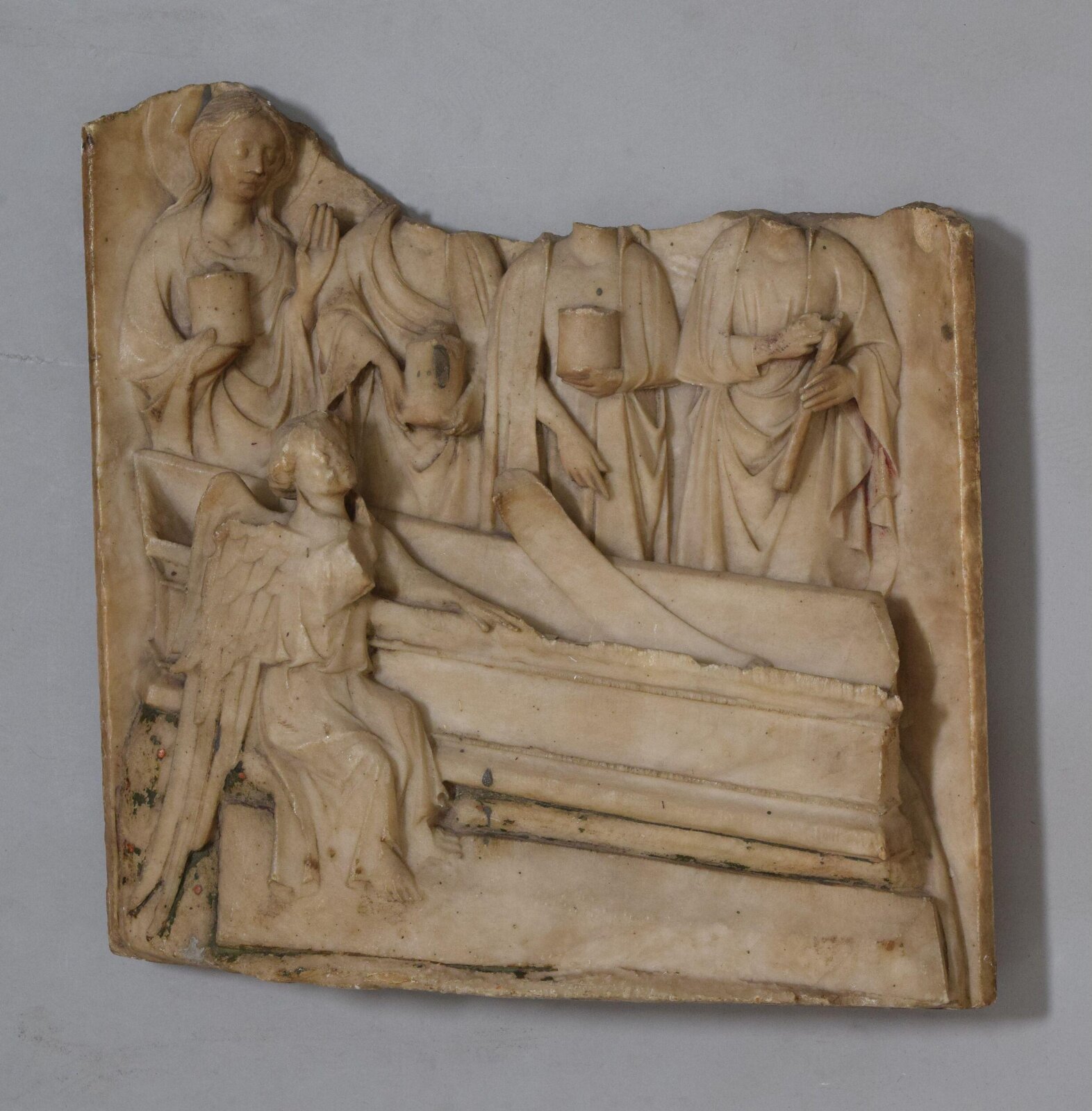
The Three Marys at the Sepulchre
見られますか?
現在は展示されていません
『The Three Marys at the Sepulchre』は今どこに? 所蔵: ヴィクトリア&アルバート博物館, ロンドン. 現在は展示されていません. 確認 2026年9月25日.

ロンドン, イギリス
コレクションに属していますが、現在は展示されていません。
- 確認
- この状態になった日
- 出典
- 美術館
この彫刻について
The three Marys, wearing gowns and cloaks draped over their shoulders, are standing behind the empty tomb, holding ointment pots. Of the three, the haloed and bare-headed figure on the left is shown with her left hand raised while the figure on the right points with her right hand to the empty tomb into which a scroll curves. Originally this scroll would have been painted with an inscription. The figure on the right of the panel presumably represents St John the Evangelist. An angel is seated in front of the tomb, his bare feet resting on its lide which lies on the ground.
続きを読む
The carving of alabaster, mostly quarried in Tutbury and Chellaston near Nottingham, took on industrial proportions in England between the middle of the 14th and the early 16th centuries. The market for altarpieces and smaller devotional images was a large one. It included not only religious foundations but also the merchant classes. Many hundreds of English alabasters were exported, some as far afield as Iceland and Santiago de Compostela in north-west Spain.
Alabaster - a form of gypsum - is a comparatively soft material and is therefore easy to carve. It can also be polished. Its natural colour was especially useful for the representation of faces and flesh, which would normally remain unpainted.
ヴィクトリア&アルバート博物館
作品データ
- 収蔵番号
- A.51-1946
描かれているもの
カタログ収録
出典
- ヴィクトリア&アルバート博物館
- 画像: ヴィクトリア&アルバート博物館 — © Victoria and Albert Museum, London










