 Alfred Stieglitzアメリカ合衆国, 1864–1946
The Steerage
見られますか?
はい、現在展示中
『The Steerage』は今どこに? ニューヨーク近代美術館, MoMA, 5階, 504, ニューヨーク. はい、現在展示中. 確認 2026年9月22日.

一般公開されています。
- 確認
- 出典
- 美術館
作品について
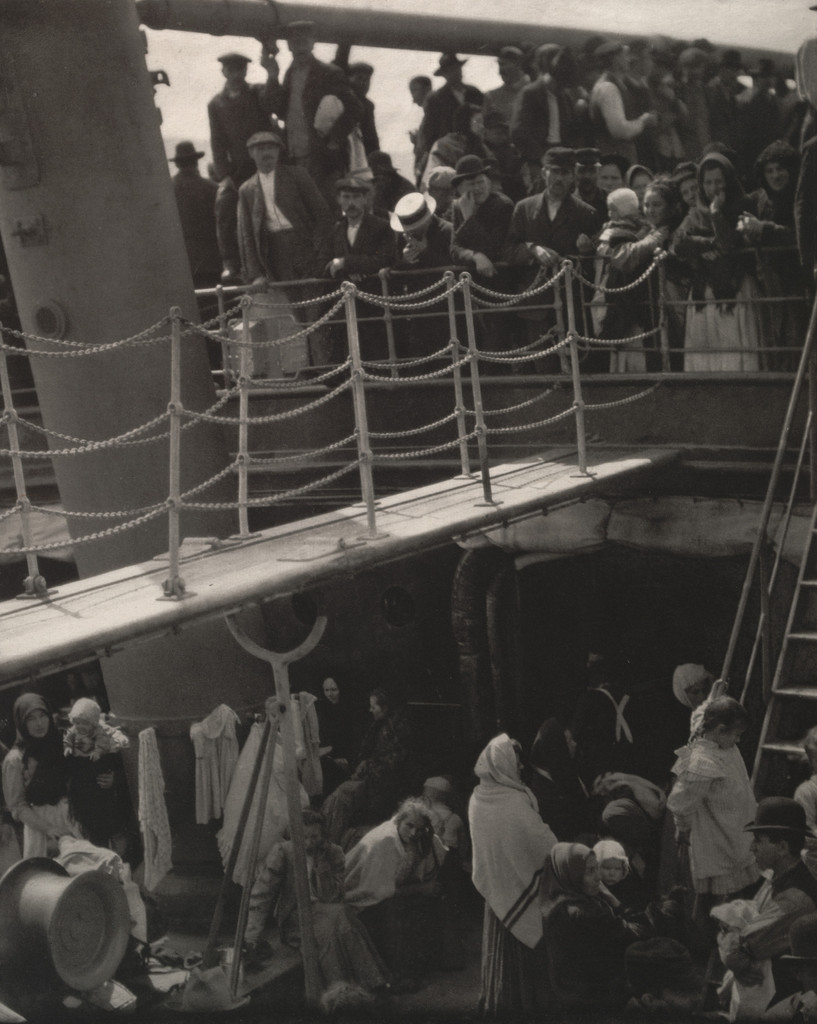
The Steerage is a black and white photograph taken by Alfred Stieglitz in 1907. It has been hailed by some critics as one of the greatest photographs of all time because it captures in a single image both a formative document of its time and one of the first works of artistic modernism.
There were men and women and children on the lower deck of the steerage. There was a narrow stairway leading to the upper deck of the steerage, a small deck right on the bow with the steamer.
To the left was an inclining funnel and from the upper steerage deck there was fastened a gangway bridge that was glistening in its freshly painted state. It was rather long, white, and during the trip remained untouched by anyone.
続きを読む
On the upper deck, looking over the railing, there was a young man with a straw hat. The shape of the hat was round. He was watching the men and women and children on the lower steerage deck...A round straw hat, the funnel leaning left, the stairway leaning right, the white drawbridge with its railing made of circular chains – white suspenders crossing on the back of a man in the steerage below, round shapes of iron machinery, a mast cutting into the sky, making a triangular shape...I saw shapes related to each other. I was inspired by a picture of shapes and underlying that the feeling I had about life."
Although Stieglitz described "an inclining funnel" in the scene, photographs and models of the ship (see below) show that this object was actually a large mast to which booms were fastened for loading and unloading cargo. One of the booms is shown at the very top of the picture.
Much has been written about the scene as a cultural document of an important period when many immigrants came to America. In fact, the picture was taken on a cruise to Europe from America, and so some critics have interpreted it as recording people who were turned away by U.S. Immigration officials and forced to go back home. Although some of the passengers might have been turned back because of failure to meet financial or health requirements for entrance, it is more likely most were various artisans who worked in the booming construction trade. Workers skilled in crafts such as cabinet-making, woodworking and marble laying were granted two-year temporary visas to complete their jobs and then returned home when the work was complete.
作品データ
- 収蔵番号
- 436.1986
カタログ収録
出典
- ニューヨーク近代美術館
- 画像: ニューヨーク近代美術館 — © the artist or rights holder
その頃、Alfred Stieglitzの人生では
生涯をすべて見る25 November 1905
The 291 gallery opens on Fifth Avenue
On November 25, 1905, the Little Galleries of the Photo-Secession opened at 291 Fifth Avenue with one hundred prints by thirty-nine photographers; Edward Steichen had encouraged Stieglitz to lease the three rooms across from his own apartment. The gallery was an instant success, with almost fifteen thousand visitors in its first season and print sales of nearly $2,800, more than half of them Steichen's work.
1907
Paris: Gertrude Stein and a turn to painting
In Paris in 1907 Stieglitz met Gertrude Stein and was captivated by Rodin, Matisse, Toulouse-Lautrec, Cézanne and Rousseau. He decided to turn his photography gallery into a full art gallery to introduce the conservative American public to the newest European art.
1907
Pamela Colman Smith's drawings at 291
In December 1906 Stieglitz met the 28-year-old artist Pamela Colman Smith and decided to show her drawings and watercolours, thinking it “highly instructive to compare drawings and photographs”. Her show, which opened in January 1907, drew far more visitors than any previous photography show, and all her works were sold.
January – April 1908
Rodin and Matisse at 291
In January 1908 Stieglitz showed drawings by Rodin at his gallery, and in April an exhibition of Matisse, beginning his campaign to introduce the American public to the newest European art.
1909
Death of his father, Edward Stieglitz
His father, Edward Stieglitz (1833–1909), who had once taken the family to Europe for the children's education, died; as he would later do after his mother's death, Alfred buried his grief in his work.
December 1909 – 1910
Toulouse-Lautrec, Rousseau and Cézanne lithographs
In December 1909 Stieglitz showed paintings by Toulouse-Lautrec at his gallery, and in 1910 works by Matisse, Rodin and Rousseau and lithographs by Cézanne.