Joan Miróスペイン王国, 1893–1983
The Policeman
お目にかかれますか?
はい、お客様をお迎えしています

シカゴ美術館
展示室展示室 398シカゴ, アメリカ合衆国
一般公開されています。裏付けとなる出典は下に記しています。
- 確認
- この状態になった日
- 出典
- 美術館自身の所蔵データ
About the painting
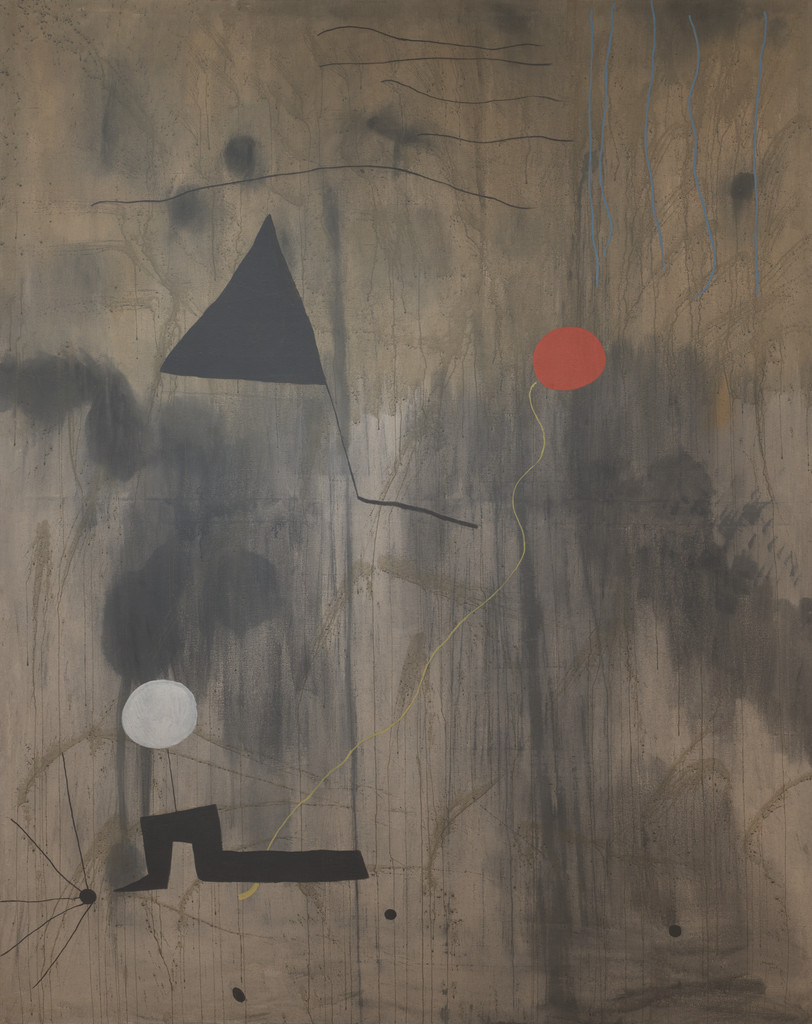
Soon after Joan Miró moved to Paris from his native Barcelona in 1920, he met a group of avant-garde painters and writers who advocated merging the everyday rational world with that of dreams and the unconscious in order to produce an absolute reality, or surreality. To release images of this higher realm, the Surrealists embraced automatism, a spontaneous working method much like free association. Miró experimented with automatism: “Even a few casual wipes in cleaning my brush,” he said, “may suggest the beginning of a picture.” Between 1925 and 1927, his experiments unleashed a revolutionary series of works called the “dream paintings,” which straddle abstraction and representation in freely moving, calligraphic compositions.
Read on
In The Policeman, a large canvas from this group, two biomorphic shapes spring to life as a policeman and a horse, their forms defined by thinly applied white paint against a neutral ocher ground. The form on the left has sprouted five buds that act as fingers, and both forms extrude curves that suggest torsos or mouths. With sketch-like dots and squiggles added to their heads to make eyes and a mustache, Miró’s shapes come to life in a liquid space as animated equivalents of a policeman and his horse.
シカゴ美術館CC BY 4.0
作品データ
- 収蔵番号
- 1991.1499
What it shows
カタログ収録
出典
- シカゴ美術館: the museum's own open data · 7 日前に取得
- 画像: シカゴ美術館 — © the artist or rights holder
その頃、Joan Miróの人生では
生涯をすべて見る1924
Joins the Surrealist circle
Miró joined the Surrealist circle, whose dream-like automatism suited his symbolic and poetic art, but chose not to become an official member so as to experiment freely; Breton called him “the most Surrealist of us all”.
1925
Friendship with Robert Desnos
Miró became friends with the poet Robert Desnos; they soon planned a livre d'artiste together, but the Spanish Civil War and World War II put the plans on hold. Desnos died in 1945, shortly after his release from the concentration camps.
second half of the 1920s
A language of signs and ideograms
In “Person Throwing a Stone at a Bird” and “Dog Barking at the Moon” (both 1926) a set of recurrent ideograms took shape: symbols of space — horizon, waves, heavenly bodies — and “mediating symbols” — birds, a ladder to the sky, an eye, an ear, a figure with giant feet.
1926
Designs for Diaghilev with Max Ernst
Miró collaborated with Max Ernst on designs for the ballet impresario Sergei Diaghilev.