 Winslow Homerアメリカ合衆国, 1836–1910
The Gulf Stream
お目にかかれますか?
はい、お客様をお迎えしています

メトロポリタン美術館
展示室展示室 767ニューヨーク, アメリカ合衆国
一般公開されています。裏付けとなる出典は下に記しています。
- 確認
- この状態になった日
- 出典
- 美術館
この絵画について
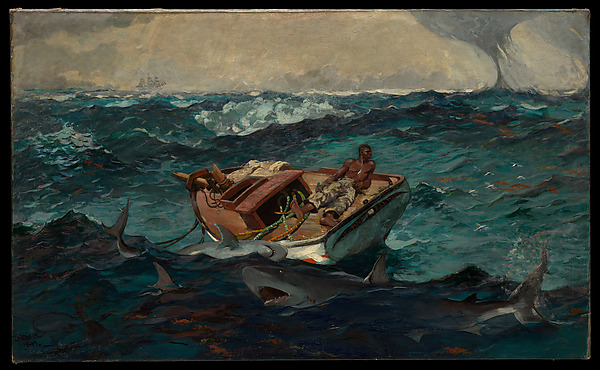
The Gulf Stream is an 1899 oil painting by the American artist Winslow Homer. It shows a man in a small dismasted rudderless fishing boat struggling against the storm-tossed waves and perils of the sea, presumably near the Gulf Stream, and was the artist's statement on a theme that had interested him for more than a decade. During the time he explored this theme, Homer, a New Englander, boated often near Florida, Cuba, and the Caribbean.
作品データ
- 収蔵番号
- 06.1234
描かれているもの
カタログ収録
出典
- メトロポリタン美術館
- 画像: メトロポリタン美術館 — Open Access (CC0)
その頃、Winslow Homerの人生では
生涯をすべて見る1888–1903
Trips to Key West
Between 1888 and 1903 Homer frequently visited Key West, Florida; some of his best-known works, “A Norther, Key West”, “The Gulf Stream”, “Taking on Wet Provisions” and “Palms in the Storm”, are said to have been produced there.
c. 1898
Death of his father
Around 1898 Homer's father died; the artist had looked after him like a “parent” since his mother's death, and by 1900 he was free of these responsibilities.
by 1900
Financial security at last
By 1900 Homer had finally reached financial stability: museums paid good prices for his paintings, and he received rents from real estate. He went on producing watercolours, mostly on trips to Canada and the Caribbean, and seascapes without figures: waves crashing against rocks in varying light.
1902
An unusual sculpture and a new gallery
In 1902 Homer exhibited a most unusual work for him, the sculpture “Hunter with Dog – Northwoods”. By then he had switched his primary gallery from Boston's Doll and Richards to Knoedler & Co. in New York.
1907
“Leave rocks for your old age”
In 1907 Homer advised a student artist: “Leave rocks for your old age—they're easy.” In his last decade he at times followed the advice himself.