Edgar Degasフランス, 1834–1917
The Convalescent
見られますか?
はい、現在展示中
『The Convalescent』は今どこに? J・ポール・ゲティ美術館, Museum West Pavilion, Gallery W204, ロサンゼルス. はい、現在展示中. 確認 2026年10月5日.
まもなく閉館· 20:00まで
一般公開されています。
- 確認
- この状態になった日
- 出典
- 美術館
この絵画について
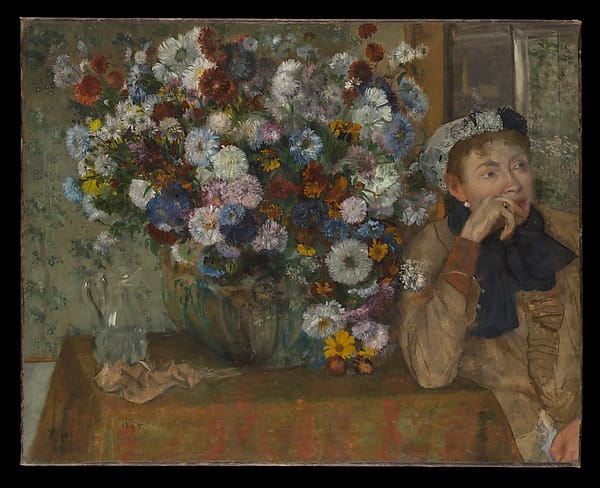
Although the identity of the sitter in this portrait is a mystery, Edgar Degas conveyed her character by capturing the overwhelming sorrow to which she has succumbed. Posed with her head tilted and leaning against the back of her left hand, she appears weary. Her languorous expression and red-rimmed eyes, together with the limp right arm hanging at her side, suggest a physical or emotional malady, though nothing in the painting confirms the cause of her affliction. Hidden beneath a brown robe and full white gown, her pose is ambiguous; it is unclear if she sits, stands, or leans. *The Convalescent* attests to Degas's interest in the world of women--their physical characteristics and surroundings, and their complex emotional and psychological conditions.
続きを読む
Unlike traditional nineteenth-century portraits, which were commissioned and usually left the artist's studio upon completion, this depiction of an unidentified woman remained in Degas's studio for at least fifteen years. The painting is unconventional in other ways as well; *The Convalescent* is more psychologically suggestive and spatially ambiguous than typical portraits of the time, such as Franz Xaver Winterhalter's official portrait, *Leonilla, Princess of Sayn-Wittgenstein-Sayn.* Degas's thick, unblended brushstrokes and flattened space bring the figure forward, conveying informality and intimacy.
J・ポール・ゲティ美術館
作品データ
- 収蔵番号
- 2002.57
カタログ収録
出典
- J・ポール・ゲティ美術館
- 画像: J・ポール・ゲティ美術館 — Open Content
その頃、Edgar Degasの人生では
生涯をすべて見る1870
A volunteer in the war; a flaw in his eyesight
When the Franco-Prussian War broke out Degas volunteered; at the first shooting practice it turned out that he saw poorly with his right eye. It was the first sign of the macular degeneration that left him almost blind at the end of his life; he was transferred to the artillery and served there to the end of the war.
1872年10月–1873年3月 · 居住
New Orleans
1873–1874
His brother's debts: he sells his house and collection
After his father's death Degas learned that his brother René had run up enormous business debts. To save the family's reputation he sold his house and an inherited art collection and for the first time in his life depended on sales of his own work.
1874
The first Impressionist exhibition
Disenchanted with the Salon, Degas joined a group of young artists organizing an independent exhibiting society. He took a leading role in organizing the eight shows of 1874–1886 and exhibited in all but one, despite constant conflicts with the group.
1881
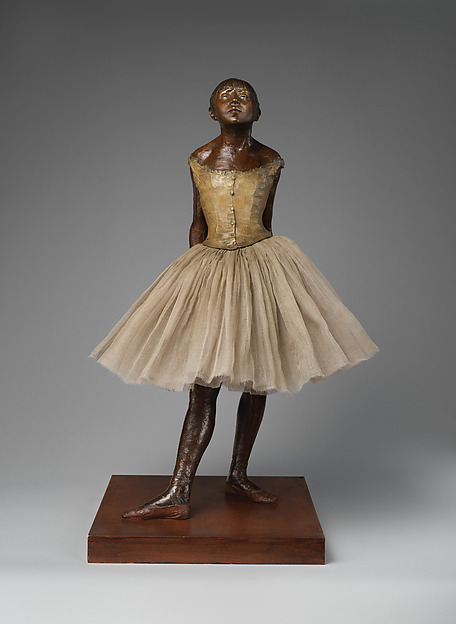
“The Little Dancer of Fourteen Years” on show
The nearly life-size wax figure with real hair and a cloth tutu, modelled on Marie van Goethem, provoked a strong reaction: critics found its realism extraordinary, but many denounced the dancer as ugly. It was the only sculpture Degas showed in his lifetime.
by 1882
His eyesight sharply worsens
By 1882 Degas's eyesight began to worsen sharply: he turned to pastel and then to sculpture, where he could rely more on touch.