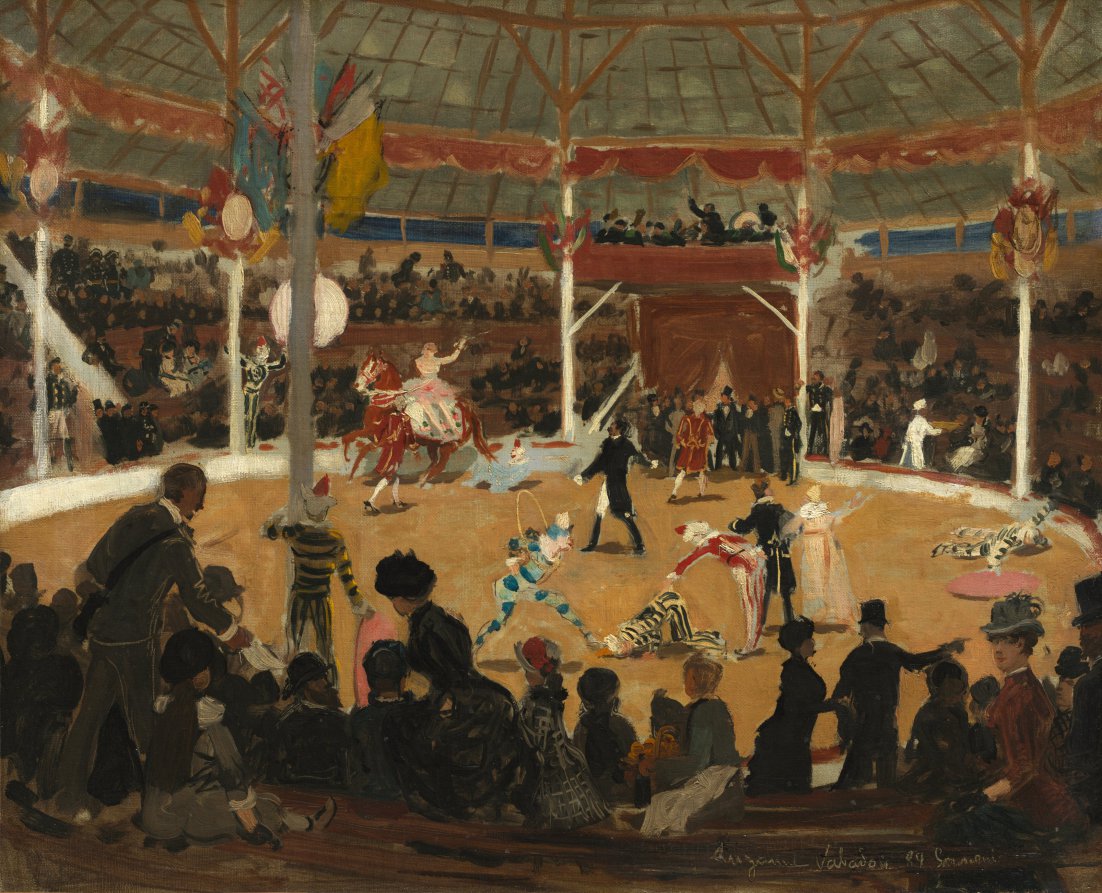
 Suzanne Valadonフランス, 1865–1938
The Circus
見られますか?
現在は展示されていません
『The Circus』は今どこに? 所蔵: クリーブランド美術館, クリーブランド. 現在は展示されていません. 確認 2026年11月23日.

クリーブランド, アメリカ合衆国
コレクションに属していますが、現在は展示されていません。
- 確認
- この状態になった日
- 出典
- 美術館
この絵画について
Suzanne Valadon’s authorship of The Circus, a signed canvas dated 1889 at the Cleveland Museum of Art in Cleveland, remains disputed. Several specialists have rejected the connection with her. Others accept it, explaining the unfamiliar manner as an early stage in her development: her mature style only began to emerge in 1891, two years after the date on this painting. Valadon produced many paintings despite never receiving a formal education in art. She was also the mother of the painter Maurice Utrillo.
美術館の言葉で
The attribution of this painting to Suzanne Valadon has been rejected by several authorities. Others support the attribution, arguing that the painting is merely atypical because it is an early work, signed and dated 1889. Valadon did not begin to develop her mature style until 1891.She was the mother of artist Maurice Utrillo and a prolific painter herself, although she never received any formal artistic training.
クリーブランド美術館
作品データ
- 収蔵番号
- 1958.56
カタログ収録
出典
- クリーブランド美術館
- 画像: クリーブランド美術館 — Museum open access
その頃、Suzanne Valadonの人生では
生涯をすべて見るc. 1886 – 1888
The affair with Toulouse-Lautrec
For two years Valadon was the lover of Henri de Toulouse-Lautrec; she frequented the bars and taverns of Paris with him and other painters and was the model for his “The Hangover” (1887–1889). The relationship ended in 1888.
1888
A suicide attempt
In 1888 Valadon attempted suicide, and that ended her affair with Toulouse-Lautrec.
early 1890s
Friendship with Edgar Degas
In the early 1890s Valadon befriended Edgar Degas, who found her drawings bold and her paintings fine: he bought her work and encouraged her, and remained one of her closest friends until his death in 1917.
1890s
Degas: her first buyer, collectors and etching
Degas was the first person to buy drawings from her, introduced her to other collectors, including Paul Durand-Ruel and Ambroise Vollard, and taught her the skill of soft-ground etching.