Gustave Moreauフランス, 1826–1898
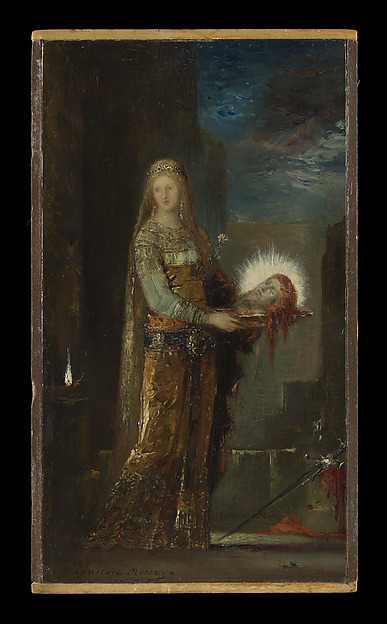
The Apparition
お目にかかれますか?
はい、お客様をお迎えしています

一般公開されています。裏付けとなる出典は下に記しています。
- 確認
- 7 時間前
- この状態になった日
- 2026年9月27日
- 出典
- 美術館自身の所蔵データ
About the painting
Seduced by the erotic dancing of his stepdaughter, Salome, the biblical ruler Herod promised to grant her a wish. Prompted by her mother, Herodias, whose marriage to Herod had been denounced by John the Baptist, Salome requested the saint’s head on a platter. In Moreau’s ornate vision, the dancer appears to have conjured the head of the ascetic prophet, whose radiance overshadows her richly dressed form. The psychologically and narratively ambiguous scene is enacted in front of the enthroned king and his wife as well as the executioner, his sword still wet with blood. A version of this painting was described by French writer Joris-Karl Huysmans in his decadent novel of 1884, À rebours (Against Nature). Huysmans, like many late 19th-century writers and artists, considered Salome the ultimate example of a femme fatale: "[S]he awakened more energetically the lethargic senses of man, she bewitched and tamed his will more confidently with her charm, that of a large venereal flower, grown in hotbeds of sacrilege, raised in impious greenhouses."
ハーバード美術館群
作品データ
- 収蔵番号
- 1943.268
カタログ収録
出典
- ハーバード美術館群: the museum's own open data · 6 日前に取得
- 画像: ハーバード美術館群 — © President and Fellows of Harvard College
その頃、Gustave Moreauの人生では
生涯をすべて見る1859–1888 · 活動地
Paris
1870–1875
Years without exhibiting: renewing his art
Disturbed by criticism that his work had become formulaic, Moreau stopped exhibiting for a few years and concentrated on renewing his art.
1875年9月18日 · 受賞
Knight of the Legion of Honour
1876
Return to the Salon: “Salome”
After the break Moreau returned to the Salon. That year he completed “Salome Dancing before Herod”, which announced the more painterly style that would characterize his later works.
1878
“Phaeton” at the World’s Fair stuns Redon
At the 1878 World’s Fair Moreau’s watercolour “Phaeton” so struck Odilon Redon that he wrote of its power to renew old art. Redon, like many critics of the time, saw Moreau’s chief merit in giving traditional painting a new direction, building a bridge between past and future.
1879
Anthony Roux commissions works on La Fontaine’s “Fables”
In 1879 the collector Anthony Roux commissioned several artists, among them Moreau, Baudry, Delaunay, Doré, Gervex, Harpignies, Hébert, Raffaëlli and Ziem, to produce works based on La Fontaine’s Fables.