 Grigoriy Myasoyedov1834–1911
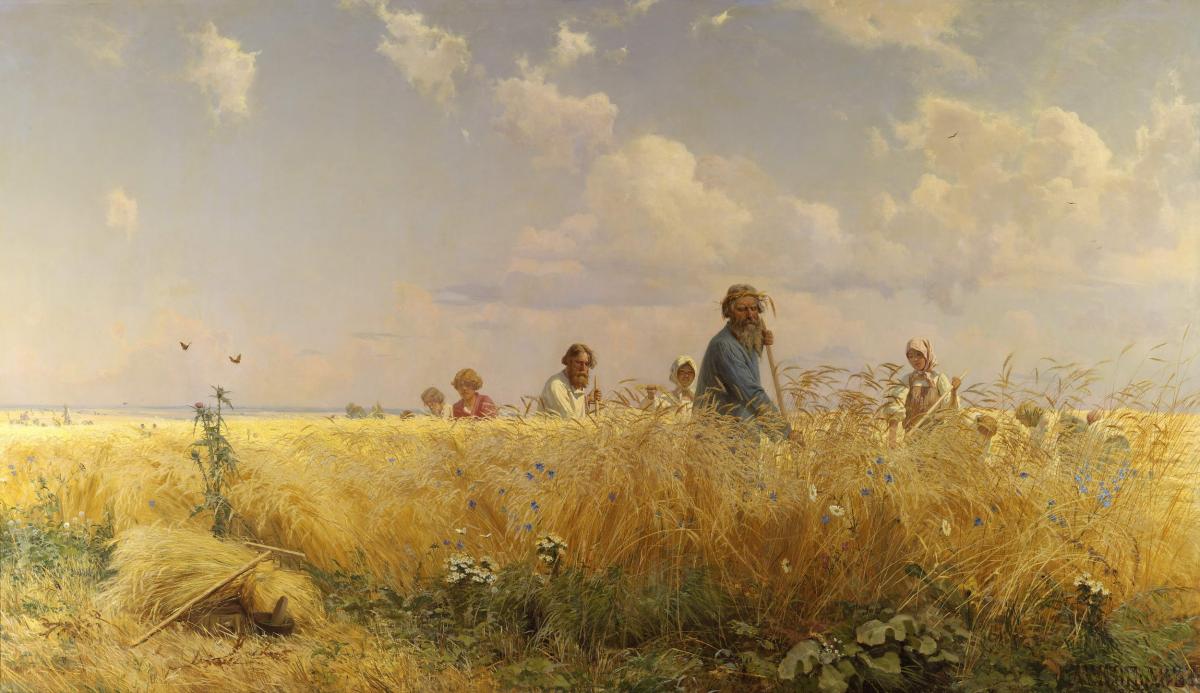
Страдная пора (Косцы)
見られますか?
はい、現在展示中
『Страдная пора (Косцы)』は今どこに? ロシア美術館, Mikhaylovskiy dvorets, Zal 31. G. G. Myasoyedov, K. A. Savitskiy, サンクトペテルブルク. はい、現在展示中. 確認 2026年9月28日.

閉館· 明日10:00に開館
一般公開されています。
- 確認
- この状態になった日
- 出典
- 美術館
この絵画について
Harvest Time (Mowers) (Russian: Страдная пора (Косцы)) is a painting by Russian artist Grigoriy Myasoedov (1834–1911), completed in 1887. It is kept in the State Russian Museum in St. Petersburg (Inventory Zh-6899). The size is 164 × 282 cm (according to other data, 179 × 275 cm). The work, combining elements of domestic genre and landscape, is devoted to the theme of peasant labor during the harvest. The painting was originally known under the title Harvest Time; later, the names Harvest and Croppers were also used. Modern literature usually uses the double title, Harvest Time (Mowers) or Harvest Time. Mowers.
続きを読む
The canvas was presented at the 15th exhibition of the Association of Travelling Art Exhibitions (Peredvizhniki), which opened in February 1887 in St. Petersburg. Right from the exposition, the painting was purchased by Tsar Alexander III. For a long time, Harvest Time was in the Gatchina Palace. In the summer of 1941, in the wake of the German invasion of the USSR, the collection of paintings from the Gatchina Palace was evacuated to Sarapul. After the war, the paintings were first in Pushkin, and then in Pavlovsk. In 1959, the canvas Harvest Time (Moers) was transferred to the State Russian Museum.
In a review article dedicated to the 15th Travelling Exhibition, art critic Vladimir Stasov called Harvest Time one of the most excellent paintings by Myasoedov and noted that it is full of "poetry, light feeling, something healthy and solemn". Art historian Dmitry Sarabianov wrote that in this work Myasoedov managed to achieve "monumental construction of the canvas", which corresponds to the general idea and shows "the beauty of the labor upsurge in the season of labor". According to art historian Irina Shuvalova, in this painting, for the first time in Russian painting, the "greatness and beauty of peasant labor and, most importantly, its powerful creative beginning" is so clearly shown.
美術館の言葉で — ロシア語
Это светлое по колориту полотно наполнено радостным настроением. Тема крестьянского труда волновала многих русских художников, но никто до Мясоедова не решил ее в таком оптимистическом ключе, с такой силой правды. Впечатление объединившего людей трудового подъема, яркого летнего дня, буйного цветения природы, шири русских полей создает живую атмосферу деревенской страды. Каталог выставки в Малаге «Времена года. Произведения из собрания Русского музея». 2015. С. 80. Присущая крестьянину истовость в полевой работе, серьезность и внутренняя собранность особенно хорошо выражены в образе пожилого косаря, увлекающего за собой остальных. Плавная текучесть основных, идущих по диагонали линий, которым вторят облака на небе, равномерность расстояний между косцами — все это рождает впечатление ритмичности их труда. Кажется, будто косцы движутся прямо на зрителя. Есть какая-то величественная красота в пейзаже, словно олицетворяющем мощь возделанной человеком земли, и в вырастающих из колосьев фигур крестьян, образы которых гармонически слиты с природой.
ロシア美術館
作品データ
- 収蔵番号
- Ж-6899
描かれているもの
カタログ収録
出典
- ロシア美術館
- 画像: ロシア美術館 — © State Russian Museum



![A Pig; Breton Peasant Kneeling [verso], Paul Gauguin, 1884-1888](https://api.nga.gov/iiif/13146db4-7e29-45f6-befe-7d3904ec97c0/full/!2400,2400/0/default.jpg)