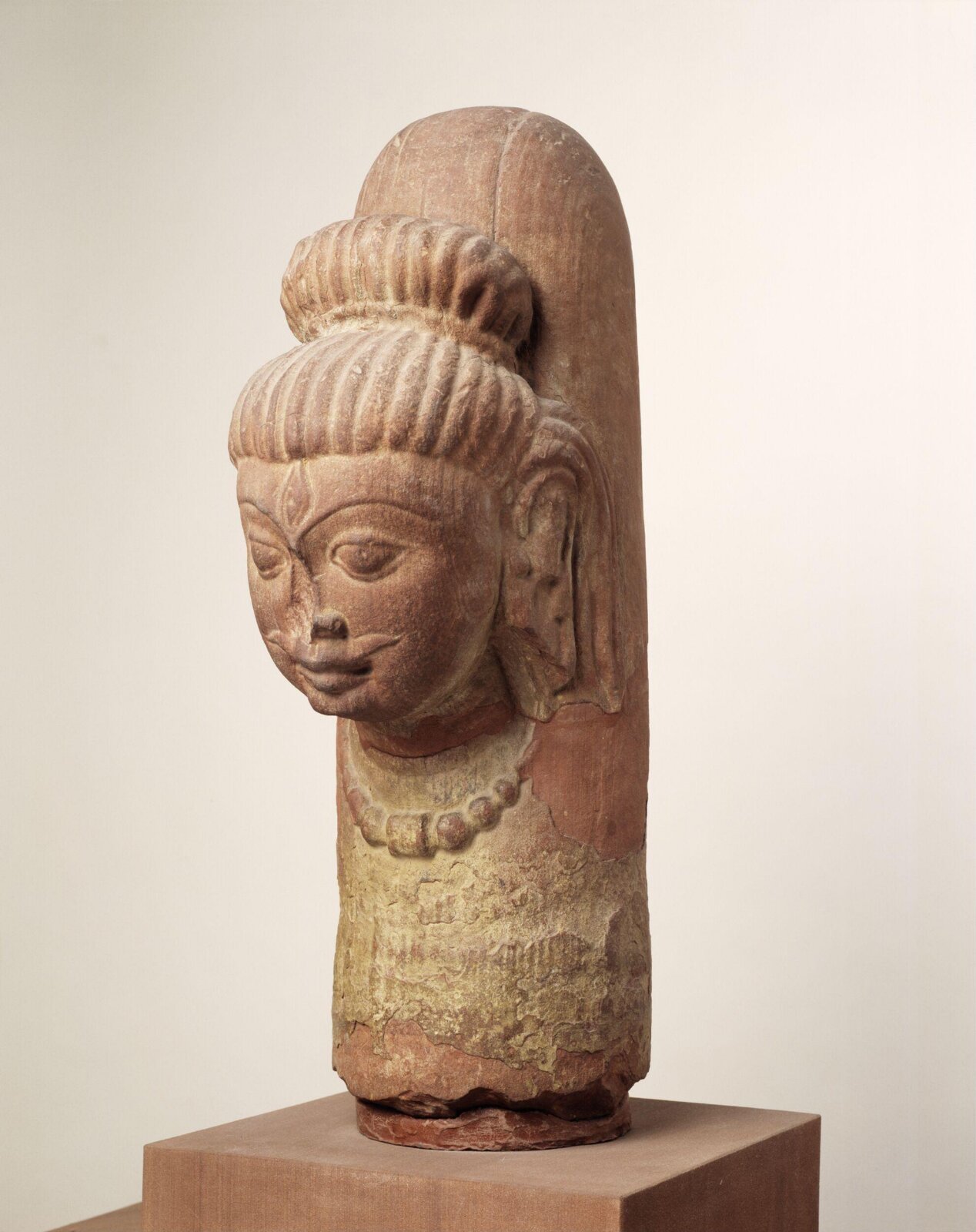
Shiva Ekamukhalinga
見られますか?
現在は展示されていません
『Shiva Ekamukhalinga』は今どこに? 所蔵: ヴィクトリア&アルバート博物館, ロンドン. 現在は展示されていません. 確認 2026年9月25日.

ロンドン, イギリス
コレクションに属していますが、現在は展示されていません。
- 確認
- この状態になった日
- 出典
- 美術館
この彫刻について
Shiva has many manifestations, but is worshipped principally, and primarily, in his linga or phallus form symbolising his primordial power of creation. From the earliest period of the appearance of Shiva in the linga form, around the 1st century BCE at Aghapur and Gudimallam, the linga shaft addorsed with Shiva in anthropomorphic form was established as the dominant linga-type of the early period. In this representation the head of Shiva, with the third eye clearly visible, emerges from the shaft of the linga. Shiva is moustached, and wears a rudraksa mala necklace, made from the stones of the fruit of a tree holy to Shiva. He wears his uncut hair piled high (jatamakuta) in the style of a yogic ascetic; further locks of hair cascade down behind his ears. A linga of this scale could have been worshipped as the cult image of a Saivite temple, of which few survive intact from the Gupta period. The distinctive pink sandstone suggests that it originated in the region of Mathura.
続きを読む
Representations of a deity emerging from a tree trunk occur in Sunga and Satavahana art of the 1st century BCE, embodying shared concepts of the divine in nature, and of the manifestation of the god-head in anthropomorphic form. The symbolism of the tree-post-pillar as devices linking the (mundane) earth and (heavenly) sky were widespread in early religious thinking in India and may be assumed to have contributed to the pillar, with or without explicit phallic overtones, becoming a central motif. The linga, which literally means "sign", became the most powerful icon of Shva, to which all others are subsidiary.
ヴィクトリア&アルバート博物館
作品データ
- 収蔵番号
- IS.10-1969
描かれているもの
カタログ収録
出典
- ヴィクトリア&アルバート博物館
- 画像: ヴィクトリア&アルバート博物館 — © Victoria and Albert Museum, London