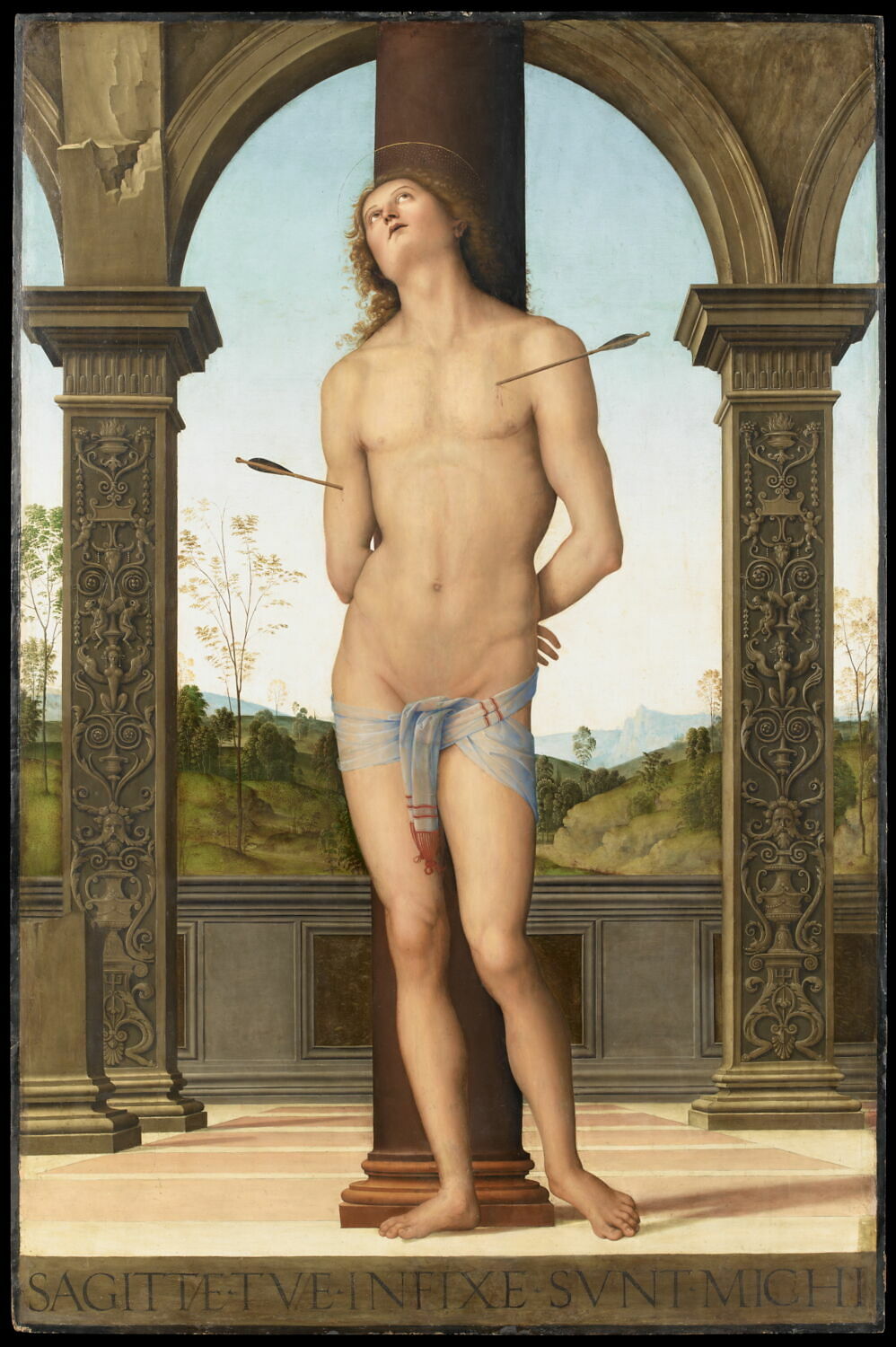
 Pietro Peruginoイタリア, 1448–1523
Saint Sébastien
お目にかかれますか?
はい、お客様をお迎えしています

一般公開されています。裏付けとなる出典は下に記しています。
- 確認
- 9 日前
- この状態になった日
- 2026年9月26日
- 出典
- 美術館自身の所蔵データ
About the painting
『聖セバスティアヌス』(せいセバスティアヌス、伊: San Sebastiano、英: St Sebastian)は、イタリアのルネサンス期の画家ペルジーノによって1495年頃に制作された聖セバスティアヌスの絵画で、現在はルーヴル美術館に所蔵されている。2012年から2017年の間、ルーブル美術館ランス別館に一時的に展示されていた。本作は、おそらく、17世紀にローマのバルベリーニ家が所蔵していたコレクションの目録に記載されていた作品であるが、コレクションは後に分散した。 19世紀にいくつかの作品が海外に持ち出され、『聖セバスティアヌス』は1896年にルーヴル美術館が購入した。
ルネサンス期には、聖セバスティアヌスを主題として扱った絵画が流行した。それは、矢を射られて身体に傷を負ったこの聖人が当時のヨーロッパを席捲していたペストの罹患者と結び付けられ、ペストと戦う聖人と見なされたからであった。
絵画は、コントラポストのポーズを取っている聖人を表しているが、そのポーズは古代ギリシャの彫刻家、ポリュクレイトスの『ドリフォロス』に由来している。現在、サン・パウロ美術館にあるペルジーノによる真筆の複製、『聖セバスティアヌ』にも同じポーズが繰り返されている。左右対称的な構図は、ペルジーノの初期の作品から取られている。その構図が最初に使用されたのは、ペルージャの近くのチェルクェートで描かれたフレスコ画、『聖ロックと聖ペテロの間の聖セバスティアヌス』においてである。聖人は、グロテスクな装飾が施された柱と欄干のある記念碑的なアーチの下のテラスに立っている。敷石台には、ラテン語の碑文「SAGITTAE. TUAE. INFIXAE. SUNT. MICHI」があり、詩篇 38:2 「汝の弓は我に突き刺さっている」から引用されている。奥行きのある風景の背景は、木々に覆われた丘や山など、ペルジーノの典型的描写である。左側には、異教世界の崩壊を象徴する、朽ちた穹窿天井と柱がある。
作品データ
- 収蔵番号
- RF 957
出典
- ルーヴル美術館: the museum's own open data · 9 日前に取得
- 画像: ルーヴル美術館 — © 2012 GrandPalaisRmn (musée du Louvre) / Tony Querrec
その頃、Pietro Peruginoの人生では
生涯をすべて見るc. 1481
Summoned to Rome to paint the Sistine Chapel
Already a renowned master, Perugino is invited by Pope Sixtus IV to Rome, among the best artists of Italy — Botticelli, Ghirlandaio, Cosimo Rosselli, Luca Signorelli and others — to take part in painting the Sistine Chapel.
c. 1481
Pinturicchio — assistant and partner
Perugino's assistant Pinturicchio accompanies him to Rome and is made his partner, receiving a third of the profits; he may have done some of the Moses and Zipporah subjects.
1486–1499
Two studios: in Florence and in Perugia
Between 1486 and 1499 Perugino works mainly between Florence and Perugia, maintaining a studio in each city. In the 1480s and 1490s he is one of the most celebrated artists of Italy.
September 1493
Marriage to Chiara Fancelli and return to Florence
According to Vasari, Perugino returns to Florence in September 1493 to marry Chiara, daughter of the architect Luca Fancelli. That same year Florence again becomes his permanent home, although he continues to accept work elsewhere.
1496
The money-changers' guild commissions the Cambio hall
The money-changers' guild of Perugia asks Perugino to decorate the Sala delle Udienze of the Collegio del Cambio, with the humanist scholar Francesco Maturanzio as consultant. The scheme — a vault with the seven planets and the signs of the zodiac, and sacred subjects on the walls — may have been finished by 1500; on the mid-pilaster Perugino placed his own bust-form portrait.
c. 1496
Raphael's possible apprenticeship as a boy
Around 1496 Raphael, still a boy, may have been placed by his uncles under Perugino's tuition and may have had a hand in the work on the vaulting of the Cambio hall.

![The Crucifixion with the Virgin, Saint John, Saint Jerome, and Saint Mary Magdalene [left panel], Pietro Perugino, c. 1482/1485](https://api.nga.gov/iiif/b43e331e-ede9-44ca-a276-0b8806630fbd/full/!2400,2400/0/default.jpg)