Albrecht Dürerドイツ, 1471–1528
書斎の聖ヒエロニムス
Saint Jérôme dans sa cellule
作品について
Saint Jerome in His Study (German: Der heilige Hieronymus im Gehäus) is a copper engraving of 1514 by the German artist Albrecht Dürer. Saint Jerome is shown sitting behind his desk, engrossed in work. The table, on the corner of which is a cross, is typical of the Renaissance. An imaginary line from Jerome's head passing through the cross would arrive at the skull on the window ledge, as if contrasting death and the Resurrection. The lion in the foreground is part of the traditional iconography of St. Jerome, and near it is a sleeping dog, an animal found frequently in Dürer's works, symbolizing loyalty. Both creatures are part of Jerome's story in the Golden Legend (c. 1260), which contained fanciful hagiographies of saints.
続きを読む
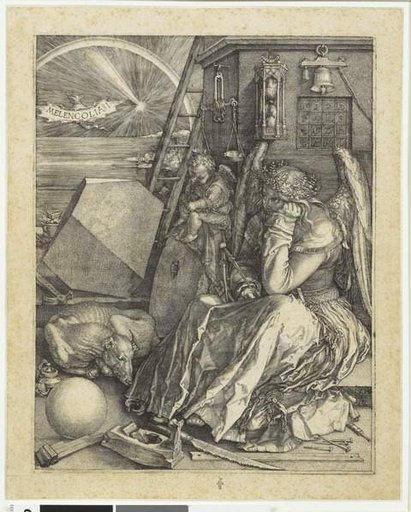
St. Jerome in His Study is often considered as part of a group of three Dürer engravings (his Meisterstiche), the other two being the well-known Melencolia I (1514) and Knight, Death and the Devil (1513). Together they have been viewed as representing the three spheres of activity recognized in medieval times: Knight, Death, and the Devil belongs to the moral sphere and the "active life"; Melencolia I represents the intellectual; and St. Jerome the theological and contemplative life.
The composition is intimate, but the viewer has difficulty locating himself in relation to the picture's space. Thomas Puttfarken suggests that while the scene is very close to the observer, Dürer did not intend the viewer to feel present: "the intimacy is not ours, but the saint's as he is engrossed in study and meditation" (94). Art historian Erwin Panofsky comments on the perspective:
The position of the sight point, quite far off centre, strengthens the impression of a representation determined not by the objective law of the architecture but by the subjective standpoint of the spectator who is just entering – a representation which owes to precisely this perspective arrangement a large part of its peculiarly 'intimate' effect. (Qtd. in Puttfarken, 94)
作品データ
- 収蔵番号
- EST Suppl 234
描かれているもの
カタログ収録
出典
- コンデ美術館
- 画像: コンデ美術館 — © Réunion des musées nationaux - utilisation soumise à autorisation; Ministère de la Culture (France), base Joconde
その頃、Albrecht Dürerの人生では
生涯をすべて見る1507–1528 · 活動地
Nuremberg
1512
Emperor Maximilian I becomes his chief patron
From 1512 Emperor Maximilian I was Dürer's chief patron. For him Dürer and his workshop produced the Triumphal Arch, a giant woodcut 295 × 357 cm printed from 192 blocks and modelled on the triumphal arches of ancient Rome.
3 January 1512
Nuremberg's privilege against forgeries
Nuremberg's city council granted Dürer a privilege for the sale of his prints, with penalties for anyone who forged them.
1513–1516
Three years without painting
Complaining that painting did not pay enough to justify the time compared with his prints, Dürer produced no paintings from 1513 to 1516.
1514
Death of his mother
In the year of Melencolia I and St Jerome in His Study, the artist's mother, Barbara Holper, died.
1515
A life pension from the emperor
The perpetually cash-strapped Maximilian could not pay on time and offered to exempt the artist from city taxes, which the Nuremberg Council opposed. At Dürer's request the emperor granted him a life pension of 100 guilders a year from the sums Nuremberg paid into the imperial treasury.
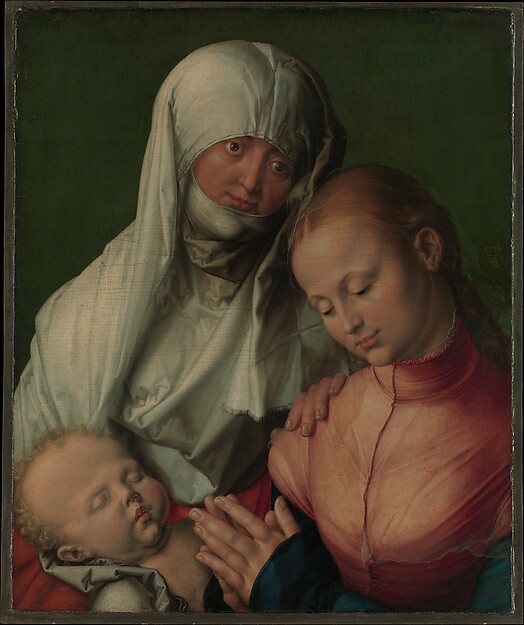
![Madonna and Child [obverse], Albrecht Dürer, c. 1496/1499](https://api.nga.gov/iiif/878db7e6-10ae-4cae-ba5d-6d6f5c413ae8/full/!2400,2400/0/default.jpg)
![Lot and His Daughters [reverse], Albrecht Dürer, c. 1496/1499](https://api.nga.gov/iiif/7565a449-f82a-414b-9bda-c93f55a51b4d/full/!2400,2400/0/default.jpg)