Julia Margaret Cameronイギリス, 1815–1879
Sadness
お目にかかれますか?
ただいまはお迎えしていません
J・ポール・ゲティ美術館
ロサンゼルス, アメリカ合衆国
コレクションに属していますが、現在は展示されていません。
- 確認
- この状態になった日
- 出典
- 美術館
作品について
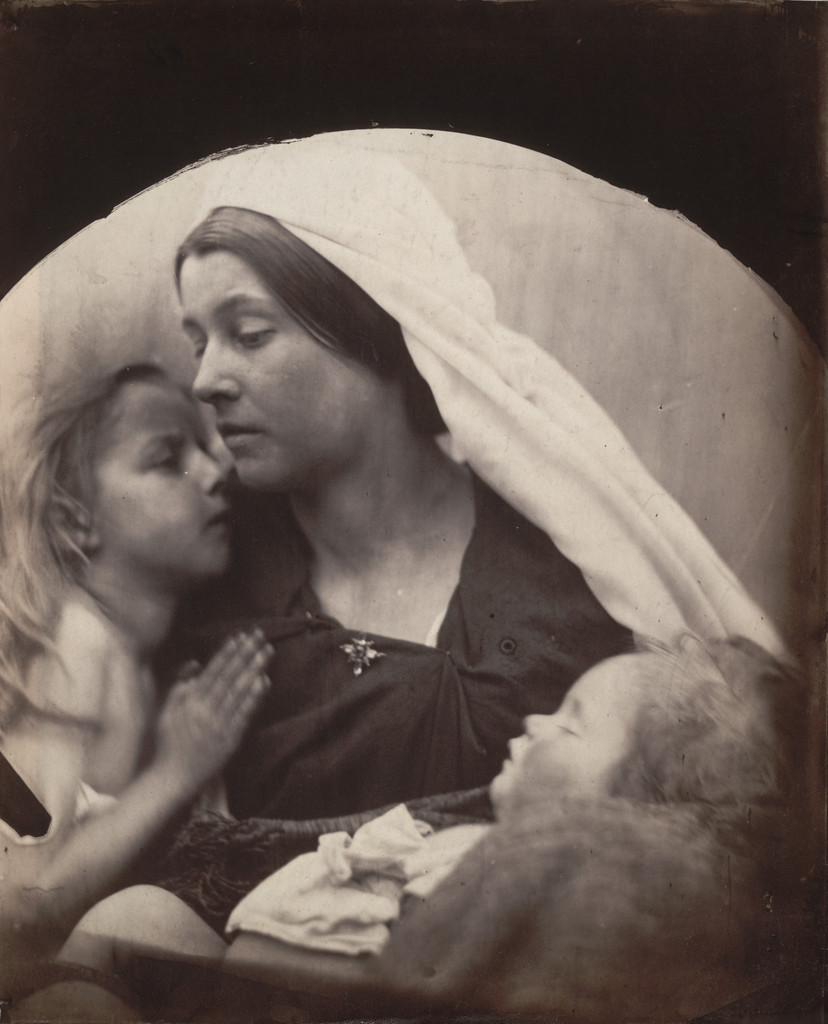
> Within a month of “her very first success”—a portrait of Annie Philpot—Cameron had created a presentation album for her close friend, the painter George Frederick Watts (1817-1904). The album (now at the George Eastman Museum in Rochester, New York), inscribed to Watts and dated February 22, 1864, contains thirty-nine of Cameron’s earliest photographs. It was some time very close to this date that she created the negative for *Sadness*, a study of Shakespearean actress Ellen Terry (1847-1928). > > Terry came from a theatrical family and had her stage debut at age nine. In 1862 she was introduced to Watts, who painted a double portrait of her with her elder sister Kate. In a union engineered by Cameron and her own sisters, Terry and Watts were married on February 20, 1864, when she was just sixteen.
続きを読む
Within a year the couple had separated; they were formally divorced in 1877. > > The pair spent their honeymoon at Freshwater, and most likely it was at this time that the portrait was made. While the possibility exists that Terry, as an actress, was striking a pose for Cameron, the picture’s title suggests the realization of a mismatched marriage. Terry’s anxiety is plainly evident—she leans against an interior wall and tugs nervously at her necklace. The lighting is notably subdued, leaving her face shadowed in doubt.
In *The Story of My Life* (1909), Terry recalls how demanding Watts was, calling upon her to sit for hours as a model and giving her strict orders not to speak in front of distinguished guests in his studio. > > Cameron’s uncertain technique is evidenced by the image loss at the lower center of the picture, where the collodion emulsion peeled away from the glass-plate negative. She must have created only a single negative at this sitting, since she presented this particular print as is in the Overstone Album. The negative was later rephotographed (with the damage repaired) and distributed commercially as a carbon print by the Autotype Company of London (see [86.XM.636.1](https://www.getty.edu/art/collection/objects/58960/julia-margaret-cameron-ellen-terry-at-age-sixteen-british-negative-1864-print-about-1875/)). This later version was also reproduced in 1913 in Alfred Stieglitz’s *Camerawork.* > > Julian Cox. *Julia Margaret Cameron*, In Focus: Photographs from the J. Paul Getty Museum (Los Angeles: J. Paul Getty Museum, 1996), 12. ©1996 The J. Paul Getty Museum.
J・ポール・ゲティ美術館
作品データ
- 収蔵番号
- 84.XZ.186.52
カタログ収録
出典
- J・ポール・ゲティ美術館
- 画像: J・ポール・ゲティ美術館 — Open Content
その頃、Julia Margaret Cameronの人生では
生涯をすべて見るc. 1863
A camera from her daughter
For Christmas her daughter and son-in-law gave the 48-year-old Cameron a camera, to amuse her in her solitude at Freshwater while her husband was in Ceylon; a hen-house became her studio and the coal-house her darkroom. She took a lesson from the photographer David Wilkie Wynfield, to whom, she said, she owed “all my attempts and indeed consequently all my success”.
1864
Elected to the Photographic Society of London
In 1864 Cameron compiled albums of her photographs for Watts and Herschel, registered her work and prepared it for exhibition and sale. She was elected to the Photographic Society of London, showing at its annual exhibitions and remaining a member until her death.
1864–1875
Eleven years of photography
Cameron's career as a photographer lasted from 1864 to 1875: in that time she made more than 900 photographs, portraying great Victorians — Darwin, Tennyson, Browning, Longfellow, Herschel, Watts, Trollope, Carlyle and the actress Ellen Terry. The Virgin Mary in her religious scenes was most often played by her housekeeper, Mary Hillier.
1865
Sales through P. & D. Colnaghi
In 1865 Cameron joined the Photographic Society of Scotland and arranged for her prints to be sold through the London dealers P. & D. Colnaghi; demand for them was strong.
August 1865
The South Kensington Museum buys 80 photographs
In August 1865 the South Kensington Museum (now the Victoria and Albert Museum) bought 80 of her photographs.
November 1865
First solo exhibition
In November 1865 Cameron held her first solo exhibition; her work was shown throughout Europe.