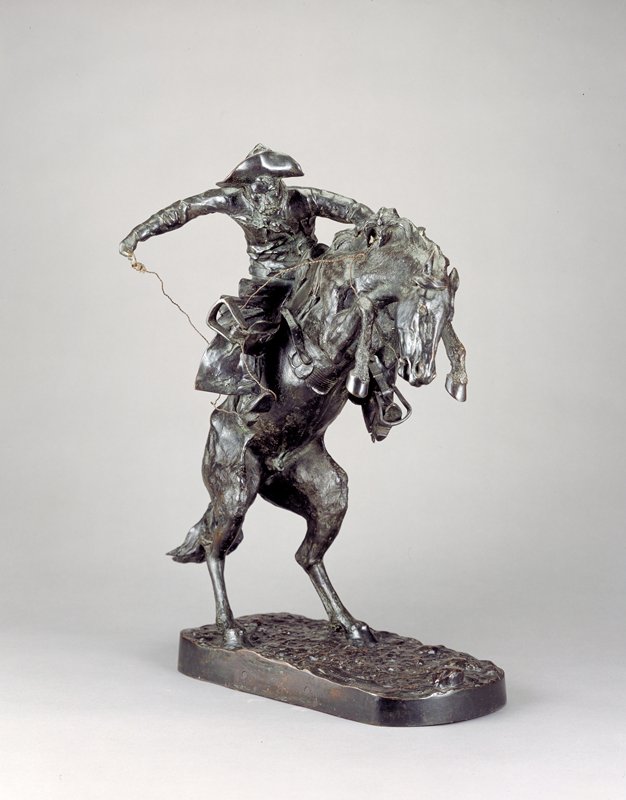
Frederic Remingtonアメリカ合衆国, 1861–1909
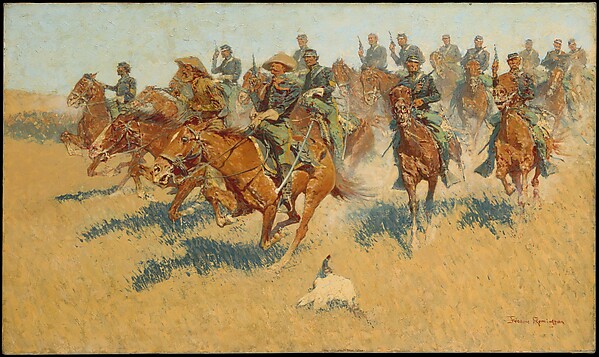
Rushing Red Lodges Passed through the Line
見られますか?
現在は展示されていません
『Rushing Red Lodges Passed through the Line』は今どこに? 所蔵: シカゴ美術館, シカゴ. 現在は展示されていません. 確認 2026年10月12日.

シカゴ, アメリカ合衆国
コレクションに属していますが、現在は展示されていません。
- 確認
- この状態になった日
- 出典
- 美術館
作品データ
- 収蔵番号
- 1982.786
カタログ収録
出典
- シカゴ美術館
- 画像: シカゴ美術館 — CC0
その頃、Frederic Remingtonの人生では
生涯をすべて見る1890s
From chronicler of the West to its historian
Gradually he transitions from the premier chronicler-artist of the Old West to its most important historian-artist. He forms an effective partnership with Owen Wister, who becomes the leading writer of Western stories of the time, and, more confident of his craft, writes that his drawing is done entirely from memory and that he no longer uses a camera: the interesting never occurs in nature as a whole but in pieces, and it is more what he leaves out than what he adds. He rarely depicts the gambling-hall and dance-hall scenes typical of Western movies and avoids frontier women; A Misdeal (1897) is a rare instance of indoor cowboy violence.
1898
At war in Cuba: a heroic image shattered
As the Spanish–American War takes shape, he returns to Cuba to see military action for the first time and goes through the most wrenching, disillusioning experience of his life. Witnessing the assault on San Juan Hill by American forces, including those led by Roosevelt, he sees his heroic conception of war shattered by the actual horror of jungle fighting and the deprivations of camp. His reports and illustrations on his return focus not on heroic generals but on the troops.
1898
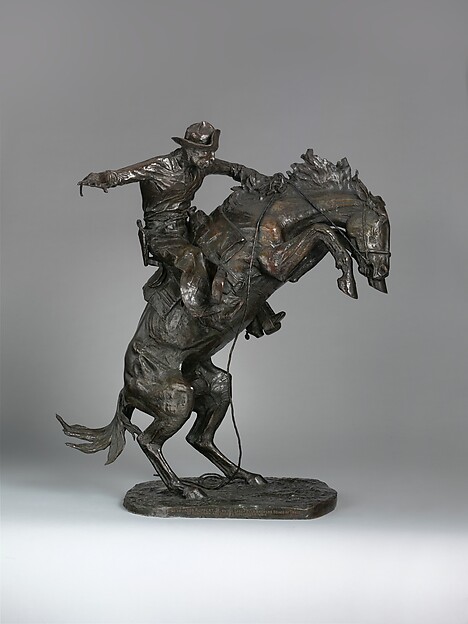
A bronze “Bronco Buster” as a gift to Roosevelt from the Rough Riders
When the Rough Riders return to the US they present their courageous leader Roosevelt with Remington's bronze statuette The Bronco Buster, which the artist calls the greatest compliment he ever had — after this everything will be mere fuss; Roosevelt replies that there could have been no more appropriate gift from such a regiment.
1898
Two paintings on US postage stamps
He achieves the public honour of having two paintings used for reproduction on US postage stamps.
1900
Harper's drops him; he writes a novel
As an economy move, Harper's drops Remington as its star artist. To compensate for the lost work he writes and illustrates a full-length novel, The Way of an Indian, intended for serialization by a Hearst publication; his protagonist, a Cheyenne named Fire Eater, is a prototype Native American as viewed by Remington and many of his time.
after 1902
Decides to give up writing and illustration
After “John Ermine” Remington decides he will soon quit writing and illustrating — he has drawn over 2,700 illustrations — to focus on sculpture and painting.