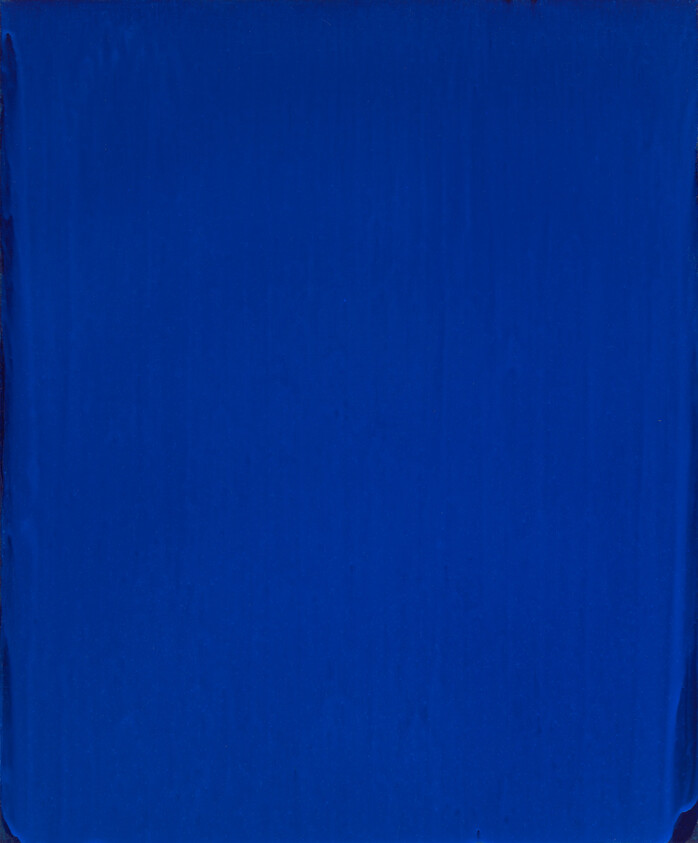
As a monochrome painting by an artist who has consciously predicated his painterly project in response to Michael Fried’s "Footnote #6," in his celebrated essay, "Art and Objecthood -- "[T]he task of the modernist painter is to discover those conventions that, at a given moment, alone are capable of establishing his work’s identity as painting" -- "Red Painting 1999 No. 4", 1999 adds both to the Fogg Art Museum's collection and to the particular formalist gauntlet laid down by Michael Fried during his years as a graduate student at Harvard. This connection is underscored by the donors’ decision to dedicate the painting to Fried. Marioni self-consciously responds to the painting of a number of artists in our collections, especially to Pollock; Rothko; Noland; Louis; Stella and Marden; even more specifically to Robert Ryman.
続きを読む
During the 1980’s, Marioni also instigated a series of dialogues and exhibition projects with the German painter Gunter Umberg, around the European concept of "concrete" painting. Like Ryman, who, in his mostly white paintings, has extracted seemingly unlimited outcomes by varying the organization and manner of his strokes; the type and density of his pigments, and the nature of his support surface and attachments of support to wall, Marioni has adapted a Minimalist reliance on permutations of a set of pre-determined variables, in his case, sticking to monochrome acrylic on canvas, but introducing a broad range of color. Marioni, however, paints with a roller, eliminating the constructive element of the stroke. In this, his project is at once more phenomenological, more iconic, and more anthropomorphic than his Abstract Expressionist or Minimalist predecessors.
Marioni’s preference for an unmediated application of paint echoes Pollock, but toward different ends: he is interested in allowing the paint "to be what it naturally is, liquid color," and he aims to avoid any intimation of drawing. At the same time, his layered pigments incorporate stain, but are not about staining; he relishes the corporeal association of paint with skin. Marioni has referred repeatedly to his Catholic interest in the fundamentally iconic essence of painting, citing both Veronica’s veil – the painting as relic – and Malevich as inspiration, toward this end. His paintings alternate between square, or iconic, formats and more vertical, larger scale planes. In both cases, Marioni treats the entire painting as image and works to inspire a private dialogue between the painting and its viewer.