 Philipp Otto Rungeドイツ, 1777–1810
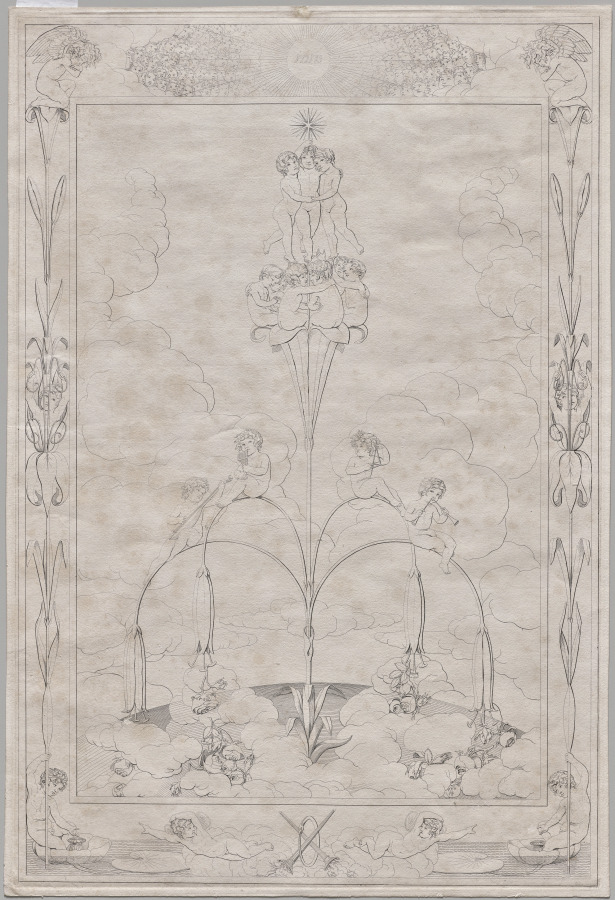
Morning
お目にかかれますか?
ただいまはお迎えしていません

クリーブランド, アメリカ合衆国
コレクションに属していますが、現在は展示されていません。
- 確認
- この状態になった日
- 出典
- 美術館
作品について
Phillip Otto Runge’s large-scale, four-part print series, Tageszeiten (Times of Day), is a landmark of German Romantic printmaking, capturing the “new art” promoted by Runge and his contemporary, Caspar David Friedrich, one rooted in a more personal and spiritual response to nature. Runge presents allegories of nature as a means to understand God and the sublime on earth. His four-part series represents not only the four times of day but also the seasons and the stages of human life, while contrasting eternal time with human time through various literary and religious references. Viewing the series from Morning to Night, seedlings emerge from the earth, bloom, decay, and die. Young spirits or children are born, mature, and grow old, eventually entering a sleep reminiscent of death.
続きを読む
A female figure appearing in two scenes, possibly Mother Nature, inspires abundance and then embraces its decline, suggesting nature’s continuity despite human mortality. In each plate, Runge contrasts eternal time with human time, or spirituality with physicality, by contrasting the iconography in the borders with that in the centers.
クリーブランド美術館
作品データ
- 収蔵番号
- 2024.2.1
カタログ収録
出典
- クリーブランド美術館
- 画像: クリーブランド美術館 — Museum open access
その頃、Philipp Otto Rungeの人生では
生涯をすべて見る1798–1801
Studies at the Royal Academy in Copenhagen
Having decided to become an artist, Runge studies at the Copenhagen Academy under Jens Juel and Nicolai Abildgaard with the financial support of his brother Daniel; Caspar David Friedrich had studied there shortly before him. He draws from the nude and studies anatomy, geometry and perspective. Some accounts date the start of his studies to 1799.
1801
Meets Pauline Bassenge
In Dresden Runge meets the sixteen-year-old Pauline Bassenge, his future wife.
1801–1804
The Dresden Academy and the circle of Romantics
In 1801 Runge moves to Dresden and studies at the Academy under Anton Graff until 1804. He grows close to the “Dresden Romantics” — Caspar David Friedrich, Johann Gottfried Quistorp and Ludwig Tieck; Tieck introduces him to the mystical treatises of Jakob Böhme and to the ideas of Novalis.
14 – 19 November 1803
Meets Goethe in Weimar
On a trip to Weimar Runge meets Goethe at the house of Christian Gottlob von Voigt and visits the poet with Ludwig Tieck on 17 and 18 November; they discuss art and natural philosophy at length. It is the start of a friendly and working relationship based on their shared interest in color and art.
1804年4月3日
Married: Pauline Runge
3 April 1804
Marries Pauline Bassenge
On 3 April 1804 Runge marries Pauline Susanne Bassenge (1785–1881) in Dresden and soon moves back to Hamburg with her; they have four children.