 Ernst Ludwig Kirchnerドイツ, 1880–1938
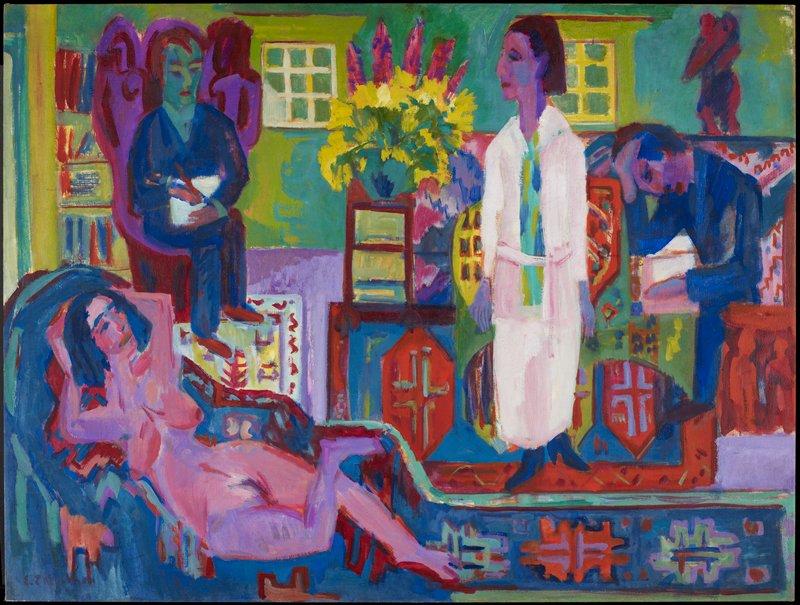
Modern Bohemia
見られますか?
はい、現在展示中
『Modern Bohemia』は今どこに? ミネアポリス美術館, G371, ミネアポリス. はい、現在展示中. 確認 2026年9月29日.

ミネアポリス, アメリカ合衆国
開館中· 21:00まで
一般公開されています。
- 確認
- この状態になった日
- 出典
- 美術館
この絵画について
In 1906, Kirchner co-founded the Dresden expressionist group known as Die Brücke (The Bridge), an avant-garde movement that investigated the realities and fantasies of a life lived with freedom, intensity, and eroticism. Modern and non-western arts were the means of their exploration—with study of the nude at the center of their practice.
Kirchner brings all these elements together in Modern Bohemia —a depiction of his lodgings in Switzerland—to express the ideal creative environment. The forms of artist, author, nude, and female spectator are united with those of Caucasian carpets and sculptural objects inspired by tribal art in a complex balance of form, pattern and color. The artist's modulation of color intensity and placement of horizontal and vertical brushstrokes evoke a woven surface effect that firmly places this painting in what is known as Kirchner's tapestry period.
ミネアポリス美術館
作品データ
- 収蔵番号
- 55.3
カタログ収録
出典
- ミネアポリス美術館
- 画像: ミネアポリス美術館 — © Minneapolis Institute of Art
その頃、Ernst Ludwig Kirchnerの人生では
生涯をすべて見る1923
Moves to the Wildboden house
In 1923 Kirchner moved to the Wildboden house, which looked over Frauenkirch and the Stafelalp on one side and Davos on the other; these landscapes became subjects of many of his paintings. In his diary he called the house a joy and a turning point of his life.
1923
A large exhibition in Basel
In 1923 Kirchner organised a large exhibition of his work in Basel.
1923
Illustrations for Georg Heym’s “Umbra Vitae”
At the same time Kirchner worked on illustrations for the poet Georg Heym’s book “Umbra Vitae.”
1925
Albert Müller and the Rot-Blau group
In 1925 Kirchner became close friends with the painter Albert Müller and his family; the founders of the Basel group Rot-Blau (“Red-Blue”) — Hermann Scherer, Albert Müller, Paul Camenisch and Hans Schiess — visited him and worked under his guidance.
1925–1926
Declines to found a new group
In Berlin Kirchner met Karl Schmidt-Rottluff, who wanted him to form a new artists’ group; Kirchner politely refused.
1925–1926
A trip to Germany: Frankfurt, Chemnitz, Berlin
At the end of 1925 Kirchner went to Germany, visiting Frankfurt, Chemnitz, where his mother lived, and Berlin. Back in Frauenkirch he wrote to Dr. Hagemann in March 1926 that he was glad to see the old pictures by Rembrandt and Dürer again, while of the moderns hardly anything had gripped him.
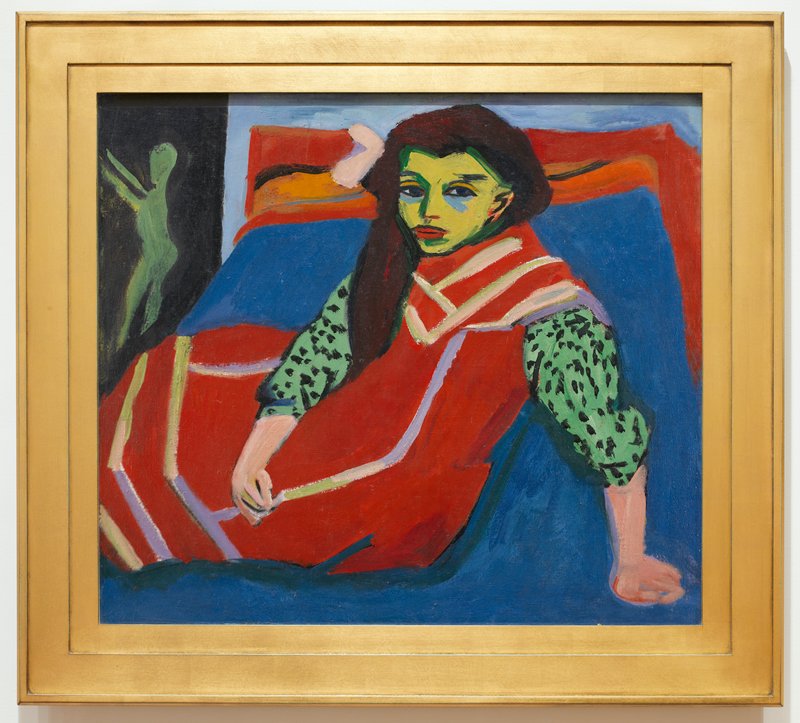
![Dance Hall Bellevue [obverse], Ernst Ludwig Kirchner, 1909/1910](https://api.nga.gov/iiif/634157b6-d0fd-4a63-b93b-0dc1eb6c03d3/full/!2400,2400/0/default.jpg)

![Dancing Couple in the Snow [reverse], Ernst Ludwig Kirchner, 1928-1929](https://api.nga.gov/iiif/02d6ebca-0992-4be5-9e1e-06749ec65449/full/!2400,2400/0/default.jpg)