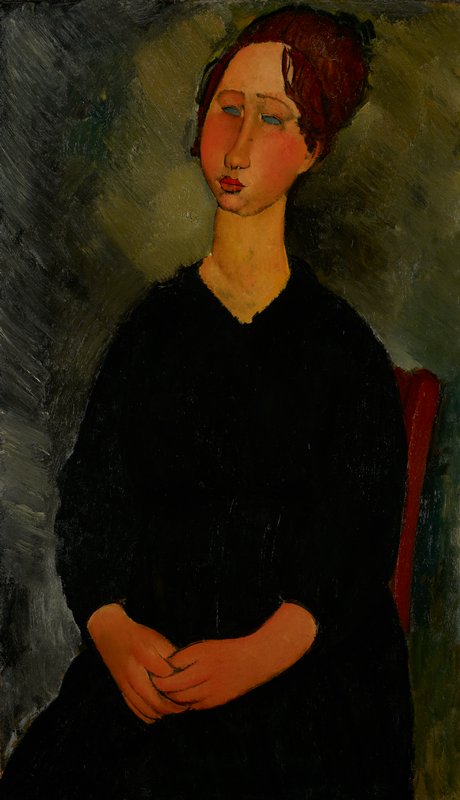
Amedeo Modiglianiイタリア, 1884–1920
Jacques and Berthe Lipchitz
お目にかかれますか?
はい、お客様をお迎えしています

シカゴ美術館
展示室展示室 391シカゴ, アメリカ合衆国
一般公開されています。裏付けとなる出典は下に記しています。
- 確認
- この状態になった日
- 出典
- 美術館自身の所蔵データ
この絵画について
Jacques and Berthe Lipchitz is a 1916 oil on canvas painting by Amedeo Modigliani. It depicts Modigliani's friend, the sculptor Jacques Lipchitz, standing alongside his seated wife Berthe.
Modigliani and Lipchitz had each moved to France at a young age, were both from Jewish backgrounds, and became close friends who frequented the same artistic circles in Paris. Despite their commonalities, there were marked differences: Lipchitz exemplified artistic industriousness while Modigliani was given to bohemian dissolution.
Before painting Jacques and Berthe Lipchitz Modigliani made a series of preparatory drawings, of which five survive: two of Lipchitz, two of Berthe, and one of them together in the resolved composition. Lipchitz described the painting's development years later:
続きを読む
In 1916, having just signed a contract with Leonce Rosenberg, the dealer, I had a little money. I was also newly married, and my wife and I decided to ask Modigliani to make our portrait. "My price is ten francs a sitting and a little alcohol, you know," he replied when I asked him to do it. He came the next day and made a lot of preliminary drawings, one right after the other, with tremendous speed and precision.... Finally a pose was decided upon— a pose inspired by our wedding photograph.
The following day at one o'clock, Modigliani came with an old canvas and his box of painting materials, and we began to pose. I see him so clearly even now— sitting in front of his canvas which he had put on a chair, working quietly, interrupting only now and then to take a gulp of alcohol from the bottle standing nearby.... By the end of the day he said "Well, I guess it's finished."
Lipchitz was uncomfortable accepting the painting for merely ten francs, and made excuses in order for Modigliani to continue working on the portrait. "You know", I said, "we sculptors like more substance." "Well," he answered, "if you want me to spoil it, I can continue." The portrait occupied Modigliani for nearly two weeks, "probably the longest time he ever worked on one painting."
One of only two double portraits painted by Modigliani, Jacques and Berthe Lipchitz has been noted for its complex and enigmatic study of contrasting personalities. Lipchitz is shown with his wife Berthe Kitrosser, a Russian poet, in their Paris apartment that had previously been the home of the sculptor Constantin Brâncuși. Posed in front of an abstracted architectural interior, Lipchitz is handsomely dressed, and stands casually with one hand on Berthe's shoulder. Their mask-like faces have encouraged varied readings; Berthe's gentle sensuality, her large eyes and lips and graceful neck, have been seen to offer a striking contrast to Lipchitz's self-pride, his small eyes and mouth and "wickedly twisted nose" combining to satirical effect. For art historian and curator Mason Klein, Berthe's face is bland and bourgeois, her frilly collar and pert nose suggesting haughtiness, while Lipchitz stands above her, domineering and protective.
Modigliani biographer Werner Schmalenbach compared Jacques and Berthe Lipchitz to the artist's Bride and Groom of 1915, and noted the development away from a purely formal depiction of 'types' to a greater interest in the characterization of individuals. This difference in the two works is consistent with an evolution in Modigliani's drawing and painting toward increased refinement.
After Modigliani died in 1920 Lipchitz crafted his death mask, making twelve plaster molds for Modigliani's friends and family. Soon thereafter Lipchitz traded the painting to his dealer in exchange for the return of sculptures "which I no longer felt were representative." The painting was purchased in 1922, and entered the Art Institute of Chicago in 1926 as part of the Helen Birch Bartlett Memorial Collection.
美術館の言葉で
After receiving his artistic training in Italy, the sculptor and painter Amedeo Modigliani moved to Paris in 1906. Three years later, he helped pioneer a general migration of artists to the neighborhood of Montparnasse, which remained the center of avant-gard activity in the city until World War II. Scores of artists lived there, and many of them shared a Jewish heritage—including Modigliani and his friend the Lithuanian-born sculptor Jacques Lipchitz.
続きを読む
Lipchitz commissioned Modigliani to paint this portrait on the occasion of his marriage to the Russian poet Berthe Kitrosser, as a way of helping his troubled friend financially. The double portrait is one of only three in the artist’s oeuvre and, according to Lipchitz, took two days to paint. Modigliani made about twenty drawings on the first day; the next day, he declared the picture finished. At the modest price of what Lipchitz remembered as “ten francs per sitting and a little alcohol,” however, he persuaded Modigliani to work on the portrait for another two weeks in an effort to provide more financial assistance to his friend. Despite Modigliani’s exceptional talent, his work found a market only after his death in 1920, which was hastened by tuberculosis and his legendary bohemian lifestyle.
シカゴ美術館CC BY 4.0
作品データ
- 収蔵番号
- 1926.221
描かれているもの
カタログ収録
出典
- シカゴ美術館:美術館のオープンデータ · 8 日前に取得
- 画像: シカゴ美術館 — CC0
その頃、Amedeo Modiglianiの人生では
生涯をすべて見るby 1914
Gives up sculpture for painting
By 1914 Modigliani abandons sculpting and focuses solely on painting, a move precipitated by the difficulty of acquiring sculptural materials once the war breaks out, and by his physical debilitation.
June 1914
Beatrice Hastings
Modigliani meets the talented and eccentric Englishwoman Beatrice Hastings, a poet and columnist for The New Age, who becomes his companion, muse and favourite model: he devotes 14 portraits to her. The relationship lasts about two years.
1916
Léopold Zborowski, friend and dealer
Modigliani befriends the Polish poet and art dealer Léopold Zborowski and his wife Anna; in the artist’s final years Zborowski is his primary dealer and friend. He lends Modigliani his apartment, supplies models and painting materials, and pays him between fifteen and twenty francs a day.
spring 1917
Meets Jeanne Hébuterne
In the spring of 1917 the Ukrainian sculptor Chana Orloff introduces Modigliani to a 19-year-old art student, Jeanne Hébuterne, who has posed for Foujita. Her conservative, devoutly Catholic family renounces her for her liaison with a Jew, but she soon lives with Modigliani anyway and becomes a principal subject of his art.
3 December 1917
His first solo exhibition — and the police
An exhibition of Modigliani’s nudes opens at Berthe Weill’s gallery in Paris, his first solo show in the city. The gallery stands opposite a police station, and the officers, outraged by the nudes, force the show to close on its opening day.
1918
Flight to the south: Cagnes-sur-Mer and Nice
Fearing a German invasion, Modigliani leaves Paris with Jeanne Hébuterne, the Zborowskis and Chaïm Soutine for the south of France, first to Cagnes-sur-Mer and then to Nice. He returns to portraiture and sends the finished canvases to Paris for sale.