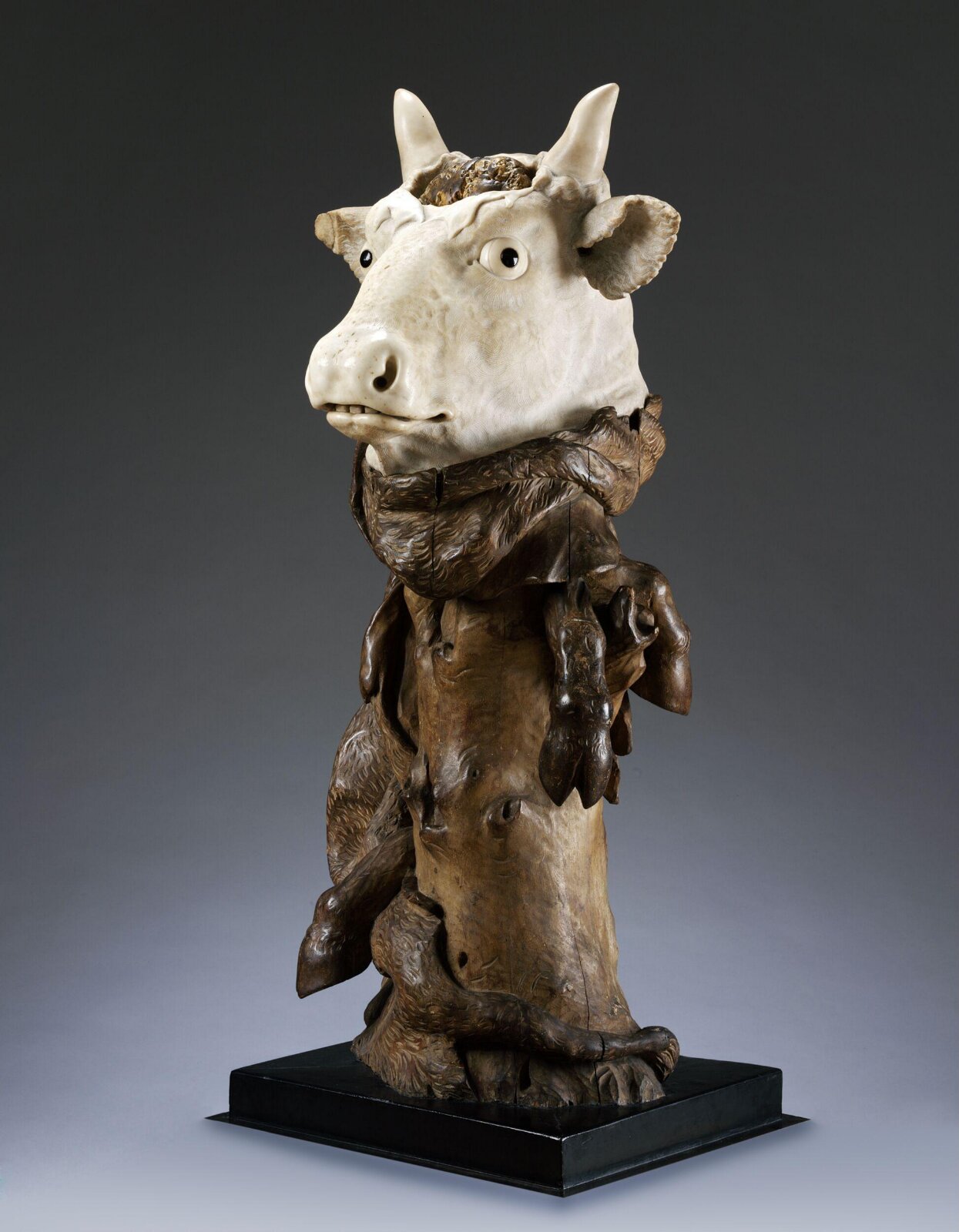
Head of an ox
見られますか?
はい、現在展示中
『Head of an ox』は今どこに? ヴィクトリア&アルバート博物館, Europe 1600-1815, Room 6, The Lisa and Bernard Selz Gallery, ロンドン. はい、現在展示中. 確認 2026年9月25日.

一般公開されています。
- 確認
- この状態になった日
- 出典
- 美術館
この彫刻について
This head of an ox, carved in marble and resting on a wooden tree trunk, contains an unusual curiosity. In the centre of the ox's head is a cavity in which rests a 'stone' identified as an osteoma, a new piece of bone growing on another (typically a skull) which was originally thought to be the fossilised or petrified brain of an ox. This may have been based on an event in Padua in 1670, when a hardened mass of bone was discovered inside a slaughtered ox.
The discovery created a sensation, as it was believed that the brain of the animal had become petrified during its lifetime. In 1933, the Natural History Museum confirmed that the huge osteoma displayed here was organic and likely to be a piece of diseased bone from a large mammal, such as an elephant or whale.
続きを読む
The sculpture may once have belonged to the Querini family at the Villa Altichiero in Padua, although there is no firm documentary evidence. Its theatricality was typical of the seventeenth-century fascination with naturally occurring oddities, particularly within the context of the noble and scholarly collections, where artistic objects sat alongside the naturalia they sought to emulate. This unusual sculpture, with its varied textures and bizarre subject-matter, would have provided a dramatic talking point.
ヴィクトリア&アルバート博物館
作品データ
- 収蔵番号
- 60-1882
描かれているもの
カタログ収録
出典
- ヴィクトリア&アルバート博物館
- 画像: ヴィクトリア&アルバート博物館 — © Victoria and Albert Museum, London

![[Die Anbetung der Hirten mit der Lampe; The Adoration of the Shepherds with the Lamp; La Nativité], Rembrandt, 1654](https://diglib.hab.de/varia/haum/rembrandt-ab3-0054/max/000001.jpg)
![[Die Anbetung der Hirten mit der Lampe; The Adoration of the Shepherds with the Lamp; La Nativité], Rembrandt, 1654](https://diglib.hab.de/varia/haum/rembrandt-v3-4537/max/000001.jpg)