Julia Margaret Cameronイギリス, 1815–1879
Hardinge Hay Cameron
お目にかかれますか?
ただいまはお迎えしていません
ロサンゼルス, アメリカ合衆国
コレクションに属していますが、現在は展示されていません。
- 確認
- この状態になった日
- 出典
- 美術館
作品について
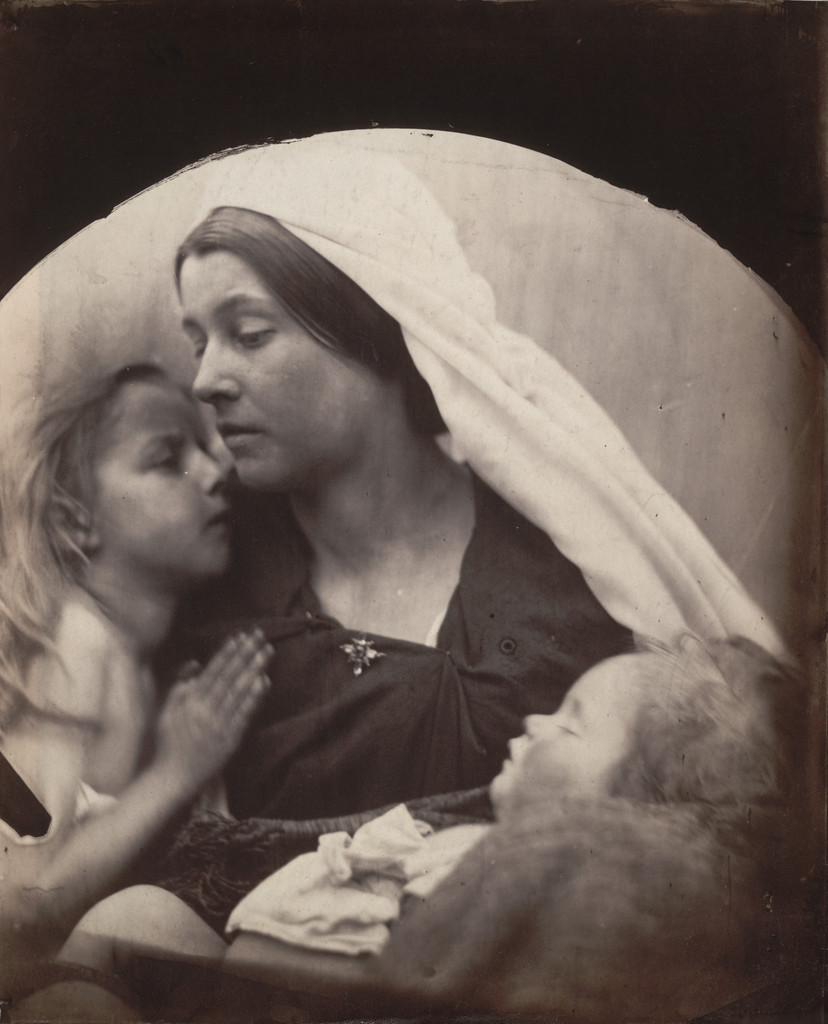
> In his influential 1859 publications *Self-Help,* Samuel Smiles described the home as “the very nucleus of national character; and from that source . . . issue the habits, principles and maxims, which govern public as well as private life.” For Julia Margaret Cameron, family life formed the cornerstone of her art. Her five sons were all pressed into service before the camera and often helped in practical matters. Describing her earliest experiments in her *Annals*, Cameron remarked: “Hardinge, being on his Oxford vacation, helped me in the difficulty of focussing,” practical advice that contributed to her “first success” with *Annie* (see [84.XZ.186.69](https://www.getty.edu/art/collection/objects/58647/julia-margaret-cameron-annie-british-january-1864/)). > > In this 1864 portrait, Hardinge (1846-1911), Cameron’s third son, is presented in the guise of an artist.
続きを読む
The style of presentation is Titianesque—the lighting is somber and moody, creating the very faintest of modeling in the skin tones, so that the subject’s facial features are clothed in a subdued, painterly chiaroscuro. The practice of dressing up and assuming a role was familiar to the Cameron children on account of the elaborate amateur theatricals that took place in their house, Dimbola, and at Farringford, the home of the neighboring Tennysons. Cameron has taken this role playing a step further and ennobled it with the camera, combining in pictorial form the real and ideal. > > The mannerism of this portrait resembles the work of the photographer David Wilkie Wynfield. He was known for his “fancy portraits” of artist friends dressed in costume as characters from English history.
These pictures fall somewhere between portraiture and genre and were made with the lens placed slightly out of focus in order to suggests the softer outlines of a painting. Cameron received some instructions from Wynfield, and their work was compared in the photographic and fine art press in 1864 and 1865. In a letter written to William Michael Rossetti on January 23, 1866, Cameron acknowledged Wynfield’s influence: “To my feeling about his beautiful Photography I owed *all* my attempts and indeed consequently all my success.” > > Julian Cox. *Julia Margaret Cameron*, In Focus: From the J. Paul Getty Museum (Los Angeles: J. Paul Getty Museum, 1996), 16. ©1996 The J. Paul Getty Museum.
J・ポール・ゲティ美術館
作品データ
- 収蔵番号
- 84.XZ.186.9
カタログ収録
出典
- J・ポール・ゲティ美術館
- 画像: J・ポール・ゲティ美術館 — Open Content
その頃、Julia Margaret Cameronの人生では
生涯をすべて見るc. 1863
A camera from her daughter
For Christmas her daughter and son-in-law gave the 48-year-old Cameron a camera, to amuse her in her solitude at Freshwater while her husband was in Ceylon; a hen-house became her studio and the coal-house her darkroom. She took a lesson from the photographer David Wilkie Wynfield, to whom, she said, she owed “all my attempts and indeed consequently all my success”.
1864
Elected to the Photographic Society of London
In 1864 Cameron compiled albums of her photographs for Watts and Herschel, registered her work and prepared it for exhibition and sale. She was elected to the Photographic Society of London, showing at its annual exhibitions and remaining a member until her death.
1864–1875
Eleven years of photography
Cameron's career as a photographer lasted from 1864 to 1875: in that time she made more than 900 photographs, portraying great Victorians — Darwin, Tennyson, Browning, Longfellow, Herschel, Watts, Trollope, Carlyle and the actress Ellen Terry. The Virgin Mary in her religious scenes was most often played by her housekeeper, Mary Hillier.
1865
Sales through P. & D. Colnaghi
In 1865 Cameron joined the Photographic Society of Scotland and arranged for her prints to be sold through the London dealers P. & D. Colnaghi; demand for them was strong.
1865
The South Kensington Museum buys 80 photographs
In August 1865 the South Kensington Museum (now the Victoria and Albert Museum) bought 80 of her photographs.
November 1865
First solo exhibition
In November 1865 Cameron held her first solo exhibition; her work was shown throughout Europe.