Figure
お目にかかれますか?
ただいまはお迎えしていません

ヴィクトリア&アルバート博物館
ロンドン, イギリス
コレクションに属していますが、現在は展示されていません。
- 確認
- 7 日前
- この状態になった日
- 2026年9月25日
- 出典
- 美術館自身の所蔵データ
About the sculpture
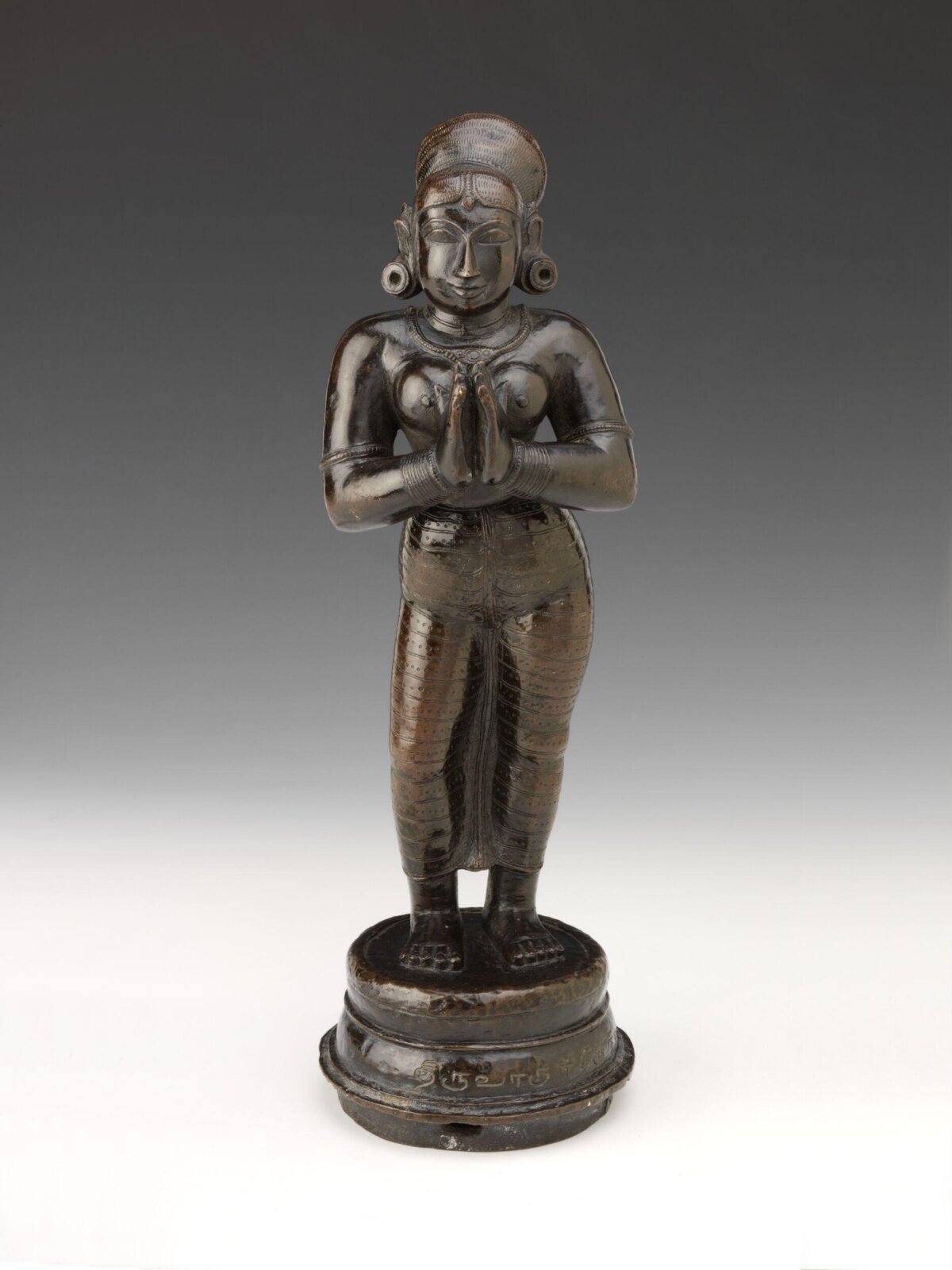
A portrait of a female devotee and donor, her hands raised in veneration (anjali). She wears a finely decorated waist cloth, with necklace, armbands, bangles, ear-lobe ornaments (patra kundalas); the hair tied up into a large bun (kesabandha), offset at the back in the south Indian manner. She is identified by a Tamil inscription on the circular base as ‘the lady Tirunilakanta of Tiruvarur’, in Tanjavur District. Such a portrait would only be commissioned to accompany - and venerate – a religious donation, be it an icon or shrine. As she is identified, unusually in Tamil culture, by association with her husband, Tiru Nilakanda, in all likelihood she originally accompanied a portrait sculpture of him. Donor portraits are relatively uncommon in Indian temple arts, though royal portraiture was an established practice from Chola period south India, and continued by the Nayak rulers. Interestingly, this was not confined to the royal household and immediate circle, and was emulated by lesser officials, as witnessed by this portrait of the wife of a regional governor.
Read on
This finely cast copper alloy image was destined to be placed in a sanctuary nearby to the subject of the donor couple’s gift, be it a shrine, or cult image or a processional icon. In all probability this portrait bronze was donated to the local temple where the lady of Tiruvarur’s husband was serving the Nayak kingdom as a local governor.
ヴィクトリア&アルバート博物館
作品データ
- 収蔵番号
- IS.1-1951
What it shows
カタログ収録
出典
- ヴィクトリア&アルバート博物館: the museum's own open data · 7 日前に取得
- 画像: ヴィクトリア&アルバート博物館 — © Victoria and Albert Museum, London