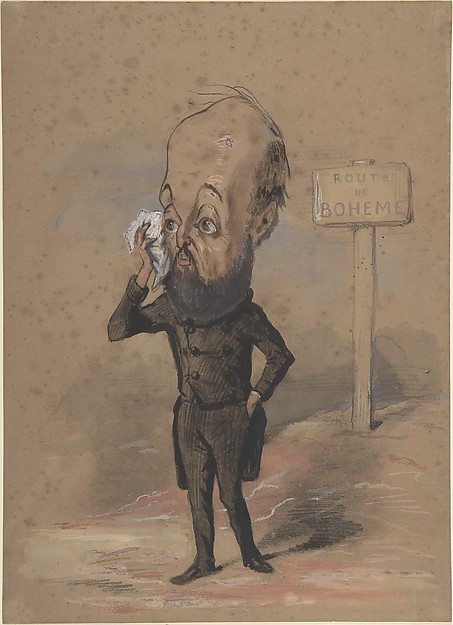
Félix Nadarフランス, 1820–1910
Eugène Pelletan
見られますか?
現在は展示されていません
『Eugène Pelletan』は今どこに? 所蔵: メトロポリタン美術館, ニューヨーク. 現在は展示されていません. 確認 2026年11月11日.

ニューヨーク, アメリカ合衆国
コレクションに属していますが、現在は展示されていません。
- 確認
- この状態になった日
- 出典
- 美術館
作品データ
- 収蔵番号
- 1991.1198
描かれているもの
カタログ収録
出典
- メトロポリタン美術館
- 画像: メトロポリタン美術館 — Open Access (CC0)
その頃、Félix Nadarの人生では
生涯をすべて見る1852–1853
Turning to photography: his brother Adrien’s studio
By 1850, at thirty, he was a darling of the boulevards, known for his wit, but neither the theatre, the art salon nor the magazines gave him enough to live on. In 1852 he became co-owner of the photographic studio of his brother Adrien (“Nadar the Younger”), and in 1853 he began taking his first photographs; the partnership soon ended in litigation.
1854
A portrait studio at 113 rue Saint-Lazare
In 1854 a friend encouraged him to begin a portrait photography business; busy with caricature, Nadar yielded operations to his younger brother Adrien, who soon ran into debt, while Nadar took portraits at his own studio at 113 rue Saint-Lazare. Tensions between the brothers led to legal disputes over the right to use the name “Nadar”.
1854年8月11日
Married: Ernestine Nadar
1855
Gold medal at the Exposition Universelle for the Pierrot series
The “Expressions of Pierrot” series was shown at the Exposition Universelle in Paris in 1855, where it won a gold medal.
1858
The world’s first aerial photographs
He became the first person to take aerial photographs, using the wet-plate collodion process: the plates had to be prepared and developed in the basket while aloft, and escaping gas ruined the images until Nadar invented a gas-proof cotton cover for his baskets. He also pioneered the use of artificial light in photography, working underground in the catacombs of Paris.
1860
A studio at 35 Boulevard des Capucines
In 1860 Nadar moved to 35 Boulevard des Capucines, where he photographed politicians (Guizot, Proudhon), stage actors (Sarah Bernhardt, Paulus), writers (Hugo, Baudelaire, Sand, Nerval, Gautier, Dumas), painters (Corot, Delacroix, Millet) and musicians (Liszt, Rossini, Offenbach, Verdi, Berlioz). In the studio he eschewed traditional sumptuous decors and unnecessary accessories and preferred natural daylight.